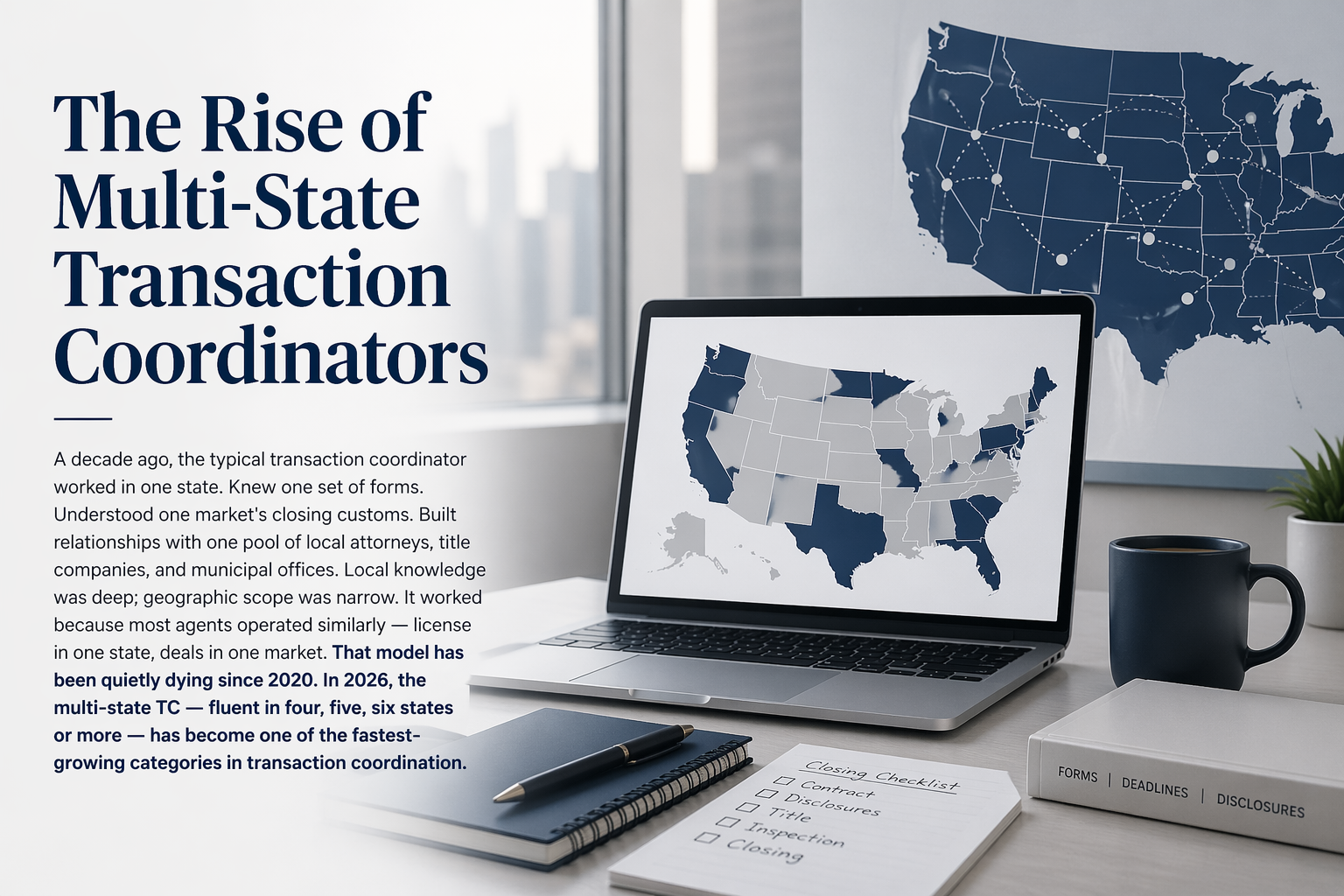
The Rise of Multi-State Transaction Coordinators
A decade ago, the typical transaction coordinator worked in one state. Knew one set of forms. Understood one market's closing customs. Built relationships with one pool of local attorneys, title companies, and municipal offices. Local knowledge was deep; geographic scope was narrow. It worked because most agents operated similarly — license in one state, deals in one market. That model has been quietly dying since 2020. In 2026, the multi-state TC — fluent in four, five, six states or more — has become one of the fastest-growing categories in transaction coordination.

Remote TCs vs. Local TCs: Does Location Still Matter?
For most of the last decade, hiring a transaction coordinator meant finding someone local. Someone who understood your state's forms, knew your market's closing customs, could grab coffee with your listing attorney, and occasionally drop by the office. "Local" was synonymous with "competent" in a lot of agents' minds. In 2026, that mental model has broken. Remote TC has become the default — not because local doesn't matter anymore, but because location doesn't matter the way expertise does. Here's an honest look at what actually matters about location in the modern TC decision.
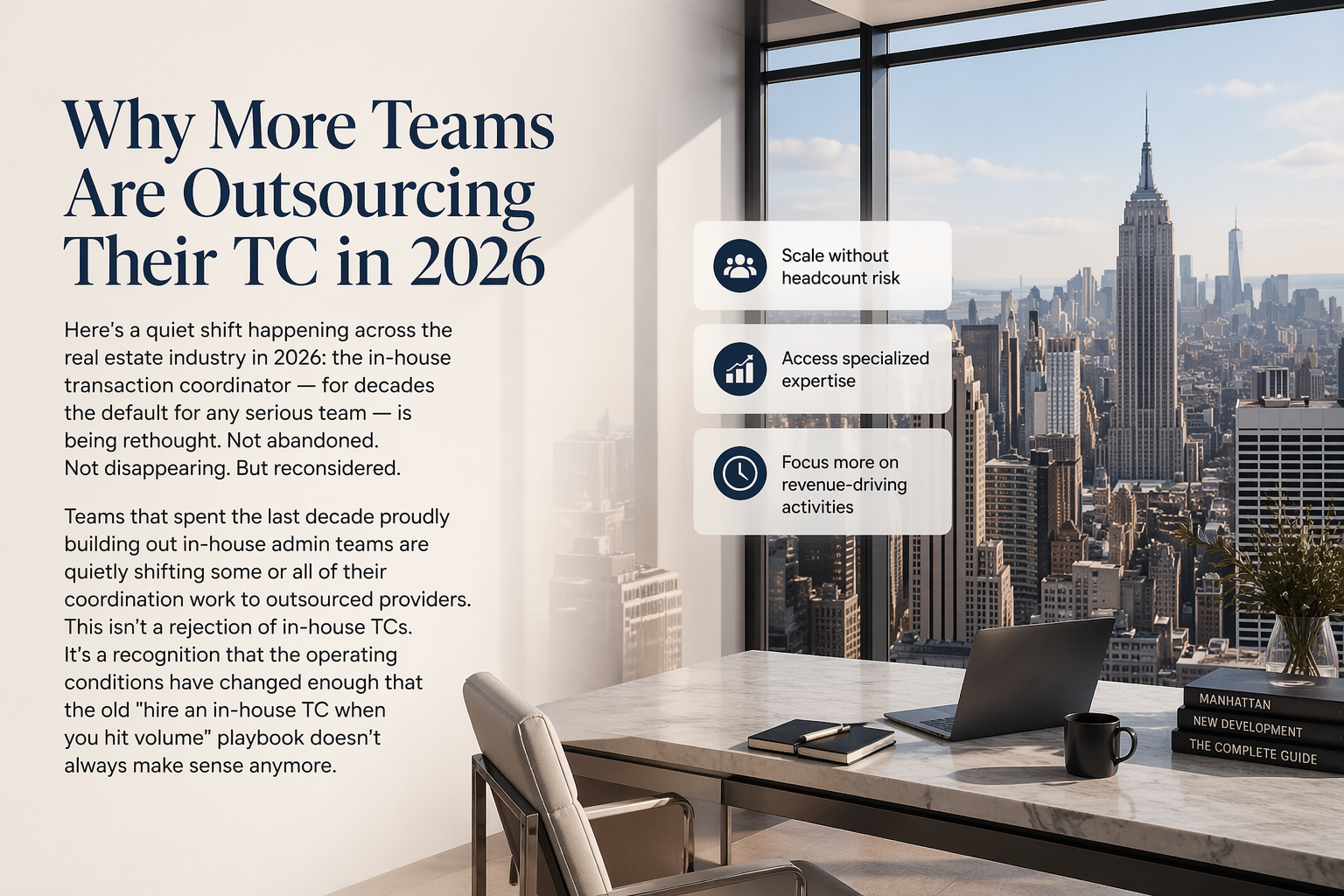
Why More Teams Are Outsourcing Their TC in 2026
Here's a quiet shift happening across the real estate industry in 2026: the in-house transaction coordinator — for decades the default for any serious team — is being rethought. Not abandoned. Not disappearing. But reconsidered. Teams that spent the last decade proudly building out in-house admin teams are quietly shifting some or all of their coordination work to outsourced providers. This isn't a rejection of in-house TCs. It's a recognition that the operating conditions have changed enough that the old "hire an in-house TC when you hit volume" playbook doesn't always make sense anymore.

Transaction Coordination Fees: Regional Benchmarks for the Northeast
Pricing a transaction coordinator service — or choosing one — is one of those things that looks simple on the surface and gets complicated fast. The "average price" depends on the state, the transaction type, the TC's experience, the scope of services, the volume you're running, and whether you're comparing to in-house salaries or outsourced fees. National averages get thrown around constantly, but they rarely reflect what Northeast agents actually pay. This is a clear-eyed look at TC pricing specifically for the Northeast — what the benchmarks actually look like in 2026, why the region runs differently than national averages, and how to think about what you should be paying.

The New Buyer Agency Rules: What Changed for TCs in 2025
2024 gave us the NAR settlement. 2025 gave us the implementation. That distinction matters. The settlement agreement set the national framework in August 2024. But 2025 was when the industry actually lived under the new buyer agency rules, when state laws codified and extended the federal requirements, when form contracts got revised multiple times to reflect what was working and what wasn't, and when transaction coordinators across the country figured out — in real time — what the new workflow actually looked like. By the end of 2025, a set of patterns had stabilized. The TC role had changed meaningfully. New workflows had emerged. Old ones had died.

Will AI Replace Transaction Coordinators? The Honest Take
Let's not dance around it. If you're a working TC, you've thought about this. If you're an agent paying for TC services, you've wondered whether you should just buy an AI tool instead. And if you've been watching the news for the last two years, you've seen the headlines oscillate between "AI will eliminate every administrative job by 2028" and "humans are irreplaceable" — sometimes in the same week. The honest answer is more interesting than either extreme. The short version: AI is absolutely going to replace parts of the TC job — maybe most of the individual tasks. It is not going to replace the role itself.
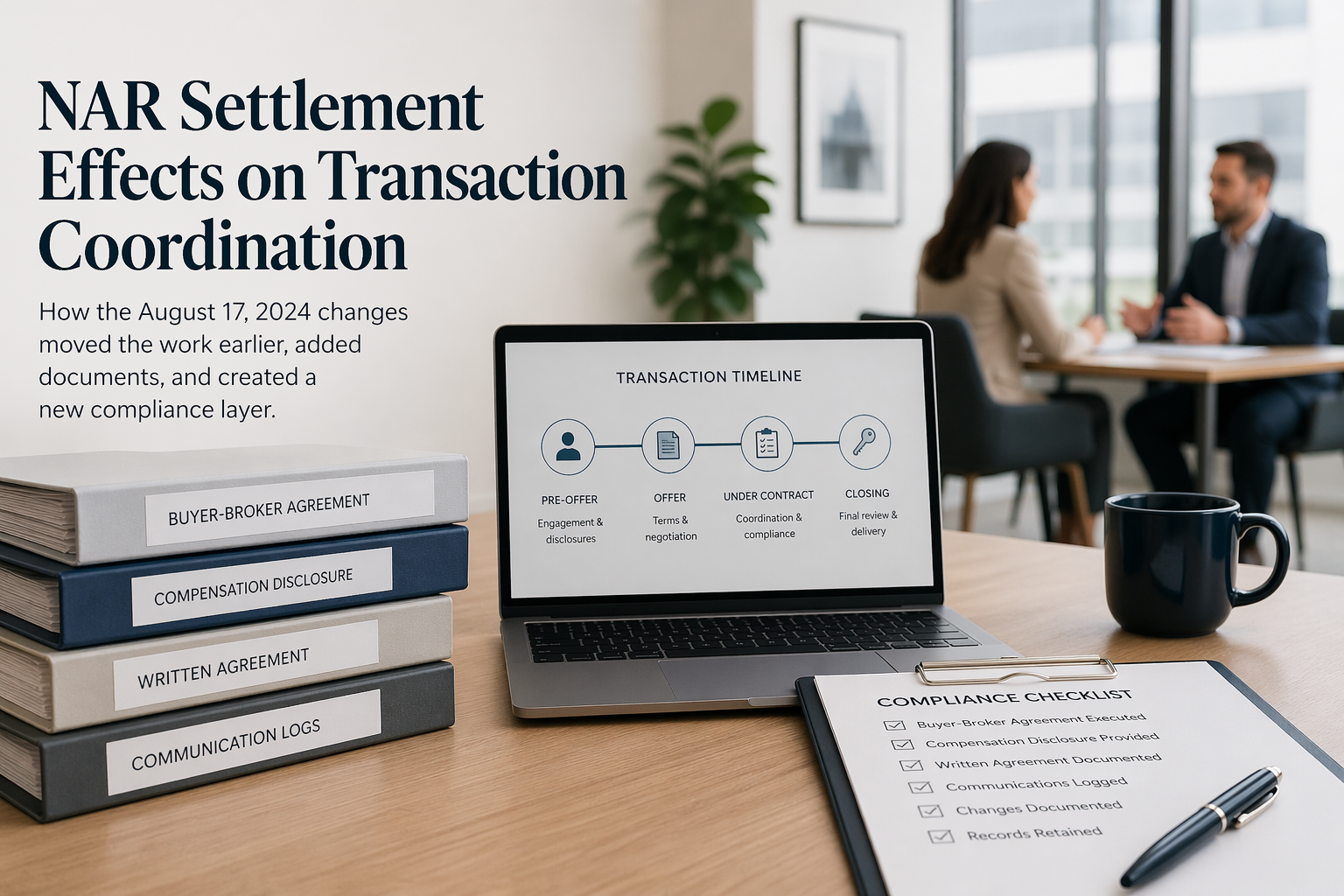
NAR Settlement Effects on Transaction Coordination
The NAR settlement didn't just change how real estate commissions get paid. It changed what transaction coordination actually is. When the practice changes took effect on August 17, 2024, most of the industry conversation focused on commission negotiation — who pays what, how it gets disclosed, what buyer-broker agreements should look like. That conversation has largely stabilized. What hasn't gotten as much attention is the quieter, structural effect the settlement has had on the transaction coordination function: the work has moved earlier in the deal, gotten more document-heavy, and added a new compliance layer that barely existed before 2024.

Why Transaction Coordination Became a Must-Have After 2020
Five years ago, hiring a transaction coordinator was a luxury. A status symbol for top producers, a nice-to-have for high-volume teams, something you got around to once you were closing 30+ deals a year and could "finally afford it." That's no longer true. In 2026, transaction coordination is operational infrastructure — the kind of thing agents running a modern business simply have, the way they have a CRM or e-signature tools. The shift didn't happen gradually. It happened in a specific window, between roughly 2020 and 2024, and it was driven by forces that have permanently changed what the real estate transaction actually looks like.

The 2026 State of Real Estate Transaction Coordination
Transaction coordination has quietly become one of the most consequential parts of the real estate industry. Not in a flashy way — nobody's livestreaming TC work on TikTok — but in the structural sense. The way deals get managed, tracked, and closed has shifted meaningfully over the last three years, and 2026 is the year those shifts stopped being edge cases and became the norm. This is a snapshot of where the industry actually is right now: what's changed, what's driving it, and what it means for agents, brokerages, and the coordinators doing the work — from AI adoption to the rise of virtual TCs to the ripple effects of the NAR settlement.

A Step-by-Step Guide to HOA and Condo Document Ordering
The HOA and condo document ordering step is the quiet landmine of the transaction. Inspection periods have obvious drama. Mortgage contingencies have obvious deadlines. But HOA docs? They sit in a forgotten corner of the checklist until suddenly it's Day 25, the closing is scheduled for Day 40, and nobody has a resale certificate because nobody remembered to order it. And then you learn that the management company takes 14 business days to produce it. Which is three weeks of calendar time. Here's the step-by-step process for ordering HOA and condo documents cleanly — what to order, when, who orders it, and how to avoid the three most common ways this phase derails a closing.
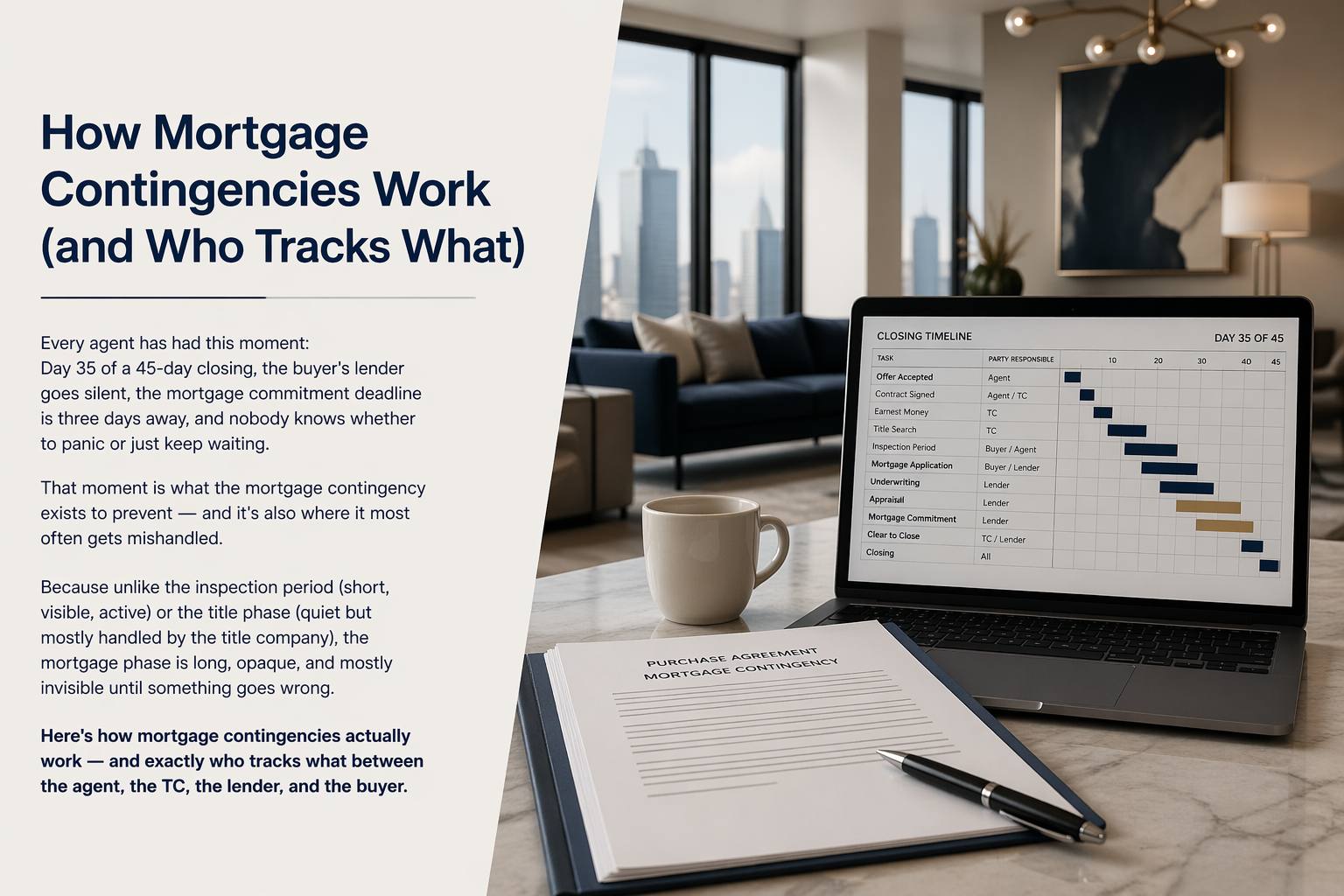
How Mortgage Contingencies Actually Work (and Who Tracks What)
Every agent has had this moment: Day 35 of a 45-day closing, the buyer's lender goes silent, the mortgage commitment deadline is three days away, and nobody knows whether to panic or just keep waiting. That moment is what the mortgage contingency exists to prevent — and it's also where it most often gets mishandled. Because unlike the inspection period (short, visible, active) or the title phase (quiet but mostly handled by the title company), the mortgage phase is long, opaque, and mostly invisible until something goes wrong. Here's how mortgage contingencies actually work — and exactly who tracks what between the agent, the TC, the lender, and the buyer.

The Inspection Period Playbook: What Agents and TCs Handle Separately
The inspection period is the single most consequential stretch of any transaction. It's where deals get saved, killed, or quietly sabotaged by poor coordination — usually in a seven-to-fourteen-day window that feels about half as long as it actually is. It's also where the agent-TC relationship either clicks or falls apart. The agent owns strategy, relationships, and judgment. The TC owns logistics, documentation, and deadlines. Here's the playbook — who does what, in what order, and where the handoffs live so nothing falls through the cracks.

How to Transition From Self-Managing to Using a TC Without Dropping Balls
You've run your own transactions for years. The system lives in your head, your inbox, and a patchwork of reminders on your phone. Now you're hiring a transaction coordinator — and the fear is real. What if balls get dropped during the handoff? What if you end up paying for help and still doing the work? Here's the seven-step transition plan that prevents the most common onboarding failures, from documenting your process to defining the handoff point to resisting the urge to shadow-manage. Done right, the transition pays for itself in your first few files.

You're Not a Bad Agent — You're Doing Two Jobs
Most agents who feel like they're failing at real estate aren't failing at real estate. They're doing a perfectly competent job at two completely different jobs — one they're licensed for, and one nobody hired them to do. With 75% of every transaction's hours going to administrative work, the math catches up fast. The narrative that struggling agents just need to work harder is comforting to some and lucrative to others, but it's usually wrong. Here's the reframe that changes what the actual problem is — and the permission to stop doing the second job.

How Many Deals Can You Really Close Without a Transaction Coordinator?
There's a number every agent chases but almost nobody calculates honestly — the point where your deal volume stops scaling with your effort and starts degrading your business. The NAR 2025 Member Profile puts the median at 10 transactions a year, and there's a reason most agents hit a wall right around there. With the average residential transaction taking 40 working hours — 30 of them administrative — the math catches up fast. We break down the real ceiling, what it costs to ignore it, and the honest break-even point for hiring a transaction coordinator.