NAR Settlement Effects on Transaction Coordination
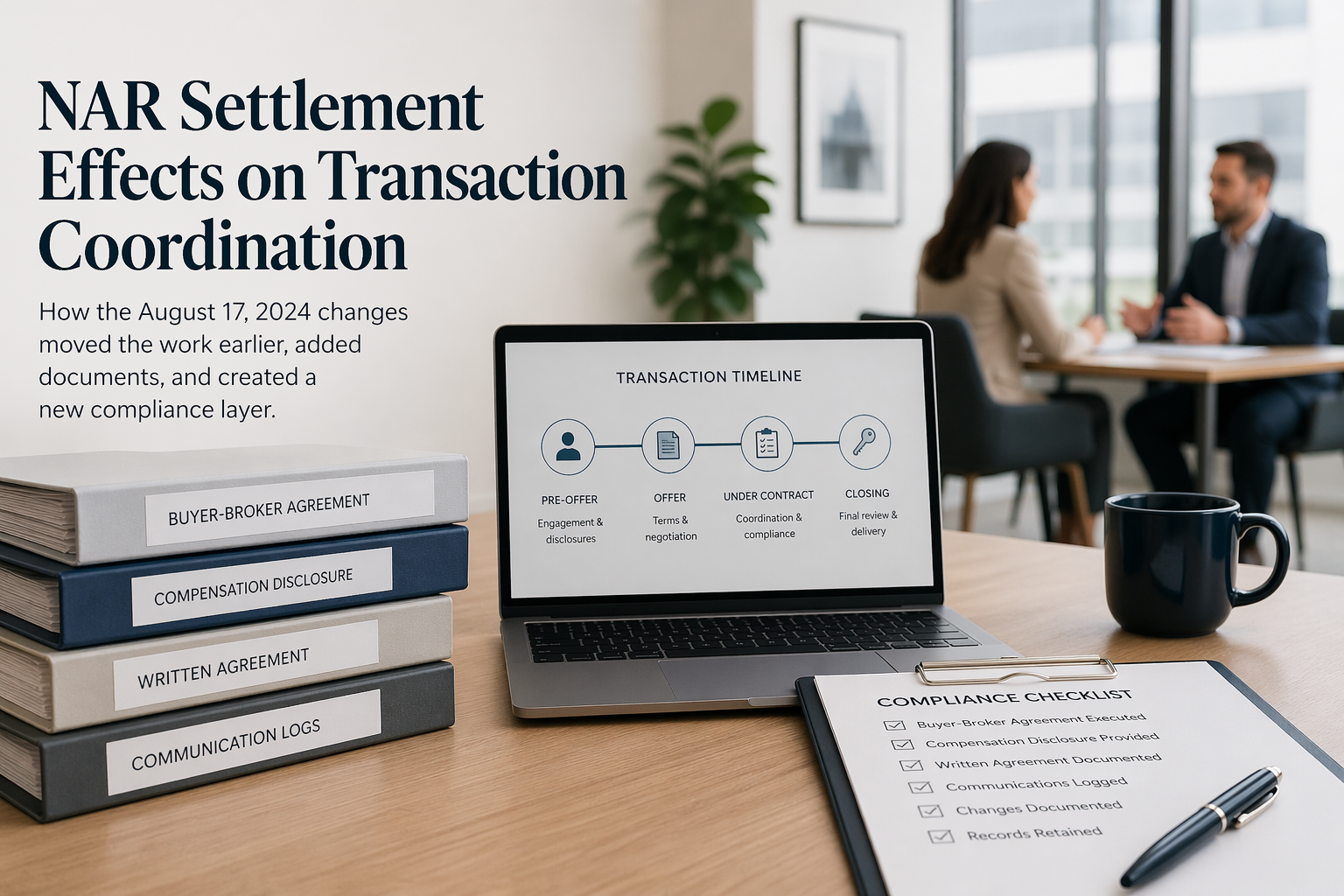
The NAR settlement didn't just change how real estate commissions get paid. It changed what transaction coordination actually is.
When the practice changes took effect on August 17, 2024, most of the industry conversation focused on commission negotiation — who pays what, how it gets disclosed, what buyer-broker agreements should look like. That conversation has largely stabilized. What hasn't gotten as much attention is the quieter, structural effect the settlement has had on the transaction coordination function: the work has moved earlier in the deal, gotten more document-heavy, and added a new compliance layer that barely existed before 2024.
For TCs and the agents who work with them, the settlement was a bigger operational shift than most people realized at the time. Two years in, the effects are clear. Here's what's changed, what it means for how transactions get run, and where the work is heading.
A quick refresher on what the settlement actually did
The March 2024 settlement in the Burnett v. NAR class action produced several binding practice changes, which went into effect August 17, 2024 (NAR; APS Law). The three that matter most for transaction coordination:
1. Mandatory written buyer-broker agreements before touring homes. MLS participants working with buyers must now enter into a written agreement before showing a property — in person or virtually (NAR Settlement FAQs). The agreement must include: a specific, conspicuous disclosure of the buyer agent's compensation amount or rate; a prohibition on the agent receiving compensation from any source exceeding the agreed amount; and a statement that commissions are fully negotiable and not set by law.
2. No offers of buyer-broker compensation on the MLS. Listing brokers can no longer advertise offers of compensation through the MLS. Compensation can still be offered — through the listing broker's website, direct communication with buyer brokers, or written broker-to-broker agreements — but not through MLS listings (Davis Graham).
3. Expanded disclosure requirements at every stage. Seller's agents must obtain written seller approval before offering any buyer-broker compensation. Commissions and fees must be documented as "objectively ascertainable" — a specific dollar amount, percentage, flat fee, or hourly rate, not an open-ended range (NAR).
State laws have layered on top of the federal settlement. California AB 2992 codified the buyer-broker agreement requirement as state law effective January 1, 2026 (LA Metro Home Finder, 2026). Several other states have passed or are considering similar legislation. The Northeast markets Signed to Keys serves have also been adopting state-specific compliance requirements — new form versions, expanded disclosure language, and in attorney states like NJ and NY, adjustments to how compensation is memorialized in contracts and closing documents.
Now, the part that gets less attention: what all of this means for the TC.
The six ways TC work has changed since August 2024
1. The transaction now starts before the contract
Pre-settlement, transaction coordination started at the executed purchase agreement. The TC's workflow began when the contract was signed. Everything before that — showings, negotiations, offer strategy — was the agent's domain alone.
Post-settlement, coordination has moved upstream. The work now effectively begins at first showing, because that's when buyer-broker agreements must be in place. That's a meaningful expansion of scope, and it's fundamentally changed how TC engagements are structured.
What's actually happening on files now:
Buyer-broker agreements are being drafted, executed, and filed before any home tour.
Compensation structures are being documented in writing weeks before a contract exists.
Agreement terms (duration, exclusivity, compensation, geographic scope) are being tracked and managed by TCs as a distinct workflow separate from transactions.
When a buyer does go under contract, the TC now starts with existing paperwork — an active buyer-broker agreement — rather than a clean slate.
The upshot: for agents using TCs correctly in 2026, "pre-transaction admin" is now a formal part of the workflow. It's not an awkward handoff between "agent's job" and "TC's job" anymore — it's an integrated pipeline from buyer relationship → buyer-broker agreement → offer → contract → closing.
2. Compensation documentation is now a discrete TC function
Pre-settlement, commission handling was a one-time event at closing — the TC reviewed the ALTA, made sure the commission split was right, and that was largely it.
Post-settlement, compensation is a multi-stage process with documentation at every step (NAR 2026 Professional Standards Summary):
Buyer-broker agreement specifying what the buyer-broker is owed
Seller's written approval for any compensation the listing broker offers to the buyer's broker
Broker-to-broker compensation agreement (when negotiated) memorializing the cooperative compensation before the buyer tours
Purchase contract language addressing any seller concessions toward buyer-broker compensation
Final ALTA reconciling all of the above at closing
Each of these is a document. Each document has to be tracked, stored, executed at the right moment, and reconciled with the others. The cumulative paperwork load around compensation is meaningfully higher than it was pre-2024, and TCs have absorbed most of it.
More importantly, compensation language has become a compliance issue in a way it wasn't before. The settlement requires that buyer-broker compensation be "objectively ascertainable" — not a range, not an estimate, not "market rate" (NAR). A file with a sloppy compensation disclosure exposes the brokerage to settlement compliance risk. TCs are now the first line of defense catching that before it becomes a problem.
3. Concessions replaced MLS-broadcast cooperative compensation — and TCs have to track them differently
Pre-settlement, the listing broker put the cooperating broker compensation on the MLS, and everyone knew what the buyer's agent was getting. Post-settlement, that information has moved off-MLS, and seller concessions have become a more common workaround for helping buyers cover their broker fees.
Seller concessions can still be communicated on the MLS, as long as they're not conditioned on or tied specifically to buyer-broker compensation (NAR). They can cover a range of buyer costs: closing costs, loan origination, repairs, and yes, buyer-broker compensation.
For TCs, this has created a new tracking challenge:
Concessions now appear in offers more frequently and in more varied structures.
The allocation of concessions to different buyer costs (closing costs vs. buyer-broker fee vs. repair credits) has to be documented and reflected on the ALTA.
Lenders have specific rules about what can and can't be paid with concessions (VA vs. FHA vs. conventional, and interested party contribution caps).
If the seller is covering buyer-broker compensation through a concession, the paperwork has to align the buyer-broker agreement with the contract language and the final ALTA.
Good TCs in 2026 have built standardized workflows around concession tracking that didn't exist in 2023. Agents who work with TCs who haven't updated their workflows are often leaving money on the table or creating compliance issues they don't realize they have.
4. Compliance audits got stricter
Brokerages across the country tightened their compliance oversight after August 2024. The reasoning: class action plaintiffs' attorneys continue to monitor compliance with the settlement, and brokerages that deviate from the rules face litigation risk (Century 21 Jordan-Link; APS Law).
What that means in practice for TCs:
Every file now has to contain a conforming buyer-broker agreement (or documented waiver for unrepresented situations).
Compensation disclosures across all documents must be consistent — if the buyer-broker agreement says 2.5%, the broker-to-broker agreement says 2.5%, and the contract says 2.5%, they all need to actually match.
Broker compliance departments are reviewing more documents per file than they used to, and flagging more inconsistencies.
Missing or mismatched compensation disclosures are being caught at the compliance stage and sent back to the TC for correction before files can close.
TCs who used to be able to close a file and move on are now regularly returning to files weeks after closing to handle compliance questions. It's additional work, and it rewards TCs with strong documentation hygiene.
5. Variable compensation scenarios have become more common
Pre-settlement, compensation was usually a flat percentage offered on the MLS. Post-settlement, it's much more variable.
A single transaction today might involve:
A buyer-broker agreement at 2.5%
A listing broker offering 2% to the cooperating broker
A seller concession of 1% toward buyer's closing costs, of which 0.5% covers the buyer-broker compensation gap
The buyer paying the remaining buyer-broker compensation directly at closing
Tracking this is meaningfully harder than pre-2024. Each of those numbers has to be documented, agreed upon at the right stage, disclosed to the right parties, and reconciled on the ALTA. The NAR 2026 Professional Standards updates specifically address the now-common scenario where "buyers have agreed in writing that their broker shall be compensated a certain amount, with the potential for some of that compensation coming from the listing side of the transaction and the buyer being responsible for any remaining compensation" (NAR, 2026).
This variable structure has created new TC work: reconciling agreed-to compensation against actual received compensation, ensuring the broker is never paid more than the buyer-broker agreement specifies, and catching situations where an unexpected seller-side offer would push total compensation above the cap.
6. Client expectations have shifted (for the better, mostly)
One of the more positive post-settlement effects: clients are more engaged with the business side of real estate than they used to be. Buyers now expect to understand what they're paying for. Sellers now expect clear disclosures. Both sides ask more questions about compensation than they did in 2023.
For TCs, that's translated to more client-facing work — not just coordinating the transaction, but helping explain what the paperwork means at various stages. A buyer signing a buyer-broker agreement usually has questions. A seller reviewing a contract that includes a concession for the buyer's broker fee often has questions. The TC has become a secondary information source when the agent isn't available, and that role has expanded visibly in the last two years.
The compound effect: pre-transaction work is now real
Step back and the pattern becomes clear. Each individual change is modest. Together, they've reshaped the front end of every transaction.
Pre-August 2024, a typical residential deal looked like this on the paperwork side:
Buyer starts working with agent (informally)
Buyer tours homes
Buyer makes offer
Contract executed → TC workflow begins
Post-August 2024, it looks like this:
Buyer contacted
Buyer-broker agreement negotiated and executed (written, compensation-specific)
Buyer tours homes under agreement
Offer prepared with explicit compensation structure
If seller offering compensation: broker-to-broker agreement executed
Seller's written approval documented
Contract executed with compensation terms explicit
TC workflow (extended) continues through closing
Each of those bolded items is new paperwork that didn't exist as a formal requirement two years ago. Each is now part of what a well-run TC workflow manages.
What this means for agents
A few practical implications:
Your TC relationship needs to start earlier. If your TC isn't handling buyer-broker agreements, they're handling half the paperwork your file actually produces. The era of the TC only showing up at the executed contract is over.
You need a TC who understands the compliance layer. Mismatched compensation numbers across documents are now a brokerage-level compliance issue, not just a clerical error. A TC who understands the post-settlement documentation requirements catches these before they become problems.
Concession tracking has become a real skill. TCs who can structure concessions cleanly — allocating them across closing costs, repairs, and buyer-broker fees in ways that align with lender rules — save agents money and protect deals. TCs who don't know the difference between a credit, a concession, and a compensation arrangement will cost you files.
Multi-state compliance matters more. With state-level legislation layering on top of the federal settlement, TCs trained across multiple states can actually be more useful than single-state specialists because they're more likely to have seen edge cases and know how different state forms handle the same compensation scenarios.
What this means for TCs
For TCs reading this, the settlement has permanently expanded the job. Adapting has meant:
Building buyer-broker agreement tracking into transaction management systems
Developing documentation standards around compensation disclosure
Creating reconciliation workflows to catch inconsistencies between the buyer-broker agreement, broker-to-broker agreement, contract, and ALTA
Understanding concession mechanics at a deeper level
Becoming more comfortable explaining compensation concepts to clients (without practicing law or giving financial advice)
Staying current on state-specific legislation and form updates
TCs who made these adjustments in late 2024 and through 2025 have seen their value proposition strengthen relative to pre-settlement. The work got harder, and the ceiling for what a skilled TC is worth got higher.
The Northeast wrinkles
A few specific effects in the states Signed to Keys serves — PA, NJ, NY, MD, CT, and DE:
Attorney state reconciliation. In NJ, NY, CT, and MD, the buyer's attorney is reviewing the compensation structure at attorney review or formal contract review. Inconsistencies between the buyer-broker agreement and the purchase contract are caught by the attorney, who then kicks the file back to the agent/TC for correction. This has made TC accuracy more critical in attorney states than in non-attorney states.
Form variations. Each state has its own standard form for buyer representation, and these have been revised multiple times since August 2024 to align with the settlement and with state-specific legislation. TCs need to know which version is current in each state.
Concession customs. NY closing customs around seller concessions differ from PA, NJ, and the other Northeast states. Post-settlement, concessions have become more common in NY specifically as a workaround for moving buyer-broker compensation off the MLS, and the mechanics are worth understanding.
Condo and co-op layering. In NYC specifically, co-op board packages now include buyer-broker agreement review in some buildings. Another paperwork layer, another tracking requirement.
The one-line summary
The NAR settlement didn't just change commissions — it expanded transaction coordination from a "contract-to-close" function into a "relationship-to-close" function, added a documentation and compliance layer around compensation that barely existed before 2024, and permanently raised the bar for what competent TC work looks like. For agents, the implication is simple: if your TC workflow still assumes the transaction starts at the signed contract, you're running a 2023 playbook in a 2026 market. The work has moved upstream, and the agents and TCs who adjusted earliest are running the cleanest, most defensible files in the industry.
Frequently Asked Questions
When did the NAR settlement practice changes take effect?
The mandatory practice changes took effect August 17, 2024 across the U.S. (NAR; Davis Graham). State-specific legislation has since layered on top — California's AB 2992 codified the buyer-broker agreement requirement as state law effective January 1, 2026, and other states have adopted or are considering similar statutes.
What do TCs actually do with buyer-broker agreements now?
TCs track the agreement from execution through to the related transaction. This includes: storing the executed agreement in the transaction management system, tracking the agreement's term and geographic scope, ensuring the compensation figure in the agreement matches what ends up in the contract and on the ALTA, and flagging any scenarios where the total compensation from all sources might exceed what the agreement allows.
How has commission documentation changed?
Before August 2024, commission was mostly a single line on the ALTA at closing. Now it's documented at four stages: in the buyer-broker agreement before home tours, in the broker-to-broker agreement (when applicable), in the purchase contract, and finally on the ALTA. TCs have to ensure consistency across all four. An inconsistency is now a compliance issue, not just a clerical one.
What's changed about concessions since the settlement?
Concessions have become a more common mechanism for sellers to help cover buyer-broker compensation, since that compensation can no longer be advertised on the MLS. Seller concessions can still be communicated on the MLS as long as they aren't conditioned on or tied specifically to buyer-broker compensation (NAR). TCs now routinely handle concession tracking across closing costs, loan costs, repairs, and buyer-broker fees in ways they didn't pre-2024.
Are buyer-broker compensation figures still negotiable?
Yes. The settlement didn't eliminate or cap commissions — it required transparency (NAR; APS Law). Commissions are fully negotiable and must be disclosed in writing. What's changed is the process: the figure has to be objectively ascertainable and agreed in writing before home tours, rather than advertised on the MLS and assumed.
Can sellers still pay the buyer's agent?
Yes. The settlement did not prohibit seller-paid buyer-broker compensation — it prohibited communicating offers of compensation on the MLS (Florida Realtors; Davis Graham). Sellers can still pay the buyer's agent directly, through seller concessions, or through negotiated broker-to-broker agreements. The information just lives somewhere other than the MLS.
How does this affect TC pricing?
Most TCs have not raised prices directly because of the settlement, though the additional work has pushed some to add buyer-broker agreement handling as part of expanded packages or as an add-on service. The real pricing pressure comes from the fact that TCs doing the work correctly — including pre-contract documentation — are providing meaningfully more value per file than TCs still operating on a 2023 playbook.
Do I need a TC for pre-contract work specifically?
Not strictly, but most growing agents find that's where the admin load actually is now. Buyer-broker agreements, pre-tour disclosures, compensation documentation, and concession structuring have all moved forward in the transaction. If your TC only picks up files at executed contract, you're managing the pre-contract paperwork yourself — which is the exact same trap the industry was in before TCs became standard at all.
What happens if a compensation disclosure is inconsistent across documents?
It depends on the brokerage's compliance process, but typically the file gets flagged at review, the TC is asked to correct the inconsistency, and closing can be delayed until the documents align. In serious cases — if a buyer-broker is paid more than the agreement allows — there could be settlement compliance exposure for the brokerage. Catching inconsistencies before they reach compliance is one of the main things a modern TC should be doing.
Has the settlement affected closing timelines?
Slightly, yes. The pre-contract phase has lengthened because of the new paperwork requirements, but the post-contract phase has stayed roughly the same. One industry analysis noted that while the pre-contract phase got longer, the reduction in last-minute commission disputes at closing has actually smoothed the final days of some transactions (Citrus Heritage Escrow, 2026).
Do different states handle the settlement differently?
Yes, increasingly. Some states (California, under AB 2992) have codified buyer-broker agreement requirements as state law. Other states have relied on the federal settlement and NAR's compliance rules. State-level forms have been updated at different paces. A TC working across multiple states needs to know which state's rules are controlling on a given file and which form version is current.
What's the biggest mistake agents are still making with the settlement?
Treating buyer-broker agreements as a single form to get signed rather than as an ongoing compliance obligation. The agreement specifies what the agent will be paid and from what sources. If anything changes during the transaction — a seller offers concessions, a new compensation arrangement gets negotiated — the agreement terms and the actual outcome need to stay aligned. Agents who sign agreements and never revisit them create compliance gaps their brokerages eventually catch.
Want a TC who's been running the post-settlement playbook since August 2024? Signed to Keys handles buyer-broker agreement tracking, concession structuring, compensation reconciliation, and settlement-era compliance across PA, NJ, NY, MD, CT, and DE — all built into the workflow, not bolted on. Request a free 30-minute consultation and we'll walk through how a settlement-compliant file should actually look.