The Inspection Period Playbook: What Agents and TCs Handle Separately
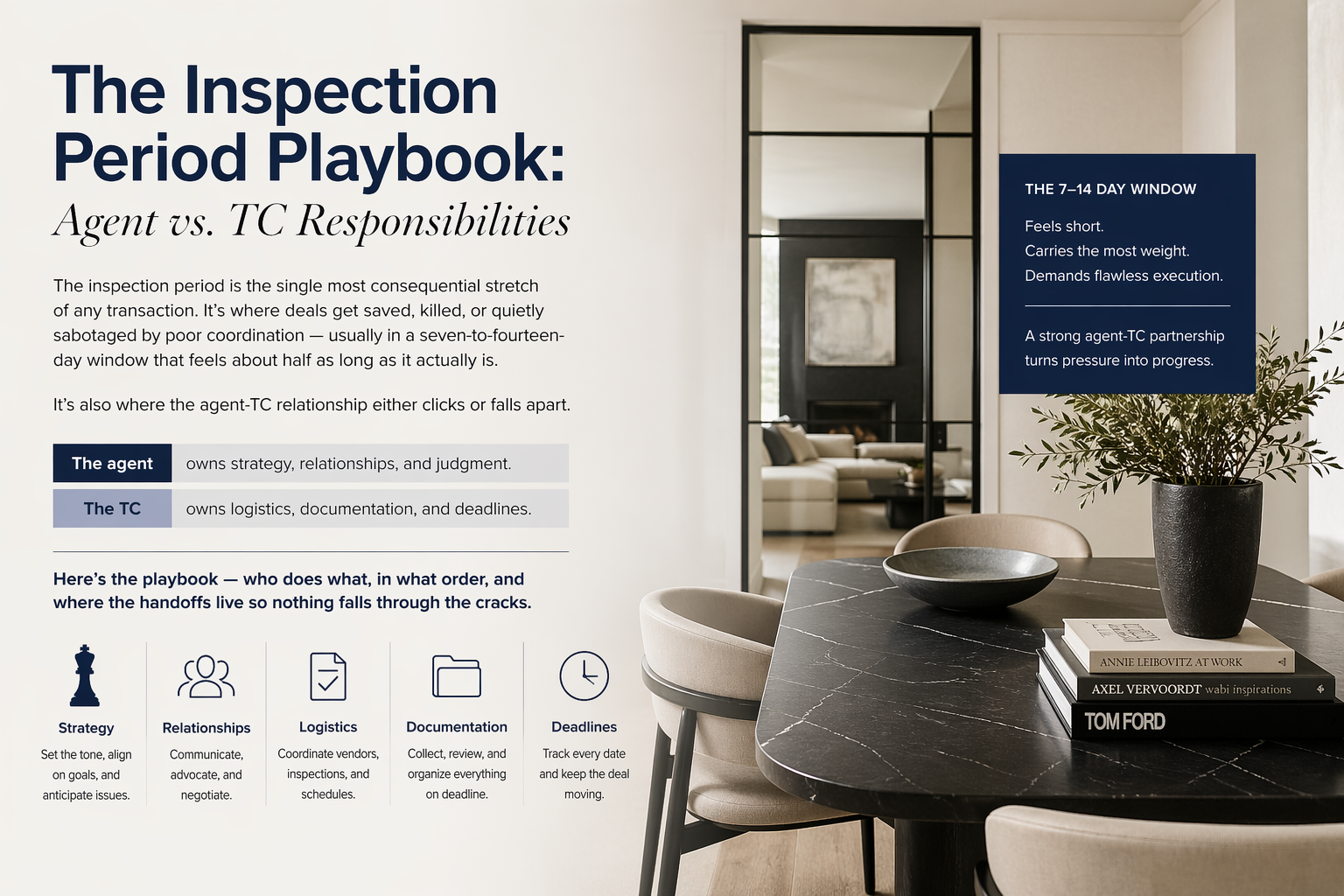
The inspection period is the single most consequential stretch of any transaction. It's where deals get saved, killed, or quietly sabotaged by poor coordination — usually in a seven-to-fourteen-day window that feels about half as long as it actually is.
It's also where the agent-TC relationship either clicks or falls apart. Because unlike the mortgage phase (mostly the lender's job) or the title phase (mostly the attorney's or title company's job), inspection is a true joint operation. The agent owns the strategy, the relationship, and the negotiation. The TC owns the logistics, the paper trail, and the deadlines. If either side freelances into the other's lane, you get duplicate emails, confused clients, and missed deadlines that can cost a buyer their earnest money.
This is the playbook. Who does what, in what order, and where the handoffs live.
The inspection period, at a glance
Residential inspection contingency periods typically run 7 to 14 days from the executed contract, though 7 to 10 days is the most common window (Rocket Mortgage; TurboHome). Commercial deals stretch to 21 to 30 days. Every contingency period has three timeframes baked into it:
The inspection period itself — when the buyer actually conducts inspections.
The cure period — the time given to the seller to respond to or address requested repairs.
The contingency removal date — the deadline by which the buyer must formally waive or remove the contingency (TurboHome).
Miss any of those three, and the consequences are real. A buyer who fails to give timely written notice within the contingency window can lose the right to back out based on inspection findings — and potentially forfeit their earnest money deposit (JVM Lending). That's not a theoretical risk. It happens.
Which is exactly why the agent-TC division of labor matters so much during this phase.
The division of labor: agent vs. TC
Think of the inspection period as having two parallel workstreams running at the same time. One is strategic and relational — that's the agent's lane. The other is logistical and deadline-driven — that's the TC's lane. When both stay in their lanes, the whole thing runs smoothly. Here's how it breaks down.
What the agent owns
Pre-inspection strategy conversation with the buyer. Before the inspection is even scheduled, the agent needs to sit down (or hop on a call) with the buyer to set expectations: what an inspection actually covers, what findings are typical versus alarming, what kind of repairs are reasonable to ask for in this market, and what the agent's recommended negotiation posture will be. This conversation shapes everything that follows.
Recommending the inspector (or curating the short list). A good agent has two or three trusted inspectors in their contact list and knows which one to recommend based on the property type — older homes with knob-and-tube wiring get the inspector who specializes in pre-war construction; a newer construction with a slab foundation gets someone else. The TC can schedule, but the agent owns the recommendation.
Attending the inspection (or at least the last 30 minutes). This is non-negotiable for most agents, especially newer ones. Being at the inspection gives you a chance to see issues in person, hear the inspector's verbal commentary (which is often more candid than the written report), and manage your buyer's emotional response in real time. Buyers who attend inspections without their agent tend to catastrophize every finding; buyers whose agent is there to provide context stay grounded.
Reading the inspection report and translating it for the buyer. Inspection reports are intentionally conservative — they flag everything. Part of the agent's job is helping the buyer understand the difference between "this needs immediate attention" and "this is a minor maintenance item the inspector has to note." Without that translation, buyers either ignore serious issues or panic over cosmetic ones.
Strategizing the inspection response. This is pure judgment work. Should the buyer ask for repairs, a credit, a price reduction, or some combination? Which items are worth fighting for, and which are nice-to-have? How hard should you push in this market, with this seller, on this property? None of that can be delegated — it's the agent's core value-add.
Negotiating with the listing agent. Once the response strategy is set, the agent handles the actual back-and-forth with the other side. Tone matters here. A sharp email can kill a deal; a warm call can save one. This is relationship work.
Handling the client's emotional state. Inspection periods are stressful. Buyers often question their decision, spouses disagree, in-laws weigh in with strong opinions from 800 miles away. The agent is the emotional anchor. A good TC will brief you on what's going on, but this lane is yours.
Making the final call if the deal dies. If the inspection surfaces issues the seller won't address and the buyer isn't willing to absorb, the agent is the one who walks the buyer through the decision to terminate. That conversation — and the strategic call that precedes it — is agent territory.
What the TC owns
Scheduling the inspection. The TC coordinates with the buyer, the listing agent, the seller (for access), and the inspector to lock in a date and time within the contingency window. Most inspection clauses give the buyer the right to access the property upon 24 hours' advance notice to the seller's agent (Law Insider), so the TC needs to handle this cleanly and in writing.
Coordinating any specialty inspections. Radon, termite/wood-destroying insect, chimney, sewer scope, oil tank sweep (common in older NJ homes), mold, septic, well water — anything beyond the general inspection. These often need to be scheduled in parallel to fit inside the contingency window, and the TC is the one keeping the calendar straight.
Logging every deadline. Inspection deadline, response deadline, seller cure period deadline, contingency removal deadline. All of them, in the system, with reminders that fire before each one, not on the day of.
Confirming attendance logistics. Who's going to the inspection? The buyer? The agent? Both? Is anyone bringing kids? Does the listing agent need to be there to provide access? The TC confirms all of this 48 hours before the appointment.
Distributing the inspection report. Once the inspector sends the written report, the TC makes sure it gets to the right people — typically the agent first for review, then the buyer after the agent has had a chance to translate it.
Drafting the inspection response documents. Inspection reply notice, request for repairs, amendment to the agreement — these are form documents with precise language and dates. The TC drafts them based on the agent's strategic direction, the agent reviews and approves, then the TC delivers them to the other side.
Tracking the seller's response. The cure period has a deadline just like the inspection period does. The TC is watching the clock and flagging the agent if the listing side goes quiet.
Confirming any agreed-upon repairs are completed before closing. If the seller agrees to fix the roof leak and re-caulk the tub, someone has to verify that happened. Usually that's documented with receipts from licensed contractors, and ideally confirmed at the final walkthrough. The TC collects the receipts and flags anything still outstanding.
Written memorialization of the outcome. Once inspection is resolved — whether through a repair agreement, credit, price adjustment, or the buyer accepting the property as-is — the TC makes sure the outcome is documented in writing and signed by both parties. Verbal agreements aren't enforceable (TurboHome), and "we talked about it on the phone" isn't a defense if it comes up later.
What's shared (and how to handle it)
A few things genuinely sit in both lanes, and these are where miscommunication happens most often. The fix is always the same: one clear handoff protocol so neither side freelances.
Communicating with the buyer about findings. The agent handles the strategic translation (what it means, what to ask for). The TC handles logistical updates (the inspection is scheduled for Thursday, the report arrived, the seller's response came in). If the buyer calls the TC asking "is this a big deal or not?" — that's a handoff to the agent, not an answer the TC should freelance.
Communicating with the listing side. Strategic negotiation goes through the agent. Document delivery, scheduling, and confirmation of receipt goes through the TC. If the listing agent emails asking for an extension, the TC acknowledges receipt and loops in the agent for the decision.
Extensions. If either side needs more time — for a specialty inspection, a contractor estimate, or seller negotiation — the decision to grant or request an extension is the agent's call. The paperwork and written confirmation are the TC's job. Industry guidance is clear on this: any extension must be negotiated and agreed to in writing before the original deadline expires (TurboHome).
A typical inspection period, day by day
Here's what the division of labor actually looks like in a 10-day inspection contingency window. Your timing will vary — shorten it for a 7-day contingency, stretch it for a 14-day one.
Day 1 (contract executed): TC logs all deadlines and sends intro emails. Agent has the pre-inspection strategy call with the buyer and recommends an inspector.
Day 2: TC coordinates with the buyer, listing agent, and inspector to schedule. Agent confirms any specialty inspections needed based on the property profile.
Days 3–4: TC schedules specialty inspections in parallel. Agent prepares the buyer for what to expect.
Day 5 (inspection day): Inspector performs the inspection. Agent attends (at least the last 30 minutes). TC confirms scheduling for any follow-up specialty inspections if needed.
Day 6: TC receives and forwards the written report to the agent. Agent reads it, translates it, and talks through findings with the buyer.
Day 7: Agent and buyer finalize the response strategy. TC drafts the reply notice / repair request / amendment based on the agent's direction.
Day 8: Agent reviews the draft, approves, and TC delivers it to the listing side in writing. Agent calls the listing agent to set the tone.
Days 9–10: TC tracks the seller's response. Agent handles any negotiation that arises. TC documents the final agreed-upon outcome in writing, gets signatures, and updates the deadline calendar (shifting any downstream dates if needed).
Every step has a clear owner. Nothing falls through the cracks because nothing is ambiguous about who's holding it.
The three ways inspection coordination goes wrong
Even with a clear division of labor, three specific failure modes show up over and over. Knowing them in advance is the best defense.
Failure mode #1: The agent schedules the inspection themselves "just to be fast." This creates a ghost deadline. The TC doesn't know what was scheduled or when confirmations went out, so they can't track it properly. Inspectors don't know who to send the report to. The buyer gets conflicting information from two sources. Rule: scheduling goes through the TC, always.
Failure mode #2: The buyer calls the TC and asks a strategic question, and the TC answers it. This is usually well-intentioned — the TC wants to be helpful, and the question feels answerable. But once the TC starts advising on whether to ask for repairs or negotiate a credit, the agent loses control of the strategy, and the client starts to see the TC as the decision-maker. Rule: strategic questions route back to the agent, every time. "That's a great question for [Agent's name] — let me make sure she's on it today" is the right answer.
Failure mode #3: A verbal agreement that never gets documented. The agent calls the listing agent and they agree the seller will fix the water heater and replace the garage door opener. Everyone feels good. Then two weeks later at closing, the garage door opener hasn't been replaced and nobody has anything in writing. Rule: every outcome gets memorialized in writing by the TC and signed by both parties within 24 hours of the verbal agreement. If it's not in writing, it didn't happen.
Why this matters more in the Northeast
Inspection periods in the states Signed to Keys serves — PA, NJ, NY, MD, CT, DE — have a few wrinkles worth flagging:
In New Jersey, the inspection period typically starts after attorney review concludes, not from the contract execution date. Most buyers get 7 to 14 days from the end of attorney review to perform inspections and deliver any repair requests. Oil tank sweeps are common and add a specialty inspection the TC needs to coordinate.
In Pennsylvania, the standard PAR contract has a specific "Inspection Contingency" timeline that starts running from the execution date, and the reply notice language is very specific about what the buyer can do (accept the property, terminate, or request repairs/credits).
In New York, inspections are often conducted before the formal contract is signed, since contract negotiation happens through attorneys. This flips the typical sequence and changes the agent/TC workflow.
In Maryland, the inspection contingency has a cure period baked in, and the smoke detector and water affidavit requirements start to appear in the seller's workflow as early as inspection resolution.
In Connecticut and Delaware, inspection periods are more standard but still require careful attention to the specific contract form being used.
A TC who's trained across these states knows the wrinkles. Which is the entire point — you, as the agent, should be thinking about negotiation strategy and client psychology. Your TC should be thinking about which state you're in and which form you're working from.
The one-line summary
The agent owns strategy, relationships, and judgment. The TC owns logistics, documentation, and deadlines. When that line is clear, the inspection period becomes a smooth joint operation instead of a coordination nightmare — and your clients feel the difference.
Frequently Asked Questions
Who actually schedules the home inspection — the agent or the TC?
The TC, in almost every case. The agent recommends the inspector (since they know which one fits the property), but the scheduling and confirmation should route through the TC so there's one source of truth on timing. Agents who schedule inspections themselves often forget to loop the TC in, which creates missed communications down the line.
Does the agent need to attend the inspection?
Ideally, yes — at least for the last 30 minutes so the agent can hear the inspector's verbal summary, see any flagged issues in person, and manage the buyer's reaction. Newer agents especially benefit from attending the full inspection. The TC doesn't attend; they handle scheduling and downstream paperwork.
How long is a typical inspection contingency period?
Residential deals typically run 7 to 10 days, though 14 days is common in some markets and 7 days is common in competitive seller's markets (Rocket Mortgage; TurboHome). Commercial inspection periods stretch to 21 to 30 days because of the complexity of what needs to be reviewed.
What's the difference between the inspection period, the cure period, and the contingency removal date?
The inspection period is when the buyer conducts inspections. The cure period is the time given to the seller to respond to or address requested repairs. The contingency removal date is the deadline by which the buyer must formally waive or remove the contingency to proceed with the sale (TurboHome). All three are tracked separately — missing any one of them has consequences.
Who drafts the inspection response document?
The TC drafts it based on the agent's strategic direction. The agent decides what to ask for (repairs, credit, price reduction, walking away); the TC handles the form language, deadlines, and delivery. The agent reviews and approves before it goes out.
What happens if the inspection uncovers something major?
The buyer has three practical options: request repairs, request a credit or price reduction in lieu of repairs, or terminate the contract and recover their earnest money deposit (Rocket Mortgage). Which path makes sense depends on the market, the severity of the issue, the seller's disposition, and the buyer's alternatives — all agent judgment calls. The TC handles the documentation whichever direction the agent chooses.
Can the inspection period be extended?
Yes, but only if both parties agree in writing before the original deadline expires (TurboHome). Extensions are common for specialty inspections (like a sewer scope or structural engineer review) that couldn't be scheduled in the original window. The agent decides whether to request or grant the extension; the TC handles the written amendment.
Should the TC ever talk directly to the buyer about inspection findings?
Yes, for logistical updates — "the inspection is scheduled for Thursday," "the report arrived and I've sent it to your agent," "the seller's response came in and your agent will call you shortly." No, for strategic questions — if the buyer asks whether something is a big deal or what they should ask for, the TC routes that to the agent.
What about verbal agreements during inspection negotiation?
Get them in writing within 24 hours, every time. Verbal agreements aren't enforceable (TurboHome), and the inspection phase is exactly the moment where "we talked about it" comes back to bite everyone. The TC's job is to memorialize every agreement in a written amendment and get it signed.
How do I make sure agreed-upon repairs actually get done?
Agree up front on how repairs will be verified — typically through licensed, insured, experienced contractor receipts delivered before closing, and a final walkthrough that confirms the work. The TC collects and tracks receipts; the agent confirms satisfaction at the walkthrough. If repairs aren't complete by closing, the options are typically a credit at settlement, a holdback in escrow, or a delayed closing.
What's an oil tank sweep and why does it matter in NJ?
An oil tank sweep is a specialty inspection that uses metal detection equipment to check for buried oil tanks on the property — common in older New Jersey homes that previously used oil heat. Undisclosed underground tanks can create massive environmental liability for the buyer, so a sweep is often ordered alongside the general inspection in NJ. Your TC should be coordinating this automatically for any pre-1975 NJ property.
What if my TC and I disagree about who handles something during inspection?
That's a signal to have the conversation once, get it in writing, and apply it consistently. The lines between agent and TC responsibilities aren't carved in stone — they depend on the agent's style, volume, and brokerage norms. What matters is that you both know exactly where the handoffs live so nothing falls through the cracks. A 30-minute conversation after your first file usually resolves 90% of future ambiguity.
Want a TC who already knows this playbook cold? Signed to Keys runs inspection coordination on every file across PA, NJ, NY, MD, CT, and DE — specialty inspections included, deadlines tracked, written amendments delivered same-day. Request a free 30-minute consultation and we'll walk through what inspection coordination would look like on your next file.