Remote TCs vs. Local TCs: Does Location Still Matter?
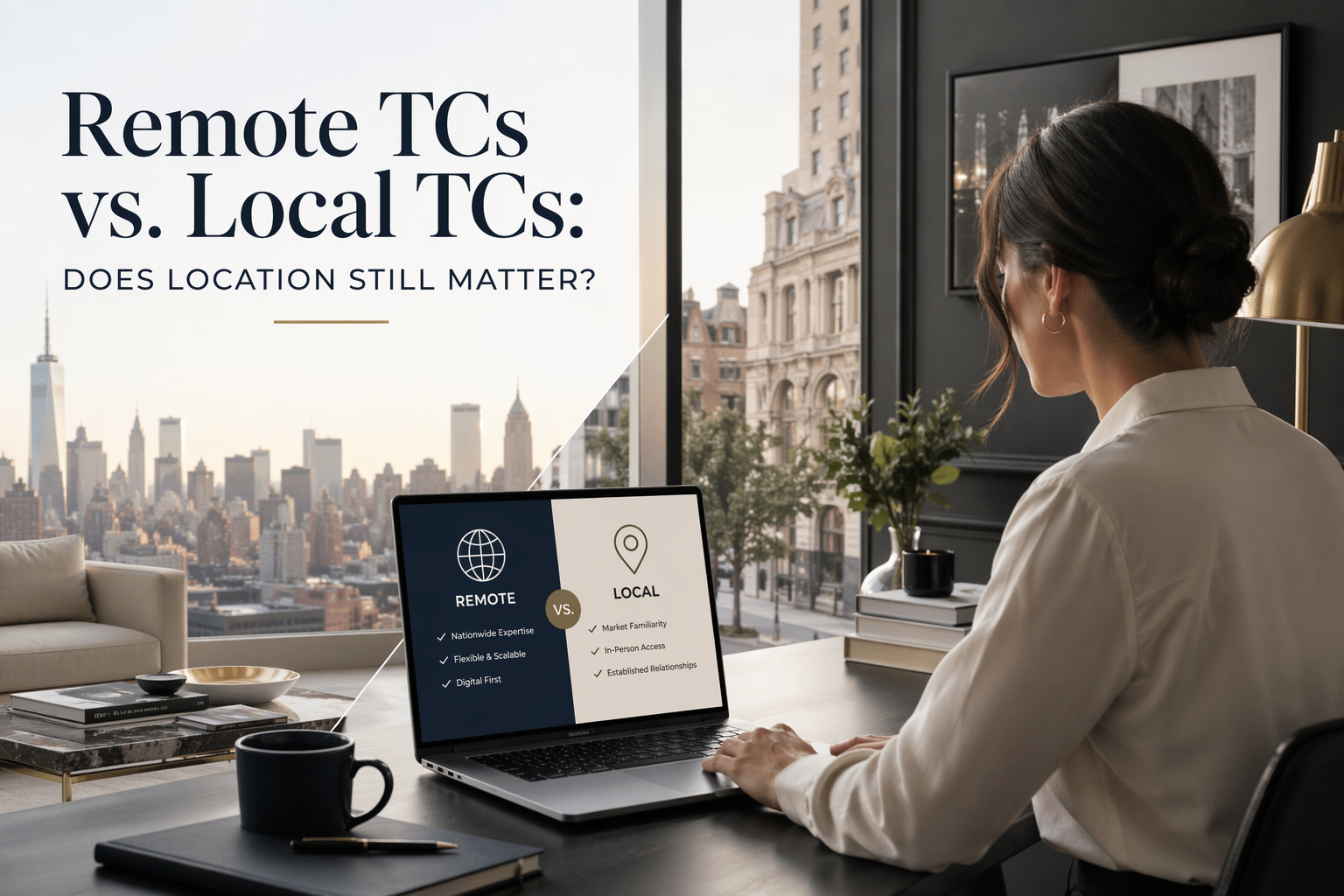
For most of the last decade, hiring a transaction coordinator meant finding someone local. Someone who understood your state's forms, knew your market's closing customs, could grab coffee with your listing attorney, and occasionally drop by the office. "Local" was synonymous with "competent" in a lot of agents' minds.
In 2026, that mental model has broken. Remote TC has become the default — not because local doesn't matter anymore, but because location doesn't matter the way expertise does. A TC in Denver can handle your Northeast transactions flawlessly if they're trained on Northeast forms. A TC down the street can run your deals poorly if they haven't kept pace with post-NAR settlement compliance or AI-assisted workflows.
The real question in 2026 isn't remote versus local. It's: does the TC have the expertise, systems, and responsiveness your deals require, regardless of where they physically sit? Here's an honest look at what actually matters, what doesn't, and how to think about location in the modern TC decision.
What "local" used to actually mean
When agents historically preferred local TCs, they were really preferring a bundle of things that happened to correlate with geographic proximity:
Knowledge of state-specific forms and timelines (NJ attorney review, PA U&O, NY mansion tax, etc.)
Familiarity with local title companies and attorneys
Same time zone responsiveness
Ability to meet in person when needed
Understanding of regional closing customs
Accessibility for client-facing moments (occasional closings, team meetings)
The implicit assumption was that only a local TC could offer all of this. In 2018, that was mostly true. In 2026, it isn't — because most of these competencies have been decoupled from physical location.
What's actually changed since 2020
Four structural shifts have broken the "local = competent" equation.
1. Cloud-based tools eliminated the in-person requirement. Every major transaction management platform — Dotloop, SkySlope, Paperless Pipeline, Open to Close, Brokermint — is cloud-based. A TC in any U.S. time zone can access the same files, run the same workflows, and maintain the same audit trails as a TC sitting next to you (Expert VA, 2026). As one industry source puts it: "The work is entirely digital. There's no part of transaction coordination that requires someone sitting next to you" (Freedom RES).
2. Closings moved digital (mostly). E-signatures, remote online notarization, secure document portals, and virtual closings have made physical presence at closings largely unnecessary. A remote TC coordinates the closing logistics — scheduling, document delivery, final checks — without needing to be in the room. The agent or client attends if in-person is required; the TC doesn't need to.
3. Multi-state training became systematic. Pre-pandemic, TCs were usually trained informally through on-the-job experience in one market. Since 2022, nationally-focused TC training programs (AIDE, DocJacket, others) have become common, producing TCs explicitly trained on real estate deal frameworks across multiple states (AIDE, 2026). A remote TC in 2026 can have deeper multi-state expertise than a local TC who only knows one state.
4. Communication expectations shifted. Clients, agents, and other parties now expect email, text, and secure portal communication. The local TC who was valuable for dropping off documents in person has lost that differentiator entirely. What people actually want in 2026 is same-day responsiveness during business hours (Freedom RES) — which a well-run remote operation delivers as reliably as a local one, sometimes more reliably.
What still genuinely matters about location
To be fair, location hasn't become completely irrelevant. A few things still matter — just not in the way people assume.
State-specific knowledge. This is the big one. Remote doesn't mean generic. A TC working on your NJ file needs to know attorney review timing, CO/CCO requirements, and smoke/CO certification processes cold. A TC on your NY file needs to know mansion tax thresholds, NYC co-op board packages, and TP-584/RP-5217 forms. A TC on your PA file needs to know municipal use and occupancy cert processes. State knowledge matters enormously; it just doesn't require state presence. What you need is a TC trained on your state, not one physically in your state.
Time zone. A TC two or three hours off your time zone can be a problem if your attorney review expires at 5 p.m. Eastern and your TC's business hours end at 3 p.m. Pacific. Most professional remote TC providers match time zones to the markets they serve — a Northeast-focused provider staffs East Coast business hours even if individual TCs live elsewhere. Confirm the operational hours, not the physical location.
Relationship density with local parties. This matters less than people assume but more than zero. A TC who's coordinated with the same title companies, municipal offices, and attorneys for years builds operational shortcuts that speed up files. Remote TCs serving a specific region for enough years develop these same networks. A remote TC who's run 500 NJ deals has the same operational memory as a local one who's run 500 NJ deals.
Compliance layer awareness. Brokerage compliance policies, state form revisions, local MLS rules — these update constantly. A good TC stays current regardless of location; a weak TC falls behind. Location correlates weakly with whether a TC has strong compliance discipline.
What doesn't matter about location (and why people still assume it does)
A few assumptions worth unwinding:
"My clients want to meet the TC." They almost never do. Clients want responsiveness, clear communication, and confidence that their file is being handled — which a great remote TC provides as well as (or better than) a great local one. Industry experience strongly suggests most clients have no idea (and don't care) whether the TC is in the next town or across the country (Freedom RES). What they notice is service quality, not zip code.
"I need someone who can show up at closing." In 2026, TCs rarely attend closings anyway. The TC coordinates the closing logistics — scheduling, document prep, final checks — but closings themselves are attended by the agent, client, attorney, and title company. Physical TC presence isn't required or expected.
"A local TC understands the market." Market understanding is an agent skill, not a TC skill. The TC's job is administrative coordination and compliance, not market analysis. A TC doesn't need to know current comp values or neighborhood dynamics — that's your job as the agent.
"Local builds trust faster." Trust comes from competence, responsiveness, and reliability. A remote TC who responds within 30 minutes and runs a clean file earns trust faster than a local one who takes a day to respond and misses a detail. Proximity doesn't generate trust; performance does.
The real dimensions that matter
If location is the wrong frame, what's the right one? Three dimensions that actually predict TC quality:
1. State and regional expertise. Has this TC run deals in your specific markets? Do they know the current forms, the timing quirks, the certification workflows? Do they know which state you're in when they open a file? For multi-state practices, is their training actually multi-state or is one state deep and others superficial?
2. Systems and responsiveness. What's their tech stack? What's their communication rhythm? How do they handle after-hours emergencies? What's their backup coverage if the primary TC is out? Do they send proactive updates or do you have to chase them?
3. Scope and professionalism. What's actually included in their service? Do they handle post-NAR settlement compliance? Buyer-broker agreement tracking? Wire fraud prevention through secure portals? Are they licensed where it matters? Do they have documented SOPs or are they winging it?
These three dimensions correlate weakly with geographic proximity. Some local TCs nail them; some don't. Some remote TCs nail them; some don't. Evaluating the dimensions directly gives you a much better signal than evaluating location.
Where "local" still wins
A few scenarios where a truly local TC can still be the right choice:
1. Teams needing in-person cultural integration. If your TC needs to attend weekly team meetings in person, be present at team events, meet with new agents face-to-face, and generally be part of the physical team culture, a local (and likely in-house) TC is the right call.
2. Highly customized brand experiences. Luxury or concierge teams sometimes want the TC to attend closings, coordinate in person with high-touch clients, or represent the brand physically. Remote doesn't fit this model.
3. Very narrow single-state practices with dense local networks. A TC who's spent 15 years working exclusively in one specific county, knows every local attorney and title officer personally, and has built a network of operational shortcuts that can't be replicated — this person is genuinely hard to replace remotely. These cases exist but aren't common.
4. Specific licensed activity requirements. In some states, TCs who are licensed real estate professionals can perform activities (like negotiation on behalf of clients) that unlicensed TCs cannot. If your workflow depends on licensed TC activity, location may matter more because licensing is state-specific.
For most practices, none of these apply.
Where "remote" genuinely wins
The scenarios where remote TCs offer real advantages:
1. Multi-state practices. A remote TC provider trained across multiple states is dramatically more useful than a local TC who knows one state and guesses at the others. If you work across PA, NJ, NY, MD, CT, or DE, remote multi-state coverage is an obvious fit.
2. Teams wanting backup coverage. Remote providers often run dedicated-TC plus backup-TC models, where a secondary coordinator trained in your files steps in when the primary is out. Local solo TCs rarely offer this. Virtual TCs are 55% less likely to switch jobs than in-house TCs, which means more continuity over time (AgentUp).
3. Cost-efficient scaling. Remote TCs typically cost less than local/in-house equivalents — not because the work is cheaper, but because remote providers don't carry the office, benefits, and overhead of an in-house employee. The savings can be 30–70% compared to traditional staffing (MyOutDesk).
4. Technology-forward operations. Remote providers tend to be more tech-savvy out of necessity — they can't survive without strong systems. An agent running a tech-forward practice often integrates more smoothly with a tech-forward remote TC than with a local one still using email and spreadsheets.
The Northeast-specific view
For the states Signed to Keys serves — PA, NJ, NY, MD, CT, and DE — the remote vs. local question plays out specifically as follows:
Attorney-state complexity favors specialists. NJ, NY, CT, and MD all require attorney involvement in transactions. A remote TC who specializes in attorney-state coordination across these markets brings more relevant experience than a local TC who only sees occasional attorney-state files.
Multi-state licensure is common. Agents in Northeast metros often hold licenses across multiple states (NYC/NJ, Philly/NJ, DC/MD/VA). A remote multi-state TC is natively built for this; a local single-state TC requires outside help for the non-local states.
Condo and co-op specialization matters. NYC co-ops and urban condos have unique workflows. Remote TCs who've specialized in these handle them better than local TCs who've only seen them occasionally.
Secondary markets benefit from remote access. Agents working in smaller Northeast markets (central PA, rural upstate NY, parts of Delaware) often don't have strong local TC options. Remote providers fill that gap effectively.
The practical takeaway for Northeast agents: a well-run remote TC provider with genuine multi-state Northeast expertise is almost always a better fit than a local TC whose reach is limited to one state or one metro.
The honest answer to "does location matter?"
No — not in the way people historically meant it. Yes — in the sense that the expertise, time zone coverage, and workflow knowledge traditionally associated with "local" still need to exist, just decoupled from physical location.
The question to ask isn't "where does this TC live?" It's "does this TC have the expertise, systems, and responsiveness my deals require?" Those attributes can exist in a TC two towns over or two time zones away. What you want is to verify them directly — by asking about scope, tools, backup coverage, state expertise, and references — rather than using location as a proxy.
The one-line summary
Location mattered when TC work was paper-based, in-person, and locally networked. Now the work is cloud-based, digital, and networked across geographies. What still matters — state-specific expertise, business-hour responsiveness, relationship density with local parties — has decoupled from physical location. A great remote TC can handle your market flawlessly; a mediocre local TC can miss details regardless of how close they sit. Evaluate the expertise, not the zip code.
Frequently Asked Questions
Can a remote TC really handle my state's specific forms and customs?
Yes — if they're trained on your state. The key distinction is trained-on versus located-in. Remote doesn't mean generic. Competent remote TC providers staff coordinators with deep expertise in specific states and markets. Ask directly what states they specialize in and how their TCs stay current on form updates. A remote TC trained on NJ attorney review and CO/CCO requirements handles those files as well as a local NJ TC — often better, because they run more volume across more files.
Will my clients know I'm using a remote TC?
Only if you tell them. Most clients interact with the TC through email, phone, and secure portals regardless of location. They don't know (and don't usually ask) whether the TC is down the street or across the country (Freedom RES). What they notice is responsiveness and service quality.
Does my TC need to attend closings?
Almost never in 2026. The TC coordinates closing logistics — scheduling, document delivery, final checks — but closings themselves are attended by the agent, client, attorney (in attorney states), and title company. Physical TC presence is rarely required or expected. E-signatures and remote online notarization have further reduced the need.
What happens if there's an urgent issue and my TC is in a different time zone?
Professional remote TC providers match operational hours to the markets they serve. A Northeast-focused provider runs East Coast business hours even if individual TCs live elsewhere. Confirm business hours and same-day responsiveness policies before hiring — those matter more than where the TC physically sits.
How do remote TCs handle state-specific compliance?
Good ones specialize by state or region and stay current on form revisions, legislation, and brokerage compliance policies through structured processes. Ask your prospective TC how they stay current on state-specific changes — a vague answer is a red flag. A strong answer includes regular training, subscription to form-update services, and active monitoring of state real estate commission updates.
Can a remote TC build relationships with local title companies and attorneys?
Yes, over time. A remote TC who runs 500 deals in NJ has worked with most of the active title companies and attorneys in NJ multiple times. Relationship density develops from volume, not physical proximity. A remote TC with 3 years of consistent Northeast volume has stronger working relationships than a local TC who just relocated.
Are remote TCs usually cheaper than local TCs?
Generally yes, by 20–50% depending on the market and model. The savings come from reduced overhead (no office, no in-house benefits), specialization efficiency, and technology leverage — not from cutting corners on the work itself. In 2026, agents can find remote TCs who deliver equal or better service at lower cost than local equivalents.
What if my TC uses a different platform than my brokerage?
Ask upfront. Competent remote TCs work across multiple transaction management platforms (Dotloop, SkySlope, Paperless Pipeline, Open to Close, Brokermint) and can adapt to your brokerage's requirements. A TC who insists on using only their preferred platform, regardless of your setup, is a red flag.
How do I verify that a remote TC has real state expertise?
Four checks: (1) Ask them to walk through specific state-specific scenarios — attorney review timing in NJ, mansion tax in NY, U&O in PA, smoke affidavits in MD. Fluent answers show real expertise. (2) Ask how many files they've run in your state in the last 12 months. (3) Ask for references from agents in your state. (4) Ask about their process for staying current on state form revisions. Concrete, detailed answers indicate real expertise; vague or generic answers indicate weak expertise.
Is a local TC still the safer choice for first-time outsourcing?
Not really, in 2026. The safety signal people intuitively associate with "local" is mostly illusory at this point — the real signals (state expertise, systems, responsiveness, backup coverage) can be verified directly regardless of location. Some agents find the transition to remote easier than expected because professional remote TC operations are often more structured and responsive than solo local operators.
Does using a remote TC expose me to any compliance risk?
Not inherently. Compliance depends on TC quality, not location. A remote TC with strong compliance discipline is safer than a local one with weak discipline. What matters is whether the TC handles post-NAR settlement compliance, buyer-broker agreement tracking, wire fraud prevention, and state-specific disclosure requirements competently — regardless of where they're located.
What's the one question I should ask a remote TC before hiring?
"Walk me through how you'd handle a deal from the moment I forward you an executed contract, including every state-specific step for [your state] and how you'd handle [a specific complex scenario in your market]." The answer will tell you within 5 minutes whether the remote TC has the expertise you need. If the answer is generic or vague, keep looking.
Looking for a remote TC with genuine Northeast expertise? Signed to Keys operates remotely across PA, NJ, NY, MD, CT, and DE with state-specific specialists, secure portals, and the same-day responsiveness Northeast agents need. Request a free 30-minute consultation and we'll walk through how remote TC work actually looks on Northeast files.