How Mortgage Contingencies Actually Work (and Who Tracks What)
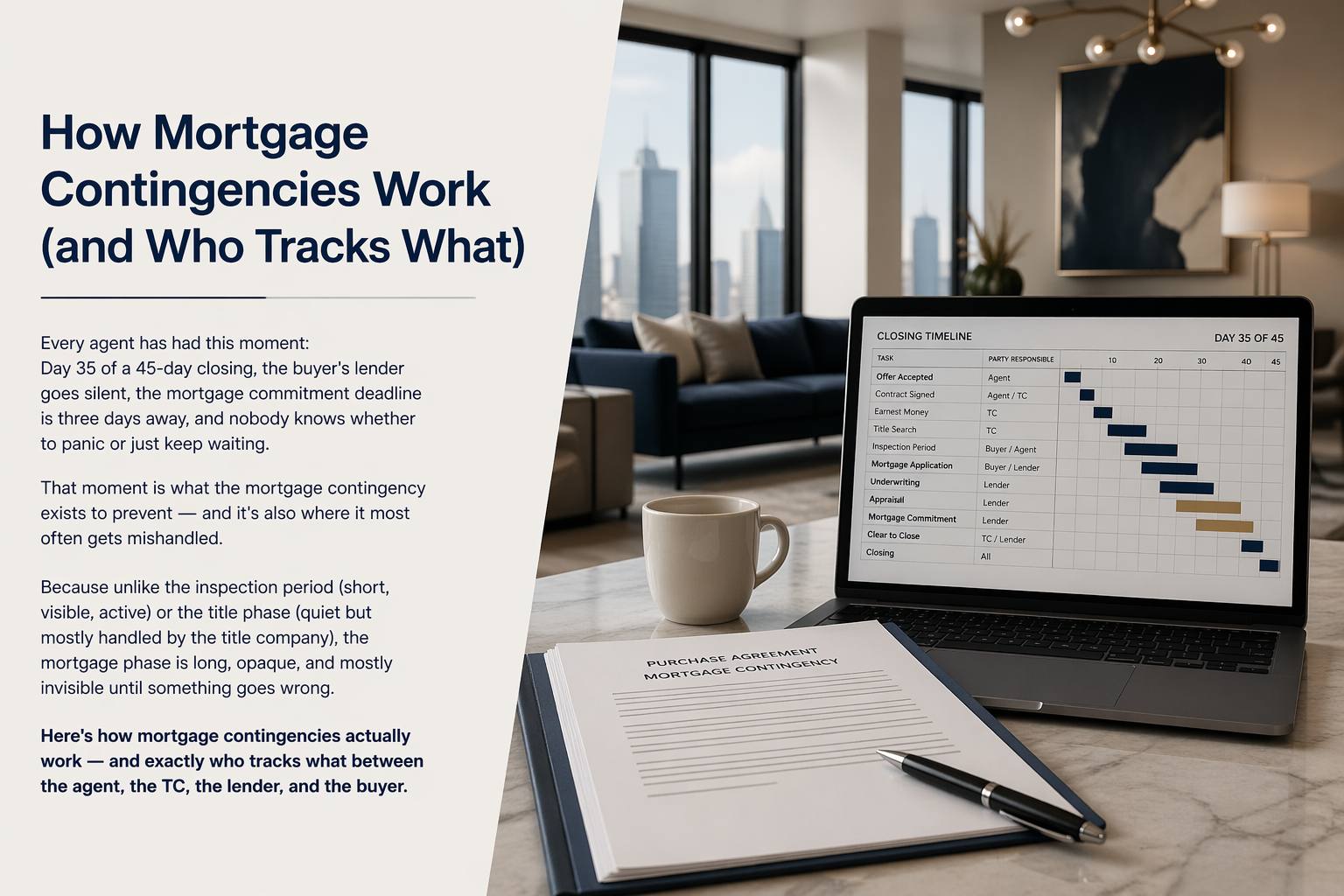
Every agent has had this moment: Day 35 of a 45-day closing, the buyer's lender goes silent, the mortgage commitment deadline is three days away, and nobody knows whether to panic or just keep waiting.
That moment is what the mortgage contingency exists to prevent — and it's also where the mortgage contingency most often gets mishandled. Because unlike the inspection period (short, visible, active) or the title phase (quiet but mostly handled by the title company), the mortgage phase is long, opaque, and mostly invisible until something goes wrong.
Here's how mortgage contingencies actually work — the real mechanics, not the textbook version — and exactly who tracks what between the agent, the TC, the lender, and the buyer. Because the single biggest driver of closing delays is still lender responsiveness (DeFalco Realty, 2026), and the single biggest cause of lost earnest money is buyers who miss contingency deadlines they didn't know were running.
What a mortgage contingency actually is
A mortgage contingency — also called a financing contingency or loan contingency — is a clause in the purchase agreement that gives the buyer a defined window to secure financing. If the buyer can't obtain the loan on the specified terms by the deadline, they can cancel the contract without penalty and recover their earnest money deposit (Chase; Rocket Mortgage).
That's the textbook version. Here's what actually matters in practice:
The contingency is the buyer's primary safety net. Roughly 70% of real estate contracts include a mortgage contingency, and about 15% of deals ultimately get canceled because the buyer couldn't secure financing (Houzeo). Those aren't edge cases — they're a normal part of the business.
A preapproval letter is not a guarantee of final approval. This is the single most misunderstood part of the mortgage contingency. Preapproval is based on the buyer's initial application and documentation. Underwriting goes much deeper — verifying employment, re-running credit, reviewing bank statements for large deposits, and scrutinizing the property itself. A buyer with a preapproval letter can absolutely still be denied at underwriting (AmeriSave, 2026).
The contingency window is not just about getting a loan — it's about getting this specific loan. Most well-drafted contingency clauses specify the loan amount, loan type (conventional, FHA, VA, jumbo), and sometimes a maximum interest rate or maximum origination fees. If the lender approves a smaller loan, or at a higher rate than the contract allows, the contingency can still kick in even though the buyer technically received an approval (Chase; AmeriSave).
How long does a mortgage contingency actually last?
The typical mortgage contingency period runs 30 to 60 days from the executed contract, with 30 to 45 days being the most common window on a standard financed purchase (Chase; Houzeo). The exact length depends on the market, the loan type, and what was negotiated.
A few nuances worth flagging:
Conventional loans typically need a 30 to 45-day commitment window.
FHA and VA loans often need 45 to 60 days due to additional documentation and appraisal requirements.
Jumbo loans and loans with complex income documentation (self-employed buyers, commission-based income, bonus income) often need longer windows.
Northeast states — particularly NJ and NY, where attorney review and formal contract customs stretch front-end timing — often run 45 to 60 days on the commitment deadline.
The contingency period runs from the effective date of the contract to the mortgage commitment deadline — not from contract to closing. Those are two different deadlines. Closing happens after commitment. Missing this distinction is one of the most common ways new agents get caught off guard.
Passive vs. active contingencies — and why it matters
There are two structural flavors of mortgage contingency, and they behave very differently when the deadline hits:
Passive contingency. The contingency automatically expires at the deadline unless the buyer takes action to invoke it. If the deadline passes with no written notice from the buyer, the buyer is now locked in — even if financing is still uncertain. Most states default to passive contingencies, and this is where buyers most often lose their earnest money by missing a deadline they didn't know was running (AmeriSave).
Active contingency. The contingency remains in effect until the buyer actively waives or removes it in writing. The buyer has to take action to give up the protection, not to keep it. Active contingencies are less common and are rare in NY, for example (Moshes Law).
The distinction matters enormously for how the TC tracks deadlines. With a passive contingency, the deadline is a cliff — miss it and the buyer loses their out. With an active contingency, the deadline is more of a milestone. Your TC needs to know which type you're working with, in which state, on which contract form.
Who tracks what: the division of labor
Mortgage contingencies are where good coordination really shines. The work splits cleanly across four parties — the agent, the TC, the lender, and the buyer — each with a specific lane. Here's how it breaks down.
What the agent owns
Recommending a trusted lender at the start. This happens before you even have an executed contract. A buyer with a lender your TC has worked with successfully closes faster and has fewer surprises than a buyer using a random online lender nobody has heard of. You own the recommendation.
Setting realistic expectations with the buyer. Before the contract is signed, explain the difference between preapproval and final approval. Explain that during the contingency period, the buyer should not change jobs, open new credit cards, make large purchases, or move money between accounts (Opendoor). These innocent-seeming actions kill deals at underwriting.
Strategic decisions on extensions. If the commitment deadline is approaching and the lender isn't ready, the decision to request an extension from the listing side is yours. The decision to cancel the deal because financing isn't materializing is also yours. The TC handles the paperwork; the call is yours.
Managing the client's emotional state. Mortgage phases are long and silent. Buyers get anxious. They call you asking whether to be worried. That's your conversation, not your TC's.
Negotiating with the listing side if something goes sideways. Appraisal comes in low, underwriting uncovers a credit issue, the buyer needs more time — all of these trigger conversations with the listing agent that require judgment and relationship skill.
What the TC owns
Logging the commitment deadline the moment the contract is executed. This is the single most important date in the contingency period. It gets logged with multiple reminders — 14 days out, 7 days out, 3 days out, and the day of.
Confirming the buyer's lender has the executed contract. The lender can't formally start underwriting until they have the signed agreement. If the TC doesn't confirm receipt, the lender's timeline silently shifts back. Within 24 hours of contract execution, the TC confirms the lender has the contract and knows the closing date.
Weekly check-ins with the lender's processor. Every 5 to 7 days throughout the contingency period, the TC reaches out to the lender to ask: Where are we in the process? Are there any outstanding conditions? Is the appraisal ordered? Is anything flagged that needs the buyer's attention? This cadence is what prevents the Day 35 surprise.
Tracking the appraisal separately. The appraisal is technically part of the mortgage process, but it has its own timeline. The TC logs when it's ordered, when it's performed, and when the result comes back — because appraisal issues account for roughly 20% of delayed closings (ListedKit).
Escalating immediately on red flags. If the lender goes quiet for more than a few days, or the processor mentions "just need one more thing" for the third week in a row, or the commitment deadline is approaching with no commitment letter in sight — that's a same-day escalation to the agent.
Drafting contingency-related documents. Extension requests, commitment confirmations, contingency removals, termination notices if the deal falls through — all form documents that the TC drafts based on the agent's direction.
Documenting everything in writing. Every lender conversation, every extension granted, every change to the timeline — memorialized in the transaction file. If something goes wrong later, the paper trail needs to be airtight.
What the lender owns
Worth calling out because agents sometimes try to do the lender's job:
Submitting the buyer's file to underwriting
Ordering and reviewing the appraisal
Running credit reports and verifying employment
Issuing the mortgage commitment letter
Communicating any conditions that need to be satisfied before clear to close
Issuing the Closing Disclosure at least 3 business days before closing (federal requirement)
The TC's job is to track the lender's progress, not to do the lender's job. There's a real difference. A good TC is relentless about follow-up without crossing into territory that's not theirs.
What the buyer owns
Also worth being explicit about, because buyers often assume someone else is handling it:
Responding to every lender document request within 24 hours
Not making any financial changes during the contingency period (no new credit, no job changes, no large deposits or withdrawals without documentation)
Locking the rate when the agent and lender advise
Signing disclosures promptly
Providing homeowners insurance binder before closing
The agent and TC can remind the buyer of these things, but the buyer has to actually do them.
The mortgage contingency timeline, in practice
Here's what a typical 45-day mortgage contingency period looks like when everyone is in their lane:
Day 1 (contract executed): TC confirms lender has the executed contract. Logs commitment deadline with reminders. Agent sets expectations with the buyer about what to avoid during the mortgage process.
Days 2–7: Buyer submits any outstanding documentation to the lender. TC confirms appraisal has been ordered. First weekly check-in with the lender's processor.
Days 8–21: Appraisal performed and report received. TC tracks appraisal separately and flags any value issues immediately. Underwriting actively reviews the buyer's file. TC's weekly check-ins continue.
Days 22–35: Conditional approval often issued in this window. TC tracks any outstanding underwriting conditions and nudges the buyer to respond quickly to documentation requests. If conditions are slow to clear, TC escalates to agent.
Days 36–45: Mortgage commitment letter issued. TC notifies agent and confirms commitment is fully "clean" (not conditional on something unresolvable). If commitment isn't coming by Day 42 or 43, TC escalates immediately so the agent can decide whether to request an extension or terminate.
After commitment: The contingency period effectively ends. The buyer is now financially committed. Deal moves to clear-to-close preparation, CD issuance, and final walkthrough.
The three ways mortgage contingency coordination goes wrong
Failure mode #1: The commitment deadline passes with no written notice. This is the worst-case scenario. On a passive contingency, the buyer loses their out and the earnest money becomes vulnerable. The fix is relentless deadline tracking — multiple reminders, a TC who knows which type of contingency applies in the state, and an agent who understands that the deadline isn't a suggestion.
Failure mode #2: The buyer does something dumb during underwriting. Opens a new credit card, finances a car "because the rate was great," puts $8,000 in their checking account from a relative and can't document the source, quits their job for a better offer. Any of these can kill the loan. The fix is setting expectations at contract signing and repeating them at each weekly check-in. "Don't change your financial picture until you're at the closing table" needs to be said a lot.
Failure mode #3: Silent lender drift. The lender goes quiet. The processor says "almost done" for weeks. Nobody surfaces the actual problem until the deadline is days away. The fix is the TC's weekly cadence of structured check-ins with specific questions — "is the appraisal ordered?" "what conditions are outstanding?" "realistic commitment date?" — rather than generic "how's everything going?" messages.
Why this matters more in the Northeast
The states Signed to Keys serves — PA, NJ, NY, MD, CT, and DE — each have their own mortgage contingency wrinkles:
NJ mortgage commitment deadlines are typically negotiated in attorney review and often extend the default window. The 3-day attorney review period happens before the mortgage contingency clock starts in practice, so effective financing windows can be tight.
NY uses mostly passive contingencies with the commitment letter being the primary trigger. The buyer must typically provide written notice of loan approval or denial, and the wording matters.
PA uses the standard PAR contract, which has specific language around the mortgage commitment deadline and what happens if the buyer is approved for less than the loan amount specified.
MD, CT, and DE have their own form contracts, each with slightly different default language around financing contingencies and extensions.
A TC trained across these states knows which form is in play, which deadline structure applies, and what written notice language is required to preserve the buyer's rights. That's not theoretical — it's the difference between a buyer getting their deposit back and losing it.
The one-line summary
The agent owns strategy and the client relationship. The TC owns deadline tracking and structured lender follow-up. The lender owns the actual loan process. The buyer owns their own financial behavior. When all four parties stay in their lanes and the TC keeps relentless written records, mortgage contingencies do what they're supposed to do — protect everyone and move the deal forward.
Frequently Asked Questions
What's the difference between a mortgage contingency and a mortgage commitment?
A mortgage contingency is a clause in the purchase contract that gives the buyer a window of time to secure financing. A mortgage commitment is a letter from the lender — issued after underwriting approves the loan — that confirms the loan will fund if the remaining conditions are met. The contingency is the contractual protection; the commitment is the lender's conditional approval. The commitment letter is typically what satisfies the contingency.
How long does a typical mortgage contingency period last?
Usually 30 to 60 days, with 30 to 45 days being the most common for conventional loans (Chase). FHA and VA loans often run 45 to 60 days due to additional documentation requirements. Jumbo loans and complex income files typically need more time. The specific length is negotiated in the contract.
What happens if the buyer misses the mortgage contingency deadline?
On a passive contingency (the default in most states), the contingency expires automatically at the deadline. The buyer loses their right to cancel the contract based on financing and can potentially forfeit their earnest money if the deal falls apart afterward (AmeriSave). This is why deadline tracking is the single most important TC job during the mortgage phase.
Can the mortgage contingency be extended?
Yes, but both parties have to agree in writing. The buyer's attorney or agent typically requests an extension before the original deadline expires. The seller can agree or refuse. If the seller refuses, the buyer has to decide whether to cancel the deal or proceed without contingency protection (Rocket Mortgage). Extensions should always be documented in a written amendment signed by both parties.
Does a preapproval letter satisfy the mortgage contingency?
No. Preapproval is not final approval. Preapproval is based on initial documentation; underwriting digs much deeper and can — and regularly does — deny loans that had preapproval letters attached (AmeriSave, 2026). The contingency is typically satisfied by a mortgage commitment letter from the lender, not a preapproval.
What should the buyer avoid during the mortgage contingency period?
Changing jobs, opening new credit accounts, financing large purchases (cars, furniture), making large unexplained deposits or withdrawals, co-signing any loans, or anything else that changes their credit, income, or debt picture (Opendoor). Any of these can cause underwriting to deny or delay the loan. Agents should set this expectation explicitly at contract signing and remind buyers during each weekly check-in.
Who is responsible for tracking the mortgage commitment deadline?
The TC, primarily, with the agent as the second set of eyes. The TC logs the deadline with multiple reminders, handles weekly check-ins with the lender, and escalates to the agent if the deadline is approaching without a commitment letter. The agent makes the strategic call on whether to request an extension or terminate.
What's the difference between a passive and active mortgage contingency?
A passive contingency expires automatically at the deadline unless the buyer takes action. An active contingency stays in effect until the buyer actively waives or removes it in writing. Most states default to passive contingencies (AmeriSave; Moshes Law). The distinction matters because it changes what happens if the deadline passes without notice.
What should be included in a well-drafted mortgage contingency clause?
A good mortgage contingency specifies the loan amount, loan type (conventional, FHA, VA, jumbo), maximum interest rate, maximum origination fees or closing costs, and the commitment deadline (AmeriSave). Without these specifics, the buyer could be forced to close on terms they didn't actually want.
What happens if the appraisal comes in low during the mortgage phase?
The buyer has options: renegotiate the purchase price down, bring additional cash to bridge the gap, dispute the appraisal with comparable sales, or (if there's an appraisal contingency) cancel the deal. A low appraisal also affects the mortgage contingency because the lender may approve a smaller loan amount than what the contract specifies, which can trigger the contingency even if the buyer was technically approved. The agent handles the strategy; the TC handles the paperwork.
Should the TC be talking directly to the lender?
Yes. Weekly structured check-ins with the lender's processor are core TC work. The TC isn't replacing the buyer-lender relationship — they're adding an accountability layer that catches problems before they become disasters. Good TCs have specific questions they ask each week rather than generic check-ins, and they document every response in writing.
How do I know if my TC is tracking the mortgage contingency properly?
Three signals: (1) You get a weekly status update that specifically mentions lender progress, (2) you know the commitment deadline without having to look it up, and (3) if the lender goes silent for more than a few days, you hear about it the same day, not the day of the deadline. If any of those three are missing, your TC's mortgage coordination isn't tight enough.
Want a TC who tracks your mortgage contingencies with the relentlessness they deserve? Signed to Keys runs structured weekly lender check-ins on every file across PA, NJ, NY, MD, CT, and DE — because the Day 35 surprise is a coordination failure, not a lender failure. Request a free 30-minute consultation and we'll walk through what mortgage tracking would look like on your next file.