The Rise of Multi-State Transaction Coordinators
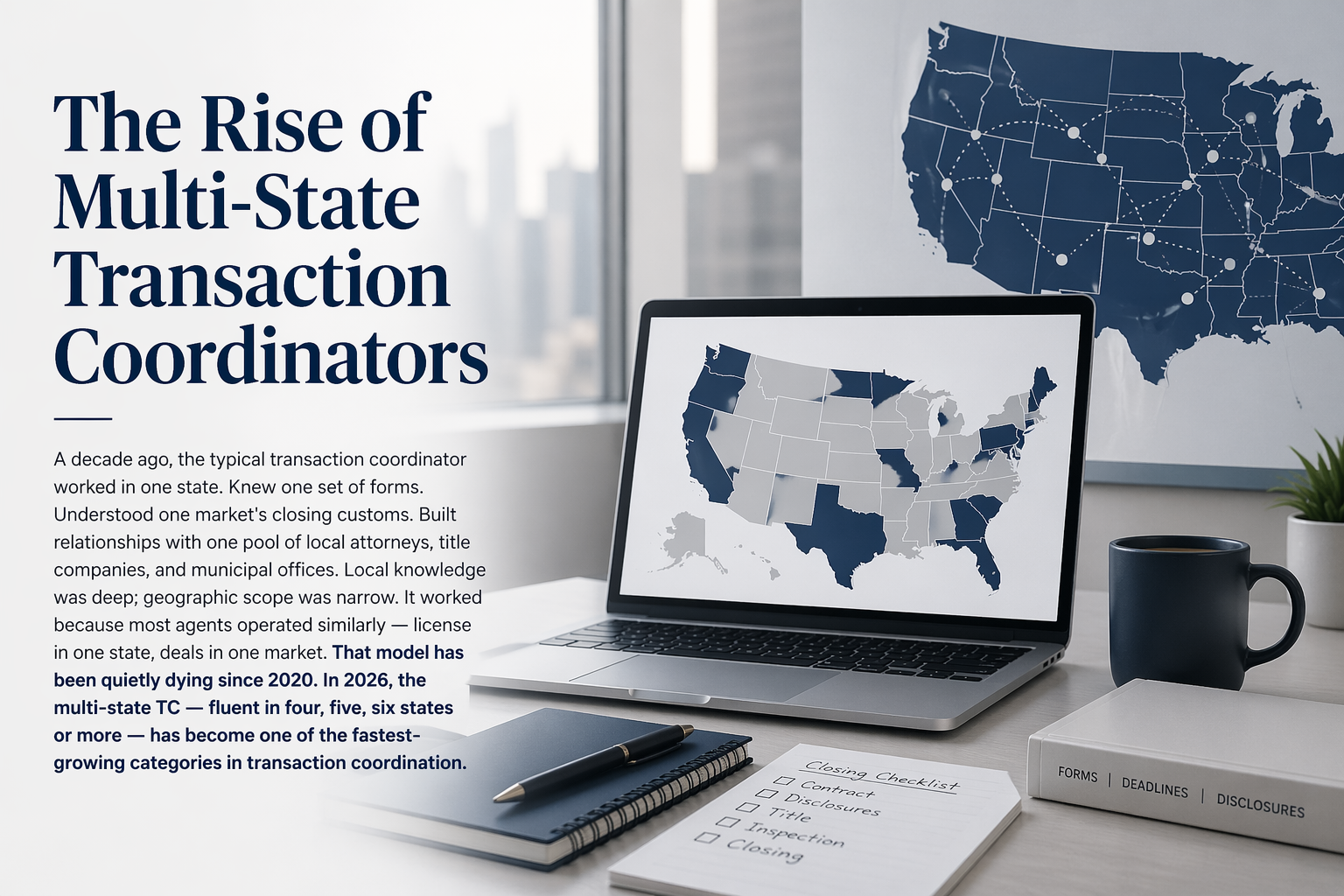
A decade ago, the typical transaction coordinator worked in one state. Knew one set of forms. Understood one market's closing customs. Built relationships with one pool of local attorneys, title companies, and municipal offices. Local knowledge was deep; geographic scope was narrow. It worked because most agents operated similarly — license in one state, deals in one market.
That model has been quietly dying since 2020. In 2026, the multi-state TC — fluent in four, five, six states or more, handling deals across licensing boundaries, time zones, and regional compliance regimes — has become one of the fastest-growing categories in transaction coordination. And it's happening for reasons that are structural, not fashionable.
Here's what's driving the rise of multi-state TCs, what makes the work distinctive, and why it matters more in the Northeast than almost anywhere else.
What "multi-state TC" actually means
First, some definitional clarity — because this term gets used loosely.
Multi-state TC refers to a transaction coordinator (or TC operation) fluent in the forms, timelines, compliance requirements, and closing customs of multiple states, and actively running files across those states regularly. This is different from:
A TC who "will work in any state" but only has experience in one.
A national TC platform that outsources to individual single-state coordinators.
A generalist TC who handles multi-state deals by researching requirements ad hoc.
A true multi-state TC has working expertise in each state they cover — meaning they know the current forms without looking them up, recognize state-specific workflow quirks instinctively, and maintain relationships with parties across states over time.
The category exists on a spectrum. Some multi-state TCs cover a tight regional cluster (PA, NJ, DE), others span broader regions (all six Northeast states), and a few cover national footprints (20+ states). The depth of expertise generally declines as the breadth expands, which is why regional specialists are usually the sweet spot.
What's driving the rise
Five forces have pushed multi-state TCs from niche to mainstream since 2020.
1. Agents are increasingly licensed across multiple states
Cross-state licensure is easier than it's been in decades, and more agents are taking advantage of it. The National Association of REALTORS and state boards have expanded reciprocity and portability arrangements, making it faster to add an additional state license to an existing one (The CE Shop; Colibri).
In Northeast metros, this is especially pronounced:
NYC/NJ — Agents routinely carry both NY and NJ licenses to serve clients moving between the two.
Philly metro — PA-NJ dual licensure is common.
DC metro — MD-VA-DC triple licensure is standard.
Border markets — Agents in Allentown, PA work NJ; agents in Wilmington, DE work PA and MD; agents in southern CT work NY.
When an agent is licensed across multiple states, a single-state TC becomes an operational bottleneck. Either the agent has to hire separate TCs for each state (expensive, fragmented, hard to coordinate), or they have to find one TC fluent across their full practice area. The second option has become dramatically more attractive.
2. Clients relocate more than they used to
Remote and hybrid work have permanently changed residential migration patterns. Buyers regularly cross state lines for lifestyle, cost of living, or job flexibility reasons. A seller in NJ buying in PA. A buyer leaving NYC for the Jersey Shore. A corporate relocation from Baltimore to Philadelphia.
Each of these is technically two transactions, but they're one family, one timeline, one stress level. Agents serving these clients increasingly want TCs who can handle both sides cleanly — which means multi-state expertise or nothing.
3. Technology decoupled TC work from geography
Every major transaction management platform is cloud-based. E-signatures work across states. Secure document portals work across states. Remote online notarization has made digital closings viable across most states. The infrastructure that used to require physical presence has moved entirely online since 2020 (Freedom RES; Expert VA, 2026).
This created a window for TCs to scale their expertise across geographies in ways that weren't operationally possible pre-2020. A TC in one city can now handle files in six states as efficiently as a TC in each of those six states — provided they have the training and systems.
4. Training got systematized across states
Before 2022, TC training was mostly informal — on-the-job, state-specific, one agent's workflow at a time. Since 2022, national TC training programs (AIDE, DocJacket, and others) have built curricula explicitly covering real estate deal frameworks across all 50 states, with specific modules for state-specific nuances (AIDE, 2026). As AIDE notes: "You need to understand not just how to run a transaction file, but where the legal lines are in the states you serve. Our TC Training Course is built for all 50 states."
This matters because it gave prospective multi-state TCs a structured path to multi-state competence. A TC entering the profession in 2026 can start with working knowledge of five or six states from day one, rather than needing to build that knowledge one painful file at a time.
5. AI made multi-state work tractable
State-specific form variation used to be one of the hardest aspects of multi-state work — different deadlines, different language, different field structures on every state's purchase agreement. AI tools that read contracts and extract deadlines regardless of form structure have substantially reduced this barrier. A TC using AI-assisted contract intelligence can handle a NJ contract, a PA contract, and a NY contract in the same afternoon without manually calibrating to each form's quirks.
Combined, these five forces have created the conditions for multi-state TC work to scale — and it has.
What makes multi-state TC work genuinely harder
Being honest: multi-state is not just single-state with a wider geographic footprint. It's structurally harder work, in specific ways.
State-specific forms vary dramatically
Every state has its own standard purchase agreement, its own disclosure forms, its own addenda, and its own amendment structures. The NJ Realtors Standard Form, the PA Association of Realtors Standard Agreement, the New York Residential Contract of Sale, the Maryland Realtors Standard Form — these are not interchangeable. Each has its own deadlines, its own language for contingency removal, and its own structural quirks.
A multi-state TC needs to know all of them — not just theoretically, but practically. Which means staying current on form revisions (which happen multiple times per year in some states), knowing where each state's specific language lives in the contract, and understanding the unique addenda each state uses.
Timelines and customs differ meaningfully
As one multi-state coordination guide puts it: "Whereas the usual Florida real estate contract inspection period is 15 calendar days, buyers utilize that time to conduct due diligence on the property and request repairs. On the other hand, New York's attorney review period is usually three to five business days. Negotiations during this time may take considerably longer" (ListedKit).
Translate that across six Northeast states and you get a timing matrix TCs have to hold in their head:
NJ: 3-business-day attorney review starts upon receipt of fully executed contract.
NY: No formal attorney review; contract negotiations happen through attorneys before signing.
PA: No attorney review; inspection contingency typically 10–15 days from execution.
MD: Buyer has a 5-day HOA disclosure review period; attorney review varies by negotiation.
CT: No formal attorney review; conveyance tax forms required at closing.
DE: Realty transfer tax forms and specific certifications at closing.
These aren't optional to know — they're baseline requirements for running deals in each state. A multi-state TC is managing all of them simultaneously, across active files.
Compliance layers stack
State-level compliance requirements vary by disclosure type, by municipality, and by closing custom. The Northeast specifically has dense certification requirements:
NJ: Certificate of Occupancy (CO) or Continued Occupancy (CCO), smoke/CO detector certification, water and sewer certifications
PA: Municipal use and occupancy (U&O) certificates
NY: Smoke and CO detector affidavits, mansion tax forms (TP-584, RP-5217)
MD: Smoke detector affidavit, water bill payoff, HOA disclosure package
CT: Conveyance tax forms, smoke/CO certifications
DE: Realty transfer tax forms, municipal certifications where applicable
A multi-state TC knows which certifications apply to which state, how far in advance to order them, which municipal offices move fast and which don't, and how to handle the timing across multiple states simultaneously.
Attorney involvement varies
Four of the six Northeast states (NJ, NY, CT, MD) are attorney states to varying degrees. Attorneys are involved at contract review, during closing preparation, and at settlement. Two (PA, DE) operate more like title states where attorneys are optional. A multi-state TC coordinating across these states has to know when to loop in attorneys, when they're not needed, and how each attorney-state's workflow differs from the others.
Turf state rules matter
Notably for Northeast agents: NJ and PA are "turf states," meaning out-of-state licensed agents cannot legally conduct real estate activities in these states without being licensed there (The CE Shop; Colibri). This affects how TCs serve out-of-state agents whose clients are transacting in NJ or PA — the TC needs to know the licensing constraints and coordinate appropriately.
Why Northeast agents specifically benefit
The six states Signed to Keys serves — PA, NJ, NY, MD, CT, and DE — form one of the most multi-state-intensive regions in the country. A few structural features make multi-state TCs especially valuable here:
Compact geography with high cross-state migration. The distance from Philadelphia to NYC is 95 miles. From NYC to Stamford, CT is 30 miles. From Baltimore to Wilmington, DE is 70 miles. Agents regularly serve clients moving across these distances, which means many "multi-state" deals actually happen in single market areas.
Dense cross-state metros. Three major metros — NYC (NY-NJ-CT), Philly (PA-NJ-DE), DC (MD-VA-DC) — span multiple states. An agent serving any of these metros is effectively operating multi-state whether they've got one license or three.
Attorney-state clustering. Four of the six states are attorney states. A TC handling a relocation from NJ to CT, or a second-home purchase from NY into MD, is coordinating attorneys on both sides of the deal — a workflow that requires specific multi-state attorney-state expertise.
Reciprocity networks. NY, PA, CT, and NJ have reciprocity arrangements of varying strength with each other (Real Estate U). An agent leveraging these arrangements inevitably runs deals across multiple states, and benefits enormously from a TC who can follow them.
What good multi-state TCs actually do
Here's the operational picture of a strong multi-state TC practice:
Current form inventory across all covered states. The TC has the latest version of every state's standard purchase agreement, disclosures, and commonly used addenda, updated as soon as they're revised.
State-specific deadline calculation. Attorney review timing in NJ, inspection periods in PA, mansion tax thresholds in NY, HOA disclosure review in MD, conveyance tax timing in CT — each calculated automatically based on which state the file is in, rather than manually per file.
Certification workflows by state. COs in NJ, U&Os in PA, mansion tax forms in NY, water affidavits in MD — each workflow triggered automatically based on state, not relying on memory.
Attorney coordination protocols. Differentiated workflows for attorney states (NJ, NY, CT, MD) and non-attorney states (PA, DE), with appropriate loops and handoffs.
Cross-state transaction coordination. For files that span two states (relocation purchases, for example), integrated timeline management that tracks deadlines across both files simultaneously.
Compliance tracking across state regulatory updates. Monitoring for state form revisions, legislative changes, and brokerage compliance policy updates across every state in scope.
The good ones make this look seamless. The bad ones make multi-state promises they can't actually operationalize.
How to evaluate a multi-state TC
If you're hiring or evaluating a multi-state TC, five questions that separate real expertise from marketing claims:
1. "Walk me through a specific state-specific scenario in each of the states you cover." Ask about NJ attorney review timing, PA U&O process, NY mansion tax thresholds, MD smoke affidavit requirements. Fluent, detailed answers indicate real expertise. Vague or generic answers indicate marketing.
2. "How many files have you run in [State X] in the last 12 months?" Multi-state depth requires volume in each state. A TC who "covers" six states but has run 80 files in one and 5 in the others is a single-state TC with optimistic marketing.
3. "How do you stay current on state form revisions?" A strong answer includes regular training, subscription to form-update services, and active monitoring of state real estate commission updates. A weak answer is "I check periodically."
4. "How do you handle a file that spans two states?" A cross-state relocation or a 1031 exchange touching two states requires integrated workflow. Ask specifically how the TC coordinates timelines, documents, and parties across the two sides.
5. "What's your process for turf-state constraints?" NJ and PA specifically. A TC who doesn't know the difference between turf states and reciprocity states isn't genuinely multi-state expert.
Satisfactory answers to all five suggest real multi-state capability. Gaps on any of them suggest breadth without depth.
Where the trend is heading
Three forecasts:
Continued regional consolidation. More multi-state TCs will specialize regionally (e.g., Northeast, Southeast, West) rather than attempting national coverage. Regional depth beats national breadth operationally.
AI-enhanced multi-state workflows. AI contract intelligence will continue reducing the friction of state-form variation, making multi-state practice more efficient and lowering the barrier for competent TCs to add states.
Market pressure on single-state generalists. TCs who only cover one state and refuse to expand will find themselves competing for a shrinking client base, particularly in regions with high multi-state agent density (Northeast, DC metro, Texas-OK border markets).
Specialization within multi-state. Just as TC work has bifurcated between mechanical and strategic, multi-state TC work will bifurcate between shallow (covers 20 states, knows 5 deeply) and deep (covers 5 states, knows all 5 deeply). The deep players will win the Northeast.
The one-line summary
Multi-state transaction coordination has risen from niche to mainstream since 2020 because agents increasingly operate across state lines, clients relocate more, technology decoupled TC work from geography, training systematized multi-state competence, and AI reduced the friction of state-form variation. In the Northeast specifically — with its dense cross-state metros, attorney-state concentration, and compact geography — a TC fluent across PA, NJ, NY, MD, CT, and DE is dramatically more valuable than six separate single-state specialists. The multi-state TC is the operational model the modern Northeast agent needs.
Frequently Asked Questions
What qualifies a TC as genuinely "multi-state"?
Real multi-state capability requires working expertise — not just awareness — in each state covered. That means knowing current forms without looking them up, understanding state-specific timelines instinctively, handling certification workflows for each state, and maintaining consistent volume across all states covered. A TC who claims multi-state coverage but has run 90% of their files in one state isn't genuinely multi-state.
Why do more agents need multi-state TCs in 2026?
Three main reasons: more agents are licensed across multiple states through reciprocity arrangements; more clients relocate across state lines, especially in compact metro regions like the Northeast; and the operational cost of hiring separate TCs for each state (fragmented workflows, inconsistent service, coordination overhead) is higher than finding one TC who covers all the needed states.
Is a multi-state TC more expensive?
Typically yes, by 10–25% compared to single-state TCs — but the alternative of hiring multiple single-state TCs is almost always more expensive. A $475 multi-state TC fee beats paying two $400 single-state TCs for a cross-state relocation. The economics favor multi-state when you actually need multi-state.
What's the difference between "multi-state TC" and "national TC"?
A multi-state TC has working expertise in a specific set of states (typically 3–8). A national TC claims broad coverage but often delivers varying depth — strong in some states, superficial in others. Regional multi-state specialists typically deliver better quality than national generalists for the states they cover.
How do multi-state TCs handle state-specific form differences?
Good ones maintain current form libraries for every state they cover, updated with each revision. They use AI contract intelligence tools to read and extract information regardless of form structure, and they have state-specific workflow templates that automatically apply the right deadlines and requirements based on which state the file is in. Bad ones rely on memory and research per file, which produces errors.
Are multi-state TCs licensed?
Usually not. Transaction coordination is a legally recognized unlicensed assistant function in most states (AIDE, 2026). California requires a Certified Transaction Coordinator designation for certain activities, and some states have nuanced rules about unlicensed TC activity, but there's no "multi-state TC license" as such. What matters is expertise across states, not licensure across states.
What states are hardest to coordinate across?
Attorney states add complexity — NJ, NY, CT, MD all require attorney involvement that varies by state. NY co-op transactions add specific board package complexity that's almost a specialty of its own. Turf states like NJ and PA add licensing considerations for out-of-state agents. Multi-state TCs who can navigate these gracefully are more valuable than those who can only handle the simpler states.
Do multi-state TCs maintain relationships with local title companies and attorneys?
The good ones do, over time, through volume. A multi-state TC who runs 200 NJ deals per year has working relationships with most of the active NJ title companies and attorneys. Volume drives relationship density, not physical proximity.
How does multi-state TC work affect closing timelines?
Done well, it doesn't — timelines match what they'd be with competent single-state coordination. Done poorly, it can extend timelines because of confusion between state requirements. The differentiator is expertise depth, not inherent multi-state overhead.
What happens when state forms get revised?
Good multi-state TCs monitor state real estate commission updates, REALTOR association form revisions, and brokerage compliance notices across every state they cover, and push updates to workflows as soon as they're adopted. Weak TCs discover form changes when a compliance team sends a file back for correction.
Are there multi-state TCs who specialize in specific regions?
Yes, and regional specialists are usually the strongest option. A Northeast-focused multi-state TC (covering PA, NJ, NY, MD, CT, DE) brings more depth per state than a national TC spread across 20 states. Regional depth beats national breadth for most use cases.
Can a multi-state TC handle turf-state transactions?
Yes, but with awareness of licensing constraints. NJ and PA turf state rules affect out-of-state agent licensing, not TC activity specifically — but a multi-state TC serving agents working near turf state borders needs to understand these constraints to coordinate correctly. Ask specifically about turf state handling when evaluating TCs.
Looking for a multi-state TC with genuine Northeast depth? Signed to Keys covers PA, NJ, NY, MD, CT, and DE with state-specific specialists, current form libraries, and proven workflows across attorney states, title states, and everything in between. Request a free 30-minute consultation and we'll walk through how multi-state coordination actually looks on Northeast files.