Why More Teams Are Outsourcing Their TC in 2026
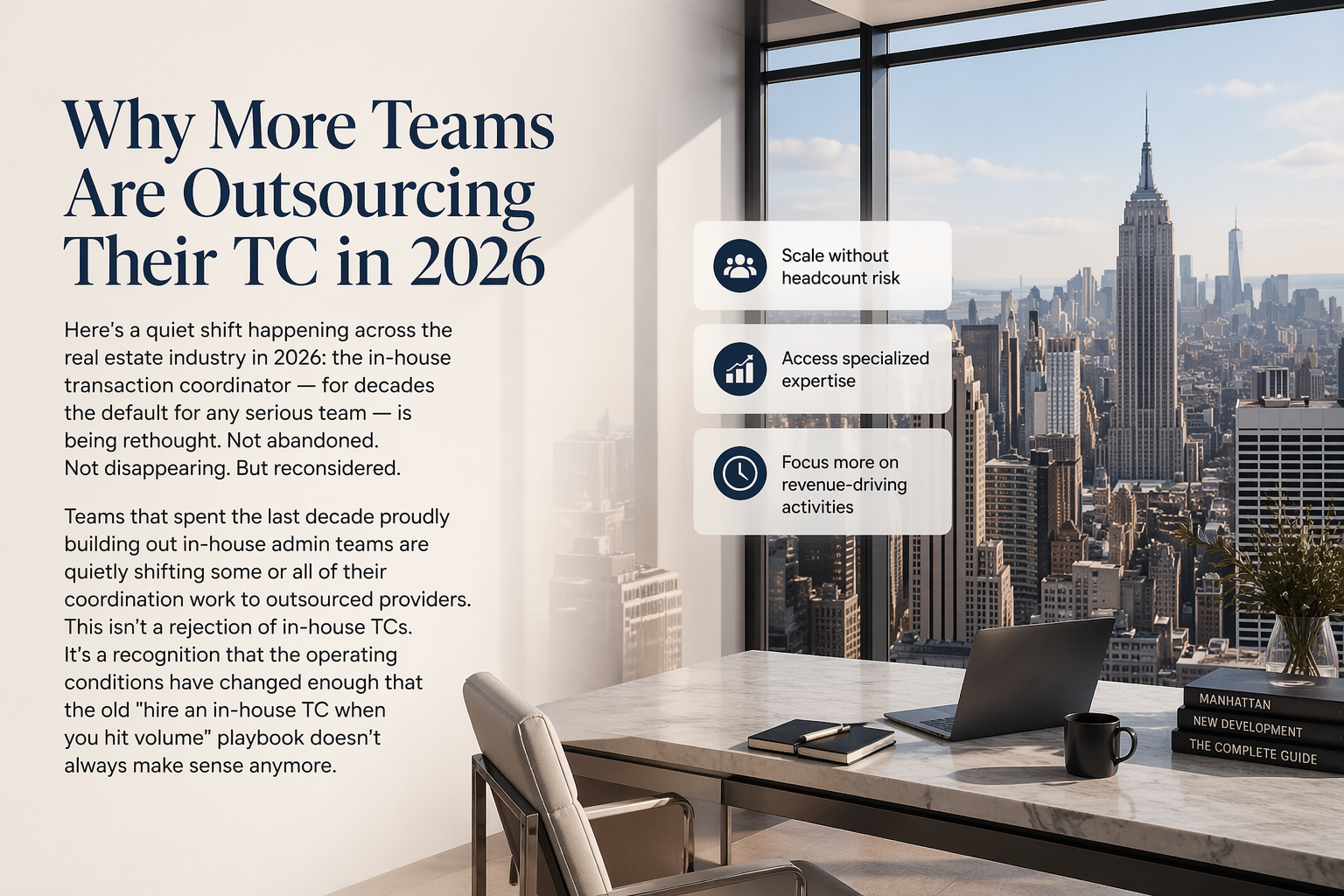
Here's a quiet shift happening across the real estate industry in 2026: the in-house transaction coordinator — for decades the default for any serious team — is being rethought.
Not abandoned. Not disappearing. But reconsidered. Teams that spent the last decade proudly building out in-house admin teams are quietly shifting some or all of their coordination work to outsourced providers. Brokerages that historically offered in-house TC services as a recruiting benefit are pointing agents to outside partners instead. New teams that a few years ago would have hired their first in-house TC as a matter of course are starting with outsourced providers from day one.
This isn't a rejection of in-house TCs. It's a recognition that the operating conditions have changed enough that the old "hire an in-house TC when you hit volume" playbook doesn't always make sense anymore. And the teams asking the question honestly — does our setup actually match our current reality? — are increasingly landing on outsourced as the better answer.
Here's what's driving the shift, what the data actually shows, and how teams should think about the decision in 2026.
The math has changed (quietly but decisively)
Start with the numbers, because they've moved more than most team leads realize.
In-house TC true cost (2026): Salary $40,000–$80,000 depending on market, plus 25–40% for benefits, payroll taxes, software, office space, and management overhead (Expert VA, 2026). True annual cost lands at $50,000–$120,000 per full-time TC. In the Northeast specifically — where salaries for skilled TCs in metro markets run higher — the upper end is the realistic baseline.
Outsourced flat-fee TC (2026): Typically $350–$550 per file nationally, or $400–$725 in the Northeast depending on state and complexity. An agent closing 5 files a month at $450 each spends $27,000/year. A team closing 15 files a month at $425 each spends $76,500/year.
The breakeven used to sit around 10–12 transactions per month. At that volume, a $50,000 in-house TC was cheaper than outsourcing at $400/file. This was the conventional wisdom for most of the last decade, and it was correct.
In 2026, the breakeven has shifted. True in-house costs have risen (higher salaries, benefits inflation, more expensive software stacks). Outsourced efficiency has improved (AI-assisted workflows allowing individual TCs to handle more files, volume discounts becoming more common). The crossover point is now closer to 20 transactions per month — and even at that volume, the non-cost factors often still favor outsourcing.
One industry guide made it explicit: "Many successful teams use an outsourced TC service as their baseline and only hire in-house when they consistently exceed 20 transactions per month for several consecutive quarters" (Expert VA, 2026). That's a meaningfully different threshold than the 10–12 deal rule that guided hiring decisions through 2022.
The seven forces driving the outsourcing shift
The math alone explains some of the movement. But several structural forces are accelerating the trend in 2026 in ways the raw numbers don't fully capture.
1. Backup coverage has become non-negotiable
The single biggest operational vulnerability of an in-house TC model is what happens when one person takes time off. An in-house TC who goes on vacation in July — peak season — leaves 10 to 15 active files with no designated coordinator. Who fills in? Usually the team lead, who's supposed to be selling. Or a junior admin who doesn't know the files. Or nobody, and things start slipping.
Outsourced providers solve this structurally. A dedicated-TC model with backup coverage on every file means there's always someone who knows the system even if the primary TC is out. One industry source describes the model: "When volume spikes or your TC needs a day off, a backup coordinator who already knows your systems steps in. This is the gap that burns teams who hire in-house" (Freedom RES).
Teams that have experienced the July vacation problem once rarely want to risk it again.
2. Volume elasticity matches team reality
Team volume fluctuates. January slow, spring busy, summer peak, fall steady, December slow. An in-house TC is paid the same in January as in July, whether they have 3 files or 23. That's expensive idle capacity in slow months and strained capacity in busy ones.
Outsourced flat-fee TCs scale with volume. You pay for 3 files in January and 23 in July, and both get handled well. For teams with seasonal or cyclical patterns — which is essentially every residential real estate team — the elasticity is significant. You stop subsidizing slow months and stop overloading busy ones.
3. Multi-state capability is harder to staff in-house
More Northeast agents are licensed across multiple states than ever — it's common for agents around the NY-NJ-PA border, around DC (MD-DE-VA), and around Philly (PA-NJ) to carry multiple state licenses. Teams operating in 2 or 3 states used to hire one in-house TC who "figured out" the other states. That gets messier every year as each state's compliance requirements expand.
A multi-state outsourced TC provider has staff trained across PA, NJ, NY, MD, CT, and DE from day one. Hiring a single in-house TC who can truly handle all six cleanly is rare and expensive. The outsourced model handles the multi-state complexity natively.
4. AI adoption favors outsourced providers
This is the less obvious force but arguably the most important. In 2026, TC productivity has bifurcated sharply based on AI adoption. TCs using AI-assisted contract intelligence, automated deadline calculation, and AI-drafted communication are handling 2–3x the transaction volume per coordinator compared to 2022 baselines (virtualworkforce.ai, 2026).
Outsourced providers have been faster to adopt these tools because they serve many clients and can amortize the cost of sophisticated tech stacks. An in-house TC at a mid-sized team is often working on whatever software the team already uses, not a specialized AI-enabled stack. Teams that hire in-house in 2026 often discover their outsourced competitors are running leaner operations with faster turnaround, because the outsourced team has tools the in-house TC doesn't.
5. Talent retention has gotten harder
Virtual TCs are 55% less likely to switch jobs than in-house TCs (AgentUp). This fact is worth dwelling on.
In-house TC roles in 2026 face real recruiting and retention challenges. The career ceiling for a salaried in-house TC at a residential team is limited. The best TCs — the ones with real expertise — often want to go independent or join specialized outsourced providers where they can handle more volume, earn more, and grow. Teams that hire in-house find themselves training TCs who leave for better opportunities within 12 to 24 months, then starting over. Outsourced providers absorb this turnover risk at the provider level, so the team doesn't feel it.
For team leads who've been through the cycle of hiring, training, and losing an in-house TC more than once, the value of outsourced stability becomes obvious.
6. Compliance expertise is harder to maintain in-house
The regulatory environment has expanded meaningfully since 2022. NAR settlement compliance, buyer-broker agreement handling, FinCEN entity reporting (as of March 2026), state-specific legislation, wire fraud prevention protocols, condo safety disclosure rules — a competent TC in 2026 has to stay current on a lot.
For an in-house TC at a mid-sized team, staying current on all of this while also running daily transaction work is genuinely hard. For an outsourced provider serving many teams, there's an incentive (and the scale) to maintain dedicated compliance expertise and push updates to every client automatically. Teams that move to outsourced providers often describe the experience as suddenly being on top of compliance they didn't even know they were missing.
7. Brokerages are stepping back from in-house TC services
A structural shift many agents don't fully register: brokerages that used to offer in-house TC services as a recruiting benefit are increasingly stepping back from this model. Some have eliminated in-house TC services entirely. Others have shifted to a "curated referral" model — the brokerage vets outside TC providers and points agents to them, but doesn't employ TCs directly.
The brokerage rationale is straightforward: running an in-house TC operation is operationally complex and carries real liability exposure. The risk-reward calculus has shifted. Letting agents pick their own outsourced TCs (from a pre-vetted list) is lower risk than being directly responsible for every file's compliance.
For team leads inside those brokerages, the practical effect is that "use the broker's TC" isn't always an option anymore. Outsourced is often the only path.
What the data shows about adoption
Several points worth noting from industry data:
50% of top-producing brokerages now use virtual/outsourced TCs, citing time and cost savings (AgentUp).
70% of real estate agents who partner with virtual TCs experience increased sales volume as a result.
Virtual workers are 4.4% more productive than in-house workers in comparable roles, according to broader workforce research cited in industry analysis.
Recruiting agency Level — Virtual Specialists — reported tripling their growth rate post-pandemic and maintaining double their pre-2020 hiring rate on an ongoing basis (Dotloop).
This isn't an emerging trend anymore. It's the settled direction of travel.
When in-house still wins (the honest counterpoint)
In-house TCs aren't going away, and there are specific scenarios where they're still the right choice:
1. Very high-volume teams with stable patterns. Teams consistently doing 25+ transactions/month with predictable volume can still make the in-house math work. At that scale, you're paying one salary instead of 25 outsourced fees per month, and the per-transaction math starts to favor in-house.
2. Teams with highly customized processes. Teams that have built deeply customized systems, unique client experience standards, or brand-specific workflows sometimes need an in-house TC steeped in their exact operation. If your team wins on operational differentiation, in-house can protect that.
3. Broker-owned operations with multiple TCs. Brokerages with enough agent volume to support a small TC team (4–6 coordinators) internally can sometimes run more economically than outsourcing. At that scale, you're effectively running your own mini-outsourced provider.
4. Teams requiring licensed activity from their TC. In some markets, TCs are licensed real estate professionals who can engage in certain licensed activities (like negotiating on behalf of clients). If your workflow depends on that, an in-house licensed TC may be the right fit.
5. Teams with branding or client-experience needs that demand in-house presence. Some luxury or concierge teams need their TC to show up at closings, attend team meetings in person, or present in-house at events. Outsourced TCs rarely do this.
If your team fits one of these scenarios, in-house may still be the right call. But for most teams — especially solo-to-mid-size operations, multi-state practices, and teams that experienced in-house coverage failures — outsourced is increasingly the obvious answer.
The hybrid model teams are landing on
Many teams in 2026 aren't making a binary choice. They're running hybrid models that combine the best of both worlds:
Outsourced as baseline, in-house as a manager. The team runs most of its files through an outsourced provider, but has one in-house operations manager who oversees the relationship, handles unusual files personally, and provides in-person team support. This hybrid gives teams the scalability and compliance expertise of outsourced with the cultural presence of in-house.
In-house for specific workflows, outsourced for the rest. Some teams keep an in-house TC for listing coordination (which is more brand-sensitive and process-specific) while outsourcing buyer-side transaction coordination. Or they keep in-house for luxury or complex deals and outsource standard residential.
In-house for a single state, outsourced for overflow. Multi-state teams sometimes keep an in-house TC who handles their core state well and contracts with an outsourced provider for the other states they work in occasionally.
These hybrid structures are becoming more common as teams realize the decision doesn't have to be all-or-nothing.
What team leads should actually evaluate
If you're a team lead considering the shift, four questions to work through honestly:
1. What's your true in-house TC cost? Salary plus 25–40% for benefits/overhead/software. Include management time supervising the TC. Include turnover costs averaged over 3–5 years. The sticker price is not the real number.
2. What's your actual monthly volume, and how seasonal is it? If your volume fluctuates meaningfully month to month, you're overpaying in slow periods and strained in busy ones with in-house. Outsourced scales naturally.
3. What happens when your in-house TC takes two weeks off? Be honest. If the answer is "the team lead covers it" or "things slip but we manage," that's operational risk you're absorbing. Outsourced providers eliminate this by design.
4. What compliance expertise does your team need, and how hard is it for one person to maintain? If you're working across multiple states, handling luxury or complex deals, or navigating post-NAR settlement requirements plus condo complexity plus wire fraud protocols, one in-house generalist often can't keep up. Outsourced providers specialize.
The team leads who work through these questions honestly usually come to the same conclusion: the conditions that made in-house the default in 2018 don't match the conditions teams actually operate in during 2026.
The Northeast specifically
A few regional considerations:
Higher in-house costs. Northeast TC salaries run meaningfully higher than national averages — $52,000–$85,000 range in NY, NJ, CT, and metro MD — which shifts the breakeven math further toward outsourced.
More multi-state teams. Northeast agents are disproportionately likely to work across state lines (NYC/NJ, Philly/NJ, DC/MD, NYC/CT). Outsourced providers with multi-state staff are a natural fit.
Attorney-state complexity. In NJ, NY, CT, and MD, attorney coordination is part of every transaction. An outsourced provider with daily attorney-coordination experience usually has smoother workflows than an in-house TC whose exposure is limited to one team's files.
Condo/co-op specialization. NYC co-ops and urban condos require specialty expertise that's hard to maintain in-house unless the team does only co-ops. Outsourced providers with dedicated condo/co-op specialists are increasingly valuable to Northeast teams.
The one-line summary
Teams are outsourcing their TC in 2026 because the conditions have shifted: in-house true costs have risen, outsourced efficiency has grown with AI adoption, backup coverage and volume elasticity now matter more than they used to, compliance expertise is harder to maintain in one person, and multi-state complexity has made specialist providers more valuable than generalist employees. The breakeven volume for in-house hiring has moved from ~10 deals/month to ~20 deals/month, and even above that, the non-cost factors often favor outsourced. This isn't a rejection of in-house TCs. It's a recognition that the 2018 playbook doesn't match 2026 reality.
Frequently Asked Questions
When does it still make sense for a team to hire an in-house TC?
Generally when the team consistently exceeds 20 transactions per month for multiple quarters (Expert VA, 2026), has highly customized workflows that require a deeply integrated in-house presence, needs licensed activity from their TC, or has luxury/concierge client standards that require in-person TC involvement at closings and team events.
What's the real cost difference between in-house and outsourced for a team?
For a team doing 10–15 transactions/month in the Northeast: in-house true cost is roughly $70,000–$110,000/year once benefits, overhead, and software are included. Outsourced flat-fee at $450/file for 12 files/month is $64,800/year. At 15 files/month it's $81,000. Outsourced is typically cheaper through roughly 20 files/month, and the non-cost factors (backup coverage, scalability, compliance expertise) often favor outsourced even above that threshold.
What happens when an in-house TC takes time off?
This is one of the biggest operational weaknesses of the in-house model. Without designated backup coverage, active files often get neglected, deadlines slip, and the team lead ends up absorbing admin work during the TC's absence. Outsourced providers with dedicated-TC plus backup models solve this structurally — there's always someone trained in your files.
Are outsourced TCs using better technology than in-house TCs?
Often, yes. Outsourced providers amortize tech spending across many clients, which lets them invest in AI-assisted contract intelligence, automated deadline calculation, secure portals, and specialized transaction management platforms that smaller teams can't justify in-house. AI-enabled TCs are handling 2–3x the volume of their 2022 counterparts, and outsourced providers have led this adoption curve.
How does outsourcing affect client experience?
Done well, it improves it. 95% of clients report feeling more confident when a TC is involved in the process (AgentUp), and dedicated outsourced TCs provide consistent communication and updates throughout the deal. Done poorly — rotating TCs, no backup, inconsistent communication — outsourcing can hurt client experience. The key is choosing an outsourced provider with a dedicated-TC model rather than a rotating-pool model.
Is the outsourcing trend specific to small teams?
No. 50% of top-producing brokerages now use virtual/outsourced TCs (AgentUp). The trend runs across team sizes. Small teams outsource for cost reasons; large teams often outsource for scalability and compliance reasons. Many large brokerages now run hybrid models with some in-house and some outsourced.
What's the biggest risk of outsourcing TC work?
Loss of brand consistency and cultural integration. Outsourced TCs often don't use the team's branding, email address, or customized workflows. For teams that win on a highly differentiated client experience, this can matter. The mitigation: choose an outsourced provider that offers dedicated TCs (not rotating pools) and take the time to integrate them into your team's standards upfront.
Can we run a hybrid model?
Yes, and many successful teams do. Common hybrids: outsourced baseline with one in-house operations manager; in-house for listing coordination with outsourced for buyer-side transactions; in-house for your core state with outsourced for secondary states. The hybrid structure lets teams capture the efficiency of outsourced while keeping the cultural presence of in-house where it matters most.
How do we evaluate an outsourced TC provider?
Five questions: (1) Do they offer dedicated TCs or rotating pools? (Dedicated is much better.) (2) What backup coverage model do they use? (3) What states do they actually specialize in? (4) What technology stack do their TCs use? (5) How do they handle compliance, particularly post-NAR settlement and state-specific rules? Vague answers on any of these are a red flag.
Should we migrate mid-year or wait for year-end?
Mid-year can work but requires careful file migration. The cleanest approach is to keep existing in-house TCs on existing active files through closing while starting new files with the outsourced provider. That gives you a clean break without mid-transaction handoffs. Budget 60–90 days for a smooth transition.
How do agents on the team feel about outsourcing?
Initially mixed, usually positive within 90 days. Some agents resist the change because they've built relationships with the in-house TC. Most adjust quickly once they see the responsiveness, consistency, and backup coverage of a good outsourced operation. The teams that manage the transition best communicate early and explicitly with agents about why the shift is happening.
What do brokerages think about teams outsourcing?
Most are neutral-to-supportive in 2026. Many brokerages have stepped back from in-house TC operations themselves and actively curate lists of vetted outsourced providers for their agents. A decade ago, outsourcing might have been seen as unusual; in 2026, it's the industry norm.
Considering outsourcing your team's TC operation? Signed to Keys runs dedicated-TC models with backup coverage across PA, NJ, NY, MD, CT, and DE — built specifically for Northeast teams navigating attorney-state complexity, multi-state licensure, and post-NAR-settlement compliance. Request a free 30-minute consultation and we'll walk through what a team outsourcing transition would actually look like for your operation.