A Complete Contract-to-Close Timeline for First-Time Agents
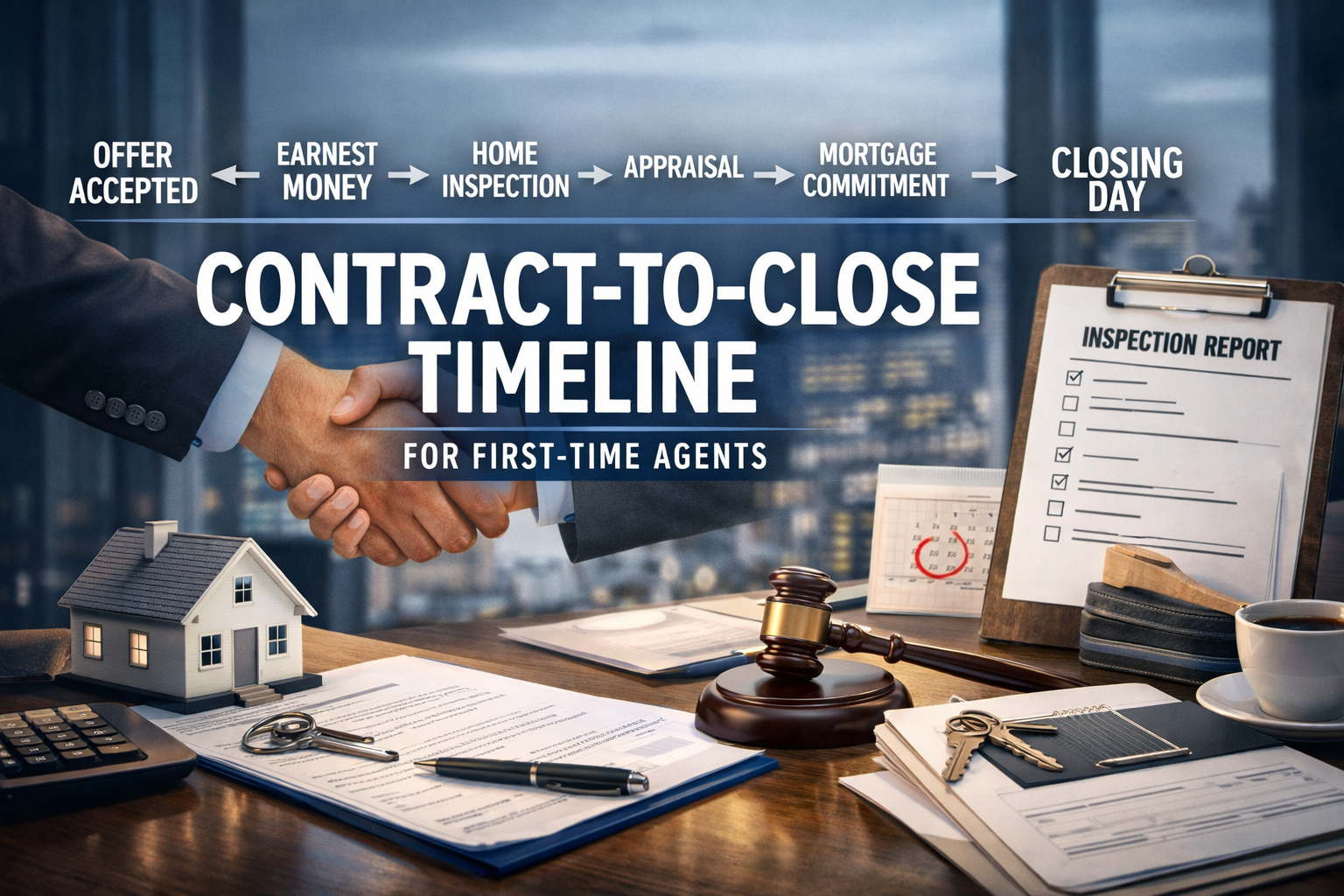
You just got the text every new agent dreams about: "Offer accepted."
Then the second text comes in from your broker: "Great — make sure EMD is in by Thursday, inspection is scheduled within the contingency window, and you've got the mortgage commitment date locked down. Oh, and don't forget the municipal certs."
Wait. What?
If you're a first-time agent staring down your first contract-to-close timeline, the gap between "offer accepted" and "keys in hand" can feel like one giant blur of deadlines you didn't know existed. The good news: the transaction has a shape. It's not random, and once you learn the rhythm, you'll run every file the same way.
Here's the complete timeline — what happens when, why each step matters, and where first-time agents most commonly drop the ball.
How long does a typical contract-to-close actually take?
For a financed residential purchase, the national average sits right around 41 to 42 days from executed contract to closing as of 2025 (Rocket Mortgage; HomeLight). The realistic range is 30 to 60 days, with most conventional loans landing right around the 45-day mark (DeFalco Realty).
A few important caveats:
Cash deals can close in as little as 10 to 14 days because there's no mortgage underwriting to wait on (DeFalco Realty).
FHA and VA loans typically run 45 to 60 days due to additional documentation and appraisal requirements.
Northeast transactions (NY and NJ especially) regularly stretch to 60 to 90 days because of attorney involvement, attorney review windows, and local title customs (DeFalco Realty, 2026).
Complicated files — entity purchases, probate sales, short sales, multi-family properties with tenants — can take longer regardless of state.
Across the states Signed to Keys serves — PA, NJ, NY, MD, CT, and DE — expect most financed deals to take 45 to 60 days, cash deals to close in 2 to 4 weeks, and NJ deals to run slightly longer because of the mandatory three-business-day attorney review period before the contract becomes legally binding.
Now, the timeline itself.
Phase 1 — Days 1 through 3: Contract Execution
The clock starts the moment both parties sign the purchase agreement. The next 72 hours are where organized agents separate themselves from disorganized ones — because everything you do (or fail to do) here ripples through the next 40 days.
What happens:
The fully executed contract is distributed to all parties — buyer, seller, both agents, attorneys (if applicable), lender, and title company.
The earnest money deposit (EMD) needs to hit escrow within the timeframe specified in the contract, typically 3 to 5 business days (Chissell Mortgage). Miss this deadline and the seller has legal grounds to void the contract.
Intro emails go out — you or your TC reaches out to the cooperating agent, lender, title company, and attorneys to introduce yourself and confirm contact info.
Every deadline in the contract gets logged into a calendar or transaction management system. This includes inspection, financing, appraisal, title, and closing dates.
In New Jersey, the three-business-day attorney review period begins the first business day after both parties receive the fully signed contract. Either attorney can disapprove the contract for any reason within that window (NJ Closing Guide; Conley v. Guerrero, 228 N.J. 339 (2017)).
In New York, the contract negotiation actually happens through attorneys before signing — so by the time the deal is signed, review is effectively complete (DeFalco Realty).
Where first-time agents drop the ball: Missing the EMD deadline. Forgetting to send intro emails to the lender or title company (which then delays everything downstream). Trusting their memory instead of logging deadlines in a system. Not reading the contract carefully enough to catch a non-standard contingency period the other side slipped in.
Phase 2 — Days 4 through 14: Due Diligence
This is the buyer's window to investigate the property and confirm they actually want to go through with the deal. Most of the action in the first two weeks happens here.
What happens:
Home inspection is scheduled and performed, typically within 5 to 15 business days of contract execution (HomeLight). The inspector is at the property for 2 to 4 hours, and the written report is usually ready the next day.
Inspection response and negotiation. The buyer's agent delivers a request for repairs, credits, or a price reduction. The listing side responds. This back-and-forth typically wraps up within 3 to 5 business days after the inspection.
Mortgage application is formally submitted (if the buyer didn't do it at preapproval).
HOA or condo documents are ordered for any property in an association. These can take 7 to 14 days to arrive depending on the management company, so order them early.
Title is ordered by the buyer's attorney or title company.
In NJ, attorney review typically wraps up within 3 to 7 business days — standard residential review concludes in that window, though it can extend to a week or more if negotiations are complex (KEJ Law).
Where first-time agents drop the ball: Not ordering HOA/condo docs early enough, which causes a scramble at the end. Letting inspection negotiations drag on without a deadline. Forgetting to confirm the lender has the fully executed contract so underwriting can actually start.
Phase 3 — Days 15 through 30: Loan Processing and Appraisal
This is the longest and most opaque phase of the transaction. The buyer submits documents to underwriting, the lender orders the appraisal, and for two to three weeks it can feel like nothing is visibly happening. It's also where the most closings get delayed.
What happens:
The lender orders the appraisal. The appraiser physically inspects the home and compares it to recent comparable sales. This takes 1 to 2 weeks depending on appraiser availability in the market.
Underwriting reviews the buyer's file — income, assets, credit, employment verification. This is where most delays occur because lenders frequently request additional documentation (DeFalco Realty, 2026).
The appraisal comes back. If it's at or above the purchase price, you're fine. If it's low, the buyer and seller renegotiate, the buyer brings more cash, or the deal gets restructured.
The mortgage commitment letter is issued. This is a conditional approval stating the lender will fund if certain final conditions are met. Most contracts give the buyer 30 to 45 days from the contract date to secure this (DeFalco Realty).
Title search results come back. Any liens, judgments, or clouds on title need to be cleared before closing.
Seller-side certifications are ordered — water, sewer, trash, electric, municipal use and occupancy (U&O), smoke detector certifications. These vary by state and municipality.
Where first-time agents drop the ball: Not staying on top of the mortgage commitment deadline. The mortgage contingency is usually the buyer's last safety net — if the commitment isn't secured by the deadline, the buyer has the right to cancel and get their deposit back, but only if proper written notice is given. Miss the window, and the contingency can expire.
Phase 4 — Days 31 through 40: Clear to Close and Pre-Closing Prep
You've made it through underwriting. Now it's a sprint to the finish line.
What happens:
The lender issues "clear to close" — meaning underwriting has approved everything and the loan is ready to fund.
The Closing Disclosure (CD) is issued. Federal law requires the buyer to receive this at least 3 business days before closing (Rocket Mortgage).
Settlement is scheduled with the title company or closing attorney.
The preliminary ALTA (settlement statement) is reviewed by both sides. This is your chance to catch math errors, wrong commission splits, or misallocated transfer taxes before closing day.
Final walkthrough is scheduled, usually within 24 to 48 hours before closing.
The buyer wires closing funds or arranges a cashier's check.
Homeowners insurance is bound for the property.
Where first-time agents drop the ball: Not reviewing the ALTA carefully. Not confirming the buyer has a paid-up insurance policy before closing. Scheduling the final walkthrough too close to closing (leaving no room to resolve issues).
Phase 5 — Closing Day
The big day. Here's what actually happens:
Final walkthrough (if it wasn't the day before).
The buyer signs closing documents — anywhere from 40 to 100 signatures depending on the loan type and state.
Funds are wired and disbursed to the seller, the seller's lender (to pay off any existing mortgage), both brokerages, and anyone else entitled to proceeds.
The deed is recorded with the county (same-day in most states, next-day in others).
Keys change hands.
Total closing day timing: usually 30 to 90 minutes for the actual signing appointment, though the disbursement and recording can happen the same day or the next business day depending on how late the signing occurs.
Phase 6 — Post-Closing (the part nobody teaches you)
The transaction isn't actually over on closing day. A few things need to happen in the days after:
Recording confirmation. Confirm the deed was recorded. Request the recorded deed for your client's records.
Final document delivery. Send the fully executed closing package to the client, your broker (for compliance), and anyone else who needs it.
Compliance file closeout. Your broker needs the full file for audit purposes. Most brokerages give you 5 to 15 days post-closing to complete this.
Client follow-up. A closing gift, a request for a testimonial while they're still excited, and a CRM update moving them to "past client" for long-term nurture.
Skip this phase and you're leaving referrals on the table.
Where most first-time agents lose time (and commission)
The single biggest driver of closing delays across every state is lender responsiveness — buyers slow to send requested documents, lenders slow to issue commitments, appraisals slow to schedule (DeFalco Realty). The second biggest driver is appraisal issues: roughly 20% of delayed closings come down to the appraisal coming in low or scheduling backlogs pushing the appointment out (ListedKit).
You can't fully control either of those. But you can control:
How fast you log deadlines. A deadline you don't see is a deadline you'll miss.
How proactively you follow up. Weekly check-ins with the lender are the difference between finding out about a commitment issue on Day 25 versus Day 40.
How early you order documents. HOA docs, municipal certs, title searches — order them as soon as attorney review ends (or immediately in non-NJ states).
How cleanly your file is organized. When a document is missing, the question isn't whether it exists — it's whether you can find it in the next 20 minutes.
This is the exact cognitive load a transaction coordinator is built to carry. Agents who use a TC save an average of 10 to 20 hours per transaction and close more deals per month than those who don't, in part because the TC is the one watching the calendar while the agent is out generating new business (AgentUp).
The one-page version
If you only take one thing away from this post, make it the rhythm:
Days 1–3: Contract distribution, EMD deposit, intro emails, deadlines logged, attorney review (NJ).
Days 4–14: Inspection, negotiation, mortgage application, HOA docs, title ordered.
Days 15–30: Appraisal, underwriting, mortgage commitment, certifications ordered.
Days 31–40: Clear to close, CD issued, ALTA reviewed, final walkthrough scheduled.
Closing day: Signing, funding, recording, keys.
Post-closing: Recording confirmation, compliance file, client follow-up.
Every deal has its own hiccups. But the shape of the transaction is the same almost every time. Once you internalize the rhythm, you stop reacting to your pipeline and start managing it.
Frequently Asked Questions
How long does a typical contract-to-close take?
For a financed residential purchase, the national average is about 41 to 42 days from executed contract to closing day (Rocket Mortgage). Most deals fall in the 30 to 60 day range. Cash deals can close in 10 to 14 days, while Northeast transactions involving attorney review (especially in NY and NJ) can stretch to 60 to 90 days.
What's the first thing I should do after a contract is fully executed?
Two things, in parallel. First, log every deadline from the contract into a calendar or transaction management system — inspection, financing, appraisal, title, closing. Second, send introduction emails to the cooperating agent, lender, title company, and attorneys so everyone is connected and knows who to contact. Both should happen the same day the contract is executed.
When does the earnest money deposit need to be delivered?
Whatever the contract specifies — typically within 3 to 5 business days of the executed contract (Chissell Mortgage). Missing this deadline gives the seller grounds to void the contract, so it's the first deadline you need to track.
What's attorney review and when does it apply?
Attorney review is a mandatory three-business-day window in New Jersey where either party's attorney can approve, disapprove, or modify a realtor-prepared contract. It begins the first business day after both parties receive the fully executed contract and is required by NJ law for standard realtor-prepared residential contracts (NJ Closing Guide). NY doesn't have a formal statutory review period but handles contract negotiation through attorneys before signing. PA, MD, CT, and DE don't have a formal attorney review step.
How long does the home inspection contingency period usually last?
Typically 5 to 15 business days from contract execution, depending on what's negotiated (HomeLight). The inspection itself takes 2 to 4 hours, and the report is usually available the next day. Inspection response negotiations usually wrap up within 3 to 5 business days after the report is delivered.
What's the difference between an appraisal and a home inspection?
A home inspection is for the buyer's benefit — it identifies the physical condition of the property, including any issues or defects. An appraisal is for the lender's benefit — it determines whether the property is worth what the buyer agreed to pay, which protects the lender's collateral. Both typically happen in the first 2 to 3 weeks of the transaction.
When does the mortgage commitment need to be issued?
Most contracts give the buyer 30 to 45 days from the contract date to secure mortgage commitment (DeFalco Realty). This is one of the most important deadlines in the transaction — if commitment isn't secured by the deadline, the mortgage contingency allows the buyer to cancel and get their deposit back, but only if the right notice is given in writing.
What happens if the appraisal comes in low?
The buyer and seller have a few options: renegotiate the purchase price down, have the buyer bring additional cash to bridge the gap, dispute the appraisal with comparable sales, or (in some cases) cancel the deal under the appraisal contingency. Appraisal issues account for roughly 20% of delayed closings (ListedKit).
What's the Closing Disclosure and why does the 3-day rule matter?
The Closing Disclosure (CD) is a federally required document that shows the buyer's final loan terms, fees, and closing costs. Federal law requires the buyer to receive it at least 3 business days before closing (Rocket Mortgage). If material changes happen after the CD is issued, the 3-day clock can reset — which can push closing back. This is why lenders try hard to get everything finalized before the CD goes out.
What certifications do I need to worry about on the seller side?
It depends on the state and municipality, but common ones include:
PA: Municipal use and occupancy (U&O) certificate
NJ: Certificate of Occupancy (CO) / Continued Occupancy (CCO), smoke and carbon monoxide certification, water and sewer certifications
NY: Smoke and CO detector affidavits, transfer tax forms (TP-584, RP-5217)
MD: Smoke detector affidavit, water bill payoff, HOA disclosure
CT: Conveyance tax forms, smoke and CO certifications
DE: Realty transfer tax forms, municipal certifications where applicable
Order these as early as possible — some take 1 to 3 weeks to turn around.
Do I attend the closing as the agent?
In most cases, yes — especially when you're new. Attending gives you a chance to support your client, catch any last-minute issues, and mark the moment (great time for a photo and a closing gift). In some states, closings are handled by attorneys and agents may not be required to attend, but showing up is almost always a better look than not showing up.
What should I do immediately after closing?
Three things: confirm the deed was recorded, send the closing package to your broker for compliance, and follow up with your client. A same-day thank-you message and a closing gift delivered that week are the small touches that turn a one-time transaction into a long-term referral source. And update your CRM — future you will thank present you.
Want the one-page version of this timeline as a reference you can send your buyers (or tape next to your monitor)? Signed to Keys runs this exact workflow on every file we handle across PA, NJ, NY, MD, CT, and DE. Request a free 30-minute consultation and we can walk through what the timeline looks like for your specific market.