Why Secure Client Portals Are Not Optional Anymore
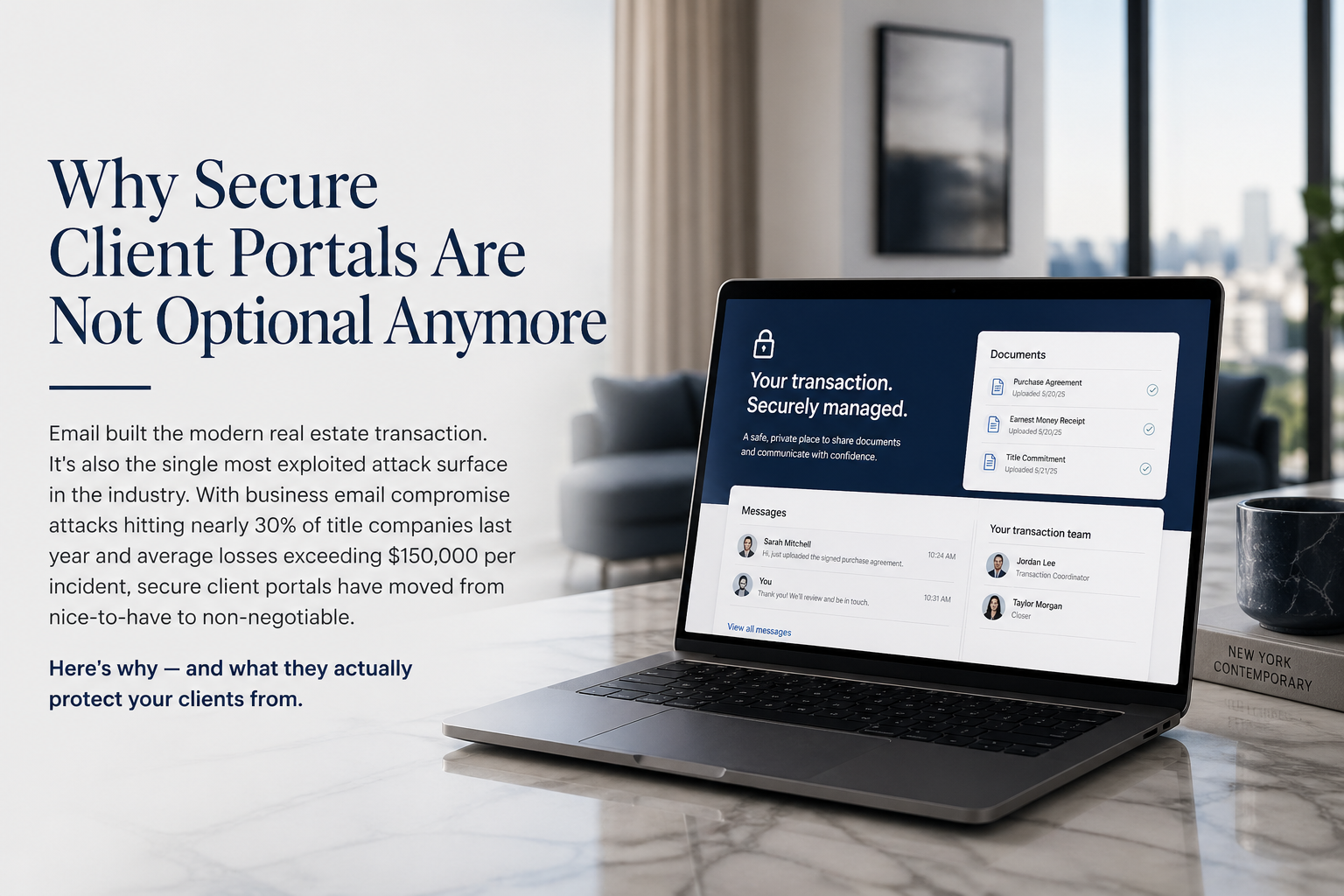
The Most Dangerous Tool in Real Estate Is the One Every Agent Uses Every Day
Email built the modern real estate transaction. It's how contracts get forwarded, how timelines get communicated, how agents stay in touch with title companies and lenders and attorneys across 30, 60, sometimes 90 days of a single deal. It's fast. It's familiar. Every party already uses it.
It's also the single most exploited attack surface in all of real estate.
Perpetrators of business email compromise in the real estate sector obtain unauthorized access to networks and systems to misappropriate confidential and proprietary information. The sector remains a target for these attacks because of the high monetary values generally associated with real estate transactions and the various communications between entities involved. FinCEN
In real estate, the average business email compromise incident results in losses of $150,000 to $200,000. Nearly 30% of title companies experienced an attempted BEC attack in the last year. Stewart
The problem is not that agents are careless. The problem is that email — standard, unencrypted, open email — was never built to handle the kind of sensitive financial communications that happen in a real estate transaction. And fraudsters have spent years figuring out how to exploit exactly that gap.
A secure client portal closes that gap. And at this point, given the scale and sophistication of what agents and their clients are up against, it is no longer a feature worth considering. It is a baseline requirement.
What a Secure Client Portal Actually Is
Before making the case for why this matters, it's worth being clear about what a secure client portal is — and what it isn't.
A secure client portal is a dedicated, encrypted digital environment where all parties in a transaction can access documents, receive updates, review timelines, and communicate — without relying on standard email as the primary channel. It requires verified login, often with multi-factor authentication. It keeps a complete audit trail of every action taken. It controls who can see what, and when.
A real estate client portal is a digital platform that keeps a transaction's details all in one system. It allows clients to see where they are in the home buying or selling process, and see where changes, updates, or new tasks are located, as opposed to tracking and updating clients through text or email. Trackxi
The best secure client portals in 2025 need to have capabilities in three important areas: security, workflow automation, and the client experience. This includes multi-factor authentication, end-to-end encryption where documents and messages are encrypted with only authorized users allowed access, role-based permissions that control who sees what, and audit trails that track every action for compliance and accountability. Moxo
This is categorically different from sending documents through Gmail or sharing files in a Dropbox folder. Those tools were not designed for real estate transactions. They leave sensitive financial information exposed, they have no transaction-level audit trail, and they do nothing to interrupt the most common fraud attack vector: a spoofed or compromised email.
Why Email Alone Is No Longer Safe Enough
The argument for email in real estate has always been convenience. Everyone has it. It's fast. It works across platforms. For many agents, it has been the invisible infrastructure of their entire business.
But convenience is exactly what fraudsters count on.
In a BEC scam, criminals send an email message that appears to come from a known source making a legitimate request. A homebuyer receives a message from his title company with instructions on how to wire his down payment. Versions of these scenarios happened to real victims — and in each case, thousands, or even hundreds of thousands of dollars were sent to criminals instead. FBI
The reason email is such an effective attack vector is structural. Standard email is not encrypted end-to-end. It passes through multiple servers on its way from sender to recipient, any of which can be intercepted. Email display names are easily spoofed — a fraudster can make their message appear in a recipient's inbox under the exact name of a trusted party, while the actual sending address is something entirely different. And once a fraudster gains access to one inbox in a transaction chain, they can read every email, learn every detail, and wait for the precise moment to strike.
The median dwell time before an attacker initiates a fraudulent action after inbox compromise is five days. Less than 8% of incidents are discovered through technical controls — most are uncovered through reconciliation or third-party notification. Palo Alto Networks
That means in the majority of cases, no technical safeguard flags the intrusion. The first indication something is wrong is when a client calls and says they wired their money somewhere and the title company never received it.
Once a BEC perpetrator gains access to a participant's email account involved in a real estate transaction, they are able to monitor the real estate proceeding and often time the fraudulent request for a change in payment type — frequently from check to wire transfer — or a change from one bank account to a different bank account under their control. Fraudulent funds may also be transferred to a secondary domestic or international account. FBI
Email, by design, allows all of this to happen. A secure portal, by design, prevents most of it.
What a Secure Portal Actually Prevents
The shift from open email to a secure portal doesn't just add a layer of encryption. It fundamentally changes the attack surface available to fraudsters.
It eliminates the spoofed email as an entry point
When all transaction communications happen inside an authenticated portal — where every user must log in with verified credentials, often with multi-factor authentication — a fraudster cannot simply send a spoofed email that lands in a buyer's inbox alongside legitimate messages. The communication channel is closed. Any message that arrives outside the portal claiming to be from the title company, the coordinator, or the lender can be immediately treated with suspicion, because the client already knows: legitimate communications come through the portal.
A portal that enforces multi-factor authentication, encryption at rest and in transit, and SOC 2 controls significantly narrows the fraud window that email leaves open. Moxo
It creates one verified point of contact
One of the most disorienting aspects of a real estate transaction for buyers, especially first-time buyers, is that they receive communications from multiple parties over weeks: the agent, the TC, the title company, the lender, the attorney. When all of these relationships and all of their messages exist in scattered email threads, it becomes genuinely difficult to know who to trust when a new, unexpected message arrives.
A portal collapses that complexity into one verified environment. Every party a buyer or seller will hear from is established in the portal at the start of the transaction. Anything that arrives outside of it is immediately questionable.
It maintains a complete, tamper-proof audit trail
Audit trails that track every action for compliance and accountability are a core feature of secure portals. This matters not just for fraud prevention, but for the transaction itself. If a dispute arises about when a document was received, when an instruction was sent, or what was communicated to which party at what stage of the deal, the portal provides an authoritative record. Scattered email threads do not. Moxo
It removes sensitive documents from open email entirely
Contracts, closing disclosures, HOA documents, title commitments, inspection reports — these are the documents that fraudsters mine for transaction details when they gain access to an email account. When those documents live in a secure portal rather than in email attachments, a compromised inbox yields far less usable intelligence.
A client portal provides secure access to important transaction documents such as reports, disclosures, and contracts, with real-time status of milestones as completed or pending. Trackxi
The Client Experience Argument Is Just as Compelling as the Security Argument
Fraud prevention often drives the conversation around secure portals — and rightly so. But it would be incomplete to treat security as the only reason this matters, because the client experience case is equally strong.
According to a recent NAR survey, over 60% of buyers and sellers say they want more visibility into their transaction progress. Brokerages that deliver transparency will win client trust and referrals. Those that don't will look disorganized, even if their back office is solid. My Broker Cloud
Think about what it looks like from the buyer's perspective when their transaction is run entirely through email. They receive messages from multiple people they've just met, about a process they don't fully understand, regarding the largest financial transaction of their life. They have no way to easily see where things stand. They have no organized view of what has happened and what comes next. They have to search through their inbox to find the right document when they need it.
This creates anxiety. And anxious buyers call their agents repeatedly with the same questions — questions that consume time and attention that agents need for new business.
One coordinator once fielded six calls in a single day from different parties on the same file. A portal eliminates these repeat questions. Clients can log in and see where things stand without anyone having to call. My Broker Cloud
Brokerages that centralize milestones inside a portal cut deal cycle time by as much as 50% according to workflow studies. Digital tools lift client satisfaction scores by 27% on average, outperforming analogue processes. Moxo
The agent who runs every transaction through a secure portal isn't just protecting clients from fraud. They're delivering a demonstrably better experience that generates more referrals, fewer repeat questions, and stronger reviews. In a business driven almost entirely by word of mouth, that is a meaningful competitive advantage.
The Benchmark Has Shifted — Clients Are Starting to Expect This
There was a time when online banking felt like a premium offering. Then it became expected. Then it became the default. Clients who had to call the bank to check their balance started to question why they were still banking there.
The same shift is underway in real estate.
Would you trust a bank without online banking? A doctor without a patient portal? Soon, clients will feel the same about brokerages without a portal. Research from Harvard Business Review shows companies that invest in customer experience earn higher loyalty and referrals — exactly what a client portal supports. My Broker Cloud
95% of businesses see rising demand for online self-service, with clients using portals to access information instantly. Businesses competing on service quality need differentiated client experiences. Moxo
For agents in competitive Northeast markets — New York, New Jersey, Pennsylvania, Maryland — this shift is already happening. Buyers and sellers who have worked with forward-thinking agents or used well-run title companies have experienced the portal difference. When they meet an agent who runs everything through email threads and text chains, the contrast is noticeable.
Buyers and sellers expect remote closings, electronic signatures, and instant updates. A strong transaction management system makes it easy to handle documents, signatures, and tasks securely online so you can meet clients wherever they are. Form Simplicity
What Happens When Agents Don't Make This Shift
The absence of a secure portal isn't a neutral choice. It is an active risk that sits in every transaction.
Without a dedicated client portal, agents face poor client experience because clients expect convenience and transparency throughout the real estate transaction process. They face inefficient workflow management because manual administration based on spreadsheets or email is extremely prone to errors. And they face competitive disadvantage because competitors are already using modern technology solutions. Content Snare
Beyond the competitive disadvantage, there is a legal dimension that is receiving increasing attention. When a client suffers a wire fraud loss and investigates how it happened, the question of whether the agent used reasonable measures to protect sensitive communications will inevitably come up. Using open, unencrypted email to transmit wire instructions, contract details, and closing timelines — when secure alternatives exist and are widely available — is a harder position to defend than it was five years ago.
The innocent parties of BEC fraud scams are forced into the unfortunate position of not only losing money to the fraudster but also having to determine legally which party should bear the loss. The payor may sue the intended payee seeking to recoup the lost funds under theories including negligence — failure to warn or protect from fraud, failure to secure network or email systems, and failure to train employees to detect and report phishing. Cowles & Thompson PC
This is not hypothetical. These lawsuits exist. And as the industry standard for transaction security rises, the bar for what constitutes reasonable protection rises with it.
What to Look for in a Secure Portal
Not every platform marketed as a "client portal" provides meaningful security. When evaluating options — whether as part of a transaction coordination service or as a standalone tool — the following are non-negotiable:
Verified login with multi-factor authentication. Every user who accesses the portal should have to verify their identity through more than just a password. This is the first and most important barrier against unauthorized access.
End-to-end encryption. Documents and messages should be encrypted both in transit and at rest, meaning that even if someone intercepts the data, it is unreadable without the decryption key tied to an authorized account.
Role-based access controls. The buyer should see what the buyer needs to see. The lender should see what the lender needs to see. Not every party needs access to every document. A well-designed portal enforces these boundaries automatically.
A complete audit trail. Every login, every document view, every message sent should be logged with a timestamp. This is essential for both compliance purposes and for fraud investigation if something goes wrong.
One centralized communication thread per transaction. The value of a portal is undermined if parties can still communicate outside of it on sensitive matters. Look for a system that consolidates transaction communication in one place, so that anything arriving through email can be immediately recognized as outside the expected channel.
How Secure Portals Fit Into a Professional Transaction Coordination Process
A secure portal is not a standalone product. It is most effective when it is embedded into a professional coordination process — one where every party is introduced to the portal at the start of the transaction, where the rules of communication are established clearly, and where there is a single, dedicated coordinator who manages the environment.
Online client portals provide a secure platform for clients to access transaction documents, communicate with their TC, and track the progress of their transactions. By embracing technology and focusing on personalized communication, real estate transaction coordination creates more satisfying client experiences, fostering long-term relationships and referrals. AgentUp
The portal alone doesn't protect anyone if the process around it is inconsistent. An agent who uses a portal but still occasionally sends wire instructions through email, or who allows lenders to share documents through text chains, has a security environment full of holes.
Professional transaction coordinators who build their entire process around a secure portal — establishing every party's access at file opening, routing all sensitive communications through it, and maintaining one verified contact for every party — create an environment where fraud is dramatically harder to execute. There are no stray email chains for fraudsters to monitor. There are no spoofed messages that will land alongside legitimate ones. There is one channel, verified and controlled, from start to close.
Transactions managed by a TC have 80% fewer errors and delays. A transaction coordinator saves an agent an average of 10 to 20 hours per transaction. When that TC is running their process through a secure portal, those efficiency gains come with a security layer that protects everything the agent has built — and everything their client has saved. AgentUp
The Answer to "Is This Really Necessary?" Is Yes
There will be agents who read this and think: I've closed hundreds of transactions over email and nothing has gone wrong. That logic deserves a direct response.
Wire fraud targeting real estate is not a random event. It targets specific transactions, at specific moments, chosen from public data. The fact that a fraud attempt hasn't happened yet doesn't mean the environment is safe — it means it hasn't been targeted yet. Nearly 30% of title companies experienced an attempted BEC attack in the last year. That number isn't declining. Stewart
A client portal isn't optional anymore. It's the bridge between your back office and your client's peace of mind. My Broker Cloud
Protecting a client's life savings from fraud is not a premium service offering. It is a professional obligation. And in 2025, meeting that obligation means moving sensitive transaction communications out of open email and into an environment built to keep them secure.
Work With a Transaction Coordinator Who Has Secure Communication Built In From Day One
At Signed to Keys, every transaction runs through a secure client portal with one dedicated, vetted point of contact. We establish verified access for every party at the start of every file. We never send or accept wire instruction changes through email. And we keep your clients informed, organized, and protected — from the moment the contract is signed to the moment they get their keys.
We serve real estate agents across Pennsylvania, New Jersey, New York, Maryland, Connecticut, and Delaware.
If you're ready to run your transactions through a process that protects your clients and gives you back your time, let's talk.
Request Your Free Consultation → signedtokeys.com
No obligation. No long-term commitment. Just 30 minutes to find out whether we're the right fit for your business.
Frequently Asked Questions
What is a secure client portal in real estate?
A secure client portal is an encrypted, login-protected digital environment where all parties in a transaction — buyers, sellers, agents, title companies, lenders, and attorneys — can access documents, receive updates, communicate, and track milestone progress without relying on standard open email. Unlike email, a portal requires verified identity to access, maintains a complete audit trail, and controls who sees which documents at which stage of the transaction.
Why isn't email secure enough for real estate transactions?
Standard email is not end-to-end encrypted, passes through multiple servers where it can be intercepted, and allows display names to be spoofed so a fraudulent message appears to come from a trusted contact. When a fraudster gains access to one inbox in a transaction chain, they can read every email, learn every detail of the deal, and send convincing fraudulent wire instructions that are nearly indistinguishable from the real thing. A secure portal closes most of these vulnerabilities by design.
How does a secure portal prevent wire fraud specifically?
When all transaction communications route through a portal that requires verified login, fraudsters cannot deliver spoofed emails into a buyer's inbox alongside legitimate messages. Buyers know that real communications come through the portal — meaning anything arriving outside of it is immediately suspect. The portal also removes sensitive documents from email attachments, reducing the intelligence available to any fraudster who does manage to compromise an inbox elsewhere in the chain.
Does using a portal make the process harder for clients?
No — and in most cases it makes the experience significantly easier. Rather than searching through email threads to find the right document or wondering where their transaction stands, clients log into one place and see the status of every milestone, every document they need to review, and every party they're working with. It reduces anxiety, reduces the number of check-in calls agents field, and consistently scores higher on client satisfaction than email-based communication.
What features does a secure portal need to have to be effective?
At minimum: multi-factor authentication for every user, end-to-end encryption for documents and messages, role-based access controls that limit what each party can see, a complete audit trail with timestamps, and a centralized communication thread for the transaction. A portal that lacks any of these features is providing a false sense of security — and may still leave meaningful vulnerabilities open to exploitation.
Is a secure portal the same as Dotloop or SkySlope?
Dotloop and SkySlope are transaction management platforms that include some secure document storage and e-signature functionality. A dedicated secure client portal goes further by creating an authenticated, encrypted environment for all transaction communication — not just document storage and signatures. The most effective setups integrate transaction management with client-facing portal access so that every party operates within one controlled environment from contract to close.
What happens legally if a client loses money to wire fraud and no secure portal was used?
This is an evolving area of liability. When a client suffers a wire fraud loss and investigates the circumstances, whether the agent used reasonable security measures to protect sensitive communications is a relevant question. Using open email to transmit or receive wire-related information — when secure alternatives are widely available and increasingly standard — is a harder position to defend than it was even a few years ago. Agents who operate without a secure portal carry more exposure in any negligence or failure-to-warn claim that follows a fraud event.
Do I need to change my entire workflow to use a secure portal?
Not necessarily. The most effective implementation is one where a professional transaction coordinator manages the portal environment on your behalf — establishing access for every party at file opening, routing sensitive communications through the portal, and maintaining the process consistently across all files. You don't need to rebuild your business around new software. You need a coordination process that already has this infrastructure built in.
How do clients respond to being asked to use a portal?
Consistently well, once they understand what it's for. Framing matters: the portal is not extra friction — it's a protected space that keeps their money safe and gives them instant visibility into their transaction progress. Clients who have experienced a portal-based transaction reliably prefer it to email-based coordination. The expectation for this kind of digital experience is growing, and agents who offer it are increasingly differentiated in their markets.
Is a secure client portal only necessary for high-value transactions?
No. Wire fraud targets transactions at every price point because the operational cost of a fraud attempt is low — fraudsters can run the same playbook across dozens of targets simultaneously. A $250,000 purchase represents life-changing money to the buyer regardless of how it compares to the market average. Every transaction that involves a wire transfer — which is nearly every closing — deserves the same level of protection.