Buyer Wire Fraud Protection: What Every Agent Should Tell Their Clients
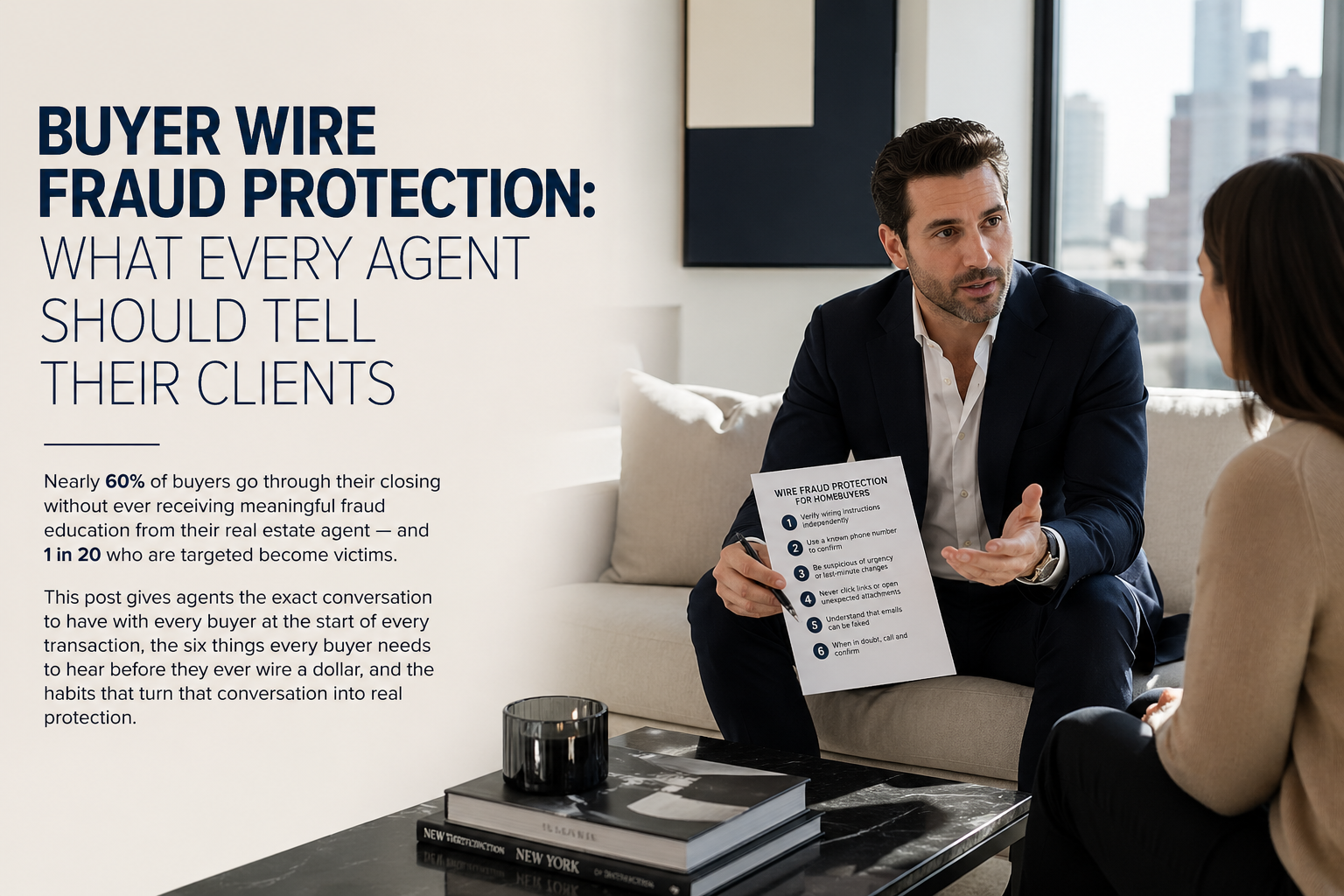
The Conversation Most Agents Are Not Having — And Why It's Costing Buyers Everything
Here is a number that should stop every agent cold: approximately 60% of consumers received minimal or no education about wire fraud during the closing process from their real estate professionals. Certifid
Not some consumers. Not buyers working with newer agents. Sixty percent — across the board — go through one of the largest financial transactions of their lives without anyone having a meaningful conversation with them about the most catastrophic risk they face.
Home buyers and sellers say they're not getting enough warnings about the risks of wire fraud and other scams targeting real estate transactions, and they want agents to educate them more about protection. National Association of Realtors
And this is not a fringe concern. Nearly a quarter of consumers received suspicious or potentially fraudulent communications during their closing. Of those targeted and pursued, 1 in 20 consumers became a victim. To put that in perspective: you are more likely to fall victim to wire fraud during a real estate closing than to be injured in a car accident. Certifid
The industry is producing billions of dollars in fraud losses every year in part because the professionals closest to buyers — the agents guiding them through every step of the transaction — are not consistently having this conversation. This post is about changing that. It is a guide to exactly what to say, when to say it, and how to build the habits that protect buyers before anyone ever has a chance to steal their money.
Why Agents Are the Critical Link in Buyer Protection
There is an assumption embedded in how the real estate industry approaches wire fraud education. The assumption is that title companies and attorneys are primarily responsible for warning buyers. In practice, that assumption leaves buyers dangerously exposed — because the agent is the relationship they trust most.
Most first-time homebuyers — 35% — believe it is their real estate agent's responsibility to protect them from fraud, followed by their bank at 28% and their title agent or attorney at 25%. Certifid
Buyers don't know what a title company is supposed to tell them. They don't know what their attorney's role covers. What they know is that their agent has been with them from the first showing, through the offer, through the inspection, and into the closing process. When something unfamiliar arrives in their inbox — a request to wire funds, a change in instructions, an urgent message from a party they half-recognize — their first instinct is to think: would my agent have warned me about this?
If the answer is no, that silence becomes the opening a fraudster walks through.
Twenty-two percent of fraudulent communication is made to appear as if it's coming from the real estate agent in the transaction. Fraudsters specifically impersonate agents because they know buyers trust them most. That means agents are not just passive parties in this equation — they are the identity being weaponized against the buyers they represent. National Association of Realtors
In one case from 2018, known as Bain v. Platinum Realty LLC, a Kansas court found a real estate agent and her brokerage liable after a buyer was forwarded fake wire instructions that appeared to come from the agent. The buyer lost $196,622. A jury found the agent and brokerage 85% liable and ordered them to pay $167,129. A federal court upheld the verdict. National Association of Realtors
The conversation about wire fraud is not just a courtesy. For many agents, it is becoming a legal and professional obligation.
When to Have the Conversation — and Why Timing Is Everything
CertifID CEO Tyler Adams puts it plainly: "Take an extra five minutes at the beginning of a transaction to tell your clients that there is a chance that fraud could be interjected in this transaction at any point. It's a difficult conversation to have. But it is way worse to reach the very end of a transaction and your client shows up at closing to find out they wired their money to a fraudster three days prior." National Association of Realtors
The beginning of the transaction is the right moment — not the week before closing, not the day the wire is due. There are three reasons for this.
First, it sets expectations. A buyer who knows at day one that fraudsters specifically target real estate closings will approach every wire-related communication with the right level of skepticism. That skepticism is calibrated and protective, not paralyzing.
Second, it establishes the rules while there is still time to reinforce them. Telling a buyer "never wire based on email alone" during the initial consultation gives them weeks to absorb and internalize that rule before the closing wire is due. Telling them three days before closing, when they're already stressed and distracted, is far less effective.
Third, it is when contact information is first exchanged. The most important protective step any buyer can take is saving the verified phone numbers of the title company and closing attorney at the start of the transaction — not finding them in an email right before the wire is due. That window only exists at the beginning.
At the beginning of the homebuying process, talk with your real estate agent about each step — including the transfer of funds for earnest money, down payment and closing. Make sure you know how you can verify any requests independently. National Association of REALTORS
What to Actually Say: Six Things Every Buyer Needs to Hear
These are not bullet points to include in an email. They are talking points for a real conversation — ideally in person or over the phone — that every agent should have with every buyer at the start of every transaction.
"Wire instructions will never change at the last minute. If you receive anything that says otherwise, call me before you do anything."
This is the single most important thing an agent can communicate. The core mechanic of nearly every real estate wire fraud scam is a last-minute change — a message claiming that the original wire instructions have been updated due to a banking issue, a system migration, or a correction.
Title companies and lenders have processes in place that should not suddenly change. Be suspicious of any last-minute change or request for information. Does the language make sense? Does it come from a verified email address? Call a trusted source before and after you wire funds. National Association of REALTORS
Buyers need to hear this stated as an absolute rule, not a suggestion. The way to phrase it: "Legitimate wire instructions are established early and do not change. If you ever receive an email, text, or phone call saying the instructions have changed — from anyone, including me — stop everything and call me directly at this number before touching your money."
"Save this phone number right now, before we go any further."
You should have a couple of contact methods for everyone involved in your closing transaction. This includes your lender, your real estate agent, your attorney and your settlement agent. Write down each party's name, phone number, email address and any other form of contact information you have. Rocket Mortgage
The critical word here is now. Have the buyer save the title company's direct phone number during the first meeting — or as soon as the title company is identified. The reason this is so important: when a fraudulent email arrives with a "verify your instructions" phone number, a buyer who already has a saved number from a verified source will immediately notice that the numbers don't match. A buyer who doesn't have a saved number will call whatever number is in the email — which is exactly what the fraudster is counting on.
Buyers should not rely on incoming phone calls claiming to be from the title or settlement company to verify banking information. Fraudsters can easily use apps to manipulate their caller ID. J.P. Morgan
Make this concrete: "Before you wire anything — earnest money, down payment, closing funds — call the title company at the number you saved today. Not a number you find in an email. The number in your phone."
"Real estate agents get impersonated. An email that looks like it came from me might not have."
This is a harder conversation to have, but it is a necessary one. Buyers operate on the assumption that an email from their agent's name and address is genuinely from their agent. That assumption is incorrect and exploitable.
Real estate agents were the most frequently impersonated professionals during a fraud attempt. According to 58% of victims, their agent appeared to be the source of suspicious communications. The MortgagePoint -
Agents who warn buyers about this in advance are not undermining their own credibility — they are demonstrating exactly the kind of transparency that earns deeper trust. The framing can be simple: "I want you to know that scammers sometimes send emails that look like they came from me. If you ever receive a wire-related email that appears to be from me and seems unexpected, call me before acting on it. I will always follow up by phone on anything involving your money."
"Urgency in an email is a red flag, not a reason to act faster."
Fraudsters manufacture deadlines because pressure short-circuits verification. The email will say: "Wire by 3 PM today or your closing will be delayed." The phone call will say: "We need this done before the bank closes." The text will say: "Your agent said this is urgent."
Go beyond just including a warning of the potential for wire fraud in your email signature. "It's a nice start — but it's not enough," says CertifID's CEO. "We need to be adding fraud warnings into our agreements and contracts, adding resources to our websites and discussing it verbally with our clients." National Association of Realtors
Legitimate title companies and lenders have processes in place that should not suddenly change. Any last-minute change or request for information deserves careful examination. National Association of REALTORS
The message to give buyers directly: "If you ever feel rushed to wire money — for any reason — that is the moment to slow down, not speed up. Legitimate closings have scheduled timelines. A real professional will never ask you to bypass verification in the name of speed."
"Do not email financial information. Ever."
Refrain from emailing financial information, as emails can be intercepted or manipulated by fraudsters. Ensure secure web transactions, looking for 'https://' in the URL and typing the web address manually rather than clicking on links in emails. Peetlaw
Buyers often don't realize how much they share through email without thinking — account numbers, bank routing information, closing fund amounts. Every piece of that information that passes through open email is a potential intelligence source for a fraudster who has compromised any inbox in the transaction chain.
Reinforce this clearly: "If anyone ever asks you to email banking information, account numbers, or wire confirmation details — don't. If you're working through our secure portal, use that. If you're unsure how to share something safely, call me first."
"If you wire money to the wrong account, you have hours — not days — to act."
Most buyers don't know what to do if fraud happens, because no one has told them. That lack of preparation is itself a risk, because recovery from wire fraud depends almost entirely on speed.
The FBI's Recovery Asset Team reported that it successfully froze or recovered 66% of attempted stolen funds in 2024 using its Financial Fraud Kill Chain. However, time is critical — victims who report within hours stand the best chance of recovery. Plymouthtitleinsurance
Give buyers a clear action plan in advance: "If you ever realize you may have wired money to the wrong account, call your bank immediately and ask for the fraud department. Then call me and call the title company. Then report it to the FBI at IC3.gov. Do all of this within the first hour. Every hour that passes reduces the chance of getting the money back."
Who Is Most Vulnerable — and How to Tailor the Conversation
Not every buyer needs exactly the same conversation. Knowing who is at greatest risk allows agents to calibrate the depth and emphasis of what they share.
First-time homebuyers fall victim to wire fraud during the closing process at a rate three times higher than those who have already bought or sold property. These inexperienced buyers are also the ones who overwhelmingly seek help from real estate agents — 35% believe it is the agent's job to protect them from fraud. Certifid
For first-time buyers, lean into the full conversation. Walk through the entire wire process: what earnest money is, when it's due, how it's transferred, and what verified instructions look like. The more unfamiliar they are with the process, the more targeted the education needs to be.
Cybercriminals tend to prey on older buyers who they believe may have limited knowledge of cybersecurity or wire transfer protocols. Old Republic Title
For older buyers, spend additional time on the mechanics of email spoofing — the fact that a name in an email's display field does not guarantee the message came from that person — and emphasize the phone verification step repeatedly. Older buyers may be more trusting of email communication and less familiar with how easily it can be manipulated.
For buyers in high-value transactions — which in Northeast markets like New York, New Jersey, and Pennsylvania can mean closings well into six figures — the education needs to be proportionally thorough, because the stakes are proportionally higher. 79% of consumers are willing to pay more to work with real estate providers who prioritize their security from wire fraud. High-value buyers especially want to know that the professional guiding them has thought about this carefully. The MortgagePoint -
The Role of the Agent's Own Process in Buyer Protection
The number-one thing real estate agents can do to prevent fraud in the closing process is to communicate not only with their clients from the start, but with the title company they're working with. Agents should connect with the title company and learn how wire instructions are sent and who will be sending them — then communicate this information to their clients so they know exactly what to expect. Chicago Agent Magazine
This is worth emphasizing because agents sometimes treat the conversation with the buyer as sufficient protection. It is necessary, but not sufficient. The process the agent operates matters just as much as the conversation the agent has.
Agents who run transactions through open email chains — where instructions, documents, and financial details pass back and forth in unsecured attachments and threads — create an environment where fraud is genuinely easy to execute. Agents who use a secure portal, work with professional coordinators who establish verified contacts at the start of every file, and have a standing policy of phone confirmation for all wires are building the structural protection that makes their buyer conversations meaningful rather than performative.
These protocols protect not only the clients but also the agents. Chicago Agent Magazine
The fraud warning in an email signature is a start. The agent who also routes every sensitive document through a secure portal, confirms all wire instructions by phone to a number saved at file opening, and works with a transaction coordinator who maintains one verified point of contact from contract to close — that agent is delivering real protection, not just the appearance of it.
Making This a Consistent Practice, Not a One-Time Conversation
The industry's problem is not that agents don't know about wire fraud. It is that the knowledge doesn't reliably reach buyers in a form they can actually use.
Buying or selling property happens only a few times in a person's life. There is little chance of awareness and preparedness — unless it comes from you. Certifid
Making this a consistent practice means building the conversation into your standard process at every transaction's opening — not reserving it for buyers who seem nervous, or clients you think are at higher risk, or deals with unusual complexity. Every buyer. Every transaction. Every time.
It means following up the verbal conversation with something written — a one-page summary of the key rules, a resource they can share with a spouse who wasn't at the meeting, a reminder text the week before closing.
Agents should give every buyer and seller a short wire safety notice and set clear expectations that wiring instructions will never change by email. Barnes Walker
And it means choosing to work with professionals — title companies, attorneys, and transaction coordinators — who take the same approach. The agent's conversation with the buyer matters enormously. So does the environment around every transaction that either makes fraud easy or makes it hard.
Work With a Transaction Coordinator Who Builds Fraud Protection Into Every File
At Signed to Keys, buyer protection is not an afterthought. Every transaction runs through a secure client portal with one dedicated, vetted point of contact. We establish verified contacts for every party at file opening, we never send or accept wire instruction changes by email, and we support agents across Pennsylvania, New Jersey, New York, Maryland, Connecticut, and Delaware in running transactions that protect clients from the moment the contract is signed.
If you want a coordinator who handles the 30-plus tasks per file and takes wire fraud protection as seriously as you do, let's talk.
Request Your Free Consultation → signedtokeys.com
No long-term commitment. No obligation. Just 30 minutes to see if we're the right fit for your business.
Frequently Asked Questions
Why is it the agent's responsibility to warn buyers about wire fraud?
Because buyers trust their agent most — and fraudsters know it. According to CertifID's research, 35% of first-time buyers believe it is their agent's job to protect them from fraud, and 58% of wire fraud victims said the suspicious communication appeared to come from their real estate agent. Agents are the relationship buyers lean on throughout the transaction, which makes them uniquely positioned to deliver effective fraud education — and uniquely exposed when that education doesn't happen.
When is the best time to have this conversation with a buyer?
At the very beginning of the transaction — at the first meeting or when the buyer representation agreement is signed. This is when contact information is first exchanged, when the process is being explained, and when buyers are most receptive to foundational information. Warning a buyer the night before closing is too late. The habits of verification need to be established weeks in advance, not hours before the wire is due.
What are the most important things to tell a buyer to do?
Save verified phone numbers for the title company and closing attorney before any wire is ever due. Call — using those saved numbers, not a number from any email — before sending any funds. Treat any last-minute change to wire instructions as fraud until proven otherwise. Never email banking information. And if something feels wrong, slow down rather than speed up. Urgency in a wire-related communication is a red flag, not a reason to act faster.
What should a buyer do if they think they've sent money to a fraudulent account?
Contact their bank's fraud department immediately and request a wire recall — within the first hour if at all possible. Then call the agent and the title company using verified numbers. Then file a report at IC3.gov and a local police report, saving all related communications. The FBI's Financial Fraud Kill Chain recovered or froze 66% of attempted stolen funds in 2024, but that success rate depends entirely on how quickly the fraud is reported.
Are first-time buyers really at greater risk than experienced buyers?
Yes — significantly. First-time buyers fall victim to wire fraud at three times the rate of experienced buyers, largely because they don't know what legitimate wire instructions look like or how they are typically communicated. They also tend to trust their real estate agent most as a source of protection, which means an agent who hasn't had the conversation has left the most vulnerable buyers with no safety net at all.
Should the wire fraud conversation happen verbally or in writing?
Both. A verbal conversation at the start of the transaction allows the agent to answer questions, gauge the buyer's understanding, and make the message personal. Written follow-up — a one-page summary, a resource document, a reminder before the closing wire is due — reinforces the key rules and gives buyers something to reference when the moment actually arrives. Neither format alone is as effective as both together.
Can fraudsters actually impersonate a real estate agent's email address?
Yes, and it is one of the most common techniques. Scammers either hack into a legitimate agent's email account and use it directly, or they create a spoofed domain that looks nearly identical — changing one letter, adding a hyphen, or using a slightly different extension like .net instead of .com. The buyer sees the agent's name in the email's display field and assumes the message is real without ever checking the actual sending address. This is why buyers need to understand that the name on an email and the address behind it can be two different things.
Does the agent need to explain the full technical mechanics of wire fraud?
No. Buyers don't need to understand business email compromise or phishing methodology to protect themselves. What they need is a clear set of rules: always verify by phone before wiring, never act on last-minute changes without calling, always use phone numbers saved at the start of the transaction and never numbers found in suspicious emails. The technical explanation is less important than the behavioral habits those rules build.
What if the buyer seems annoyed or thinks the conversation is unnecessary?
Have it anyway, and frame it as a professional obligation rather than a personal concern. A brief, matter-of-fact version of the conversation — "I walk every buyer through this because wire fraud targeting real estate closings has increased dramatically and the losses are catastrophic when it happens" — communicates seriousness without alarm. Most buyers, once they understand the stakes, are glad someone took the time to prepare them. And the ones who seem dismissive are often the ones who most needed to hear it.
How does working with a professional transaction coordinator support buyer protection?
A professional TC establishes verified contacts for every party at the start of every file, maintains one consistent communication channel through a secure portal, and enforces a standing policy of phone confirmation for all wire-related activity. This gives buyers a structural layer of protection that supports and reinforces the verbal education the agent provides. The TC is also monitoring the file daily — which means any unusual communication pattern or unexpected request is caught by someone who knows what the transaction is supposed to look like.