
When Is It Time to Hire a TC? 7 Signs You're Already Overdue
Most agents ask "when should I hire a transaction coordinator?" years after they should have. By the time they're asking, they're usually already past the point where TC support would have started paying for itself. Here are seven specific signs that indicate you're already overdue for structural coordination support — and what to do about it.

The Weekend Agent: How Paperwork Ate Your Saturday
It's Saturday morning, 7:15 AM. You're up earlier than you meant to be because you remembered around 11 PM last night that three things didn't get done on Friday. This is what most real estate agents' weekends look like. Here's why, and how agents who've restructured their practices get their weekends back.
Why 30+ Administrative Tasks Per File Is Killing Your Business
Open any residential real estate transaction file from contract to close, and you'll find 30 to 60 distinct administrative tasks that need to happen — not client-facing work, not strategic decisions, just administrative execution. Most agents carry this load personally. Here's why that's quietly killing your business, and what to do about it.

"I Don't Have Time to Prospect" — The Real Reason Agents Stay Stuck
Talk to any real estate agent whose business has plateaued for a few years and you'll usually hear some version of the same explanation: "I don't have time to prospect." This explanation feels true — the calendar really is full. But the explanation isn't the actual cause. Here's what is, and how to fix it.

The Hidden Cost of Doing Your Own Transaction Coordination
Most real estate agents doing their own transaction coordination will tell you it's free. They already do the work, so why pay someone else? This reasoning is wrong, but not in an obvious way. Here's the honest accounting of what DIY transaction coordination actually costs — including the hidden costs agents never track.

Why Your Closings Keep Getting Delayed (It's Not the Buyer)
When a closing gets pushed, the story agents tell is usually about the buyer. Some of that is true — but the pattern across hundreds of delayed closings tells a different story. It's not the buyer. It's coordination infrastructure. Here's the uncomfortable truth about why closings keep getting delayed and what actually prevents it.
The 12 Deadlines Most Real Estate Agents Miss (and How to Never Miss Them Again)
Every real estate transaction runs on deadlines. The agents who consistently close on time don't have special powers — they have systems. Here are the 12 deadlines agents most commonly miss, why each matters, and the specific operational practices that prevent the miss. Written for agents serious about running a clean practice.
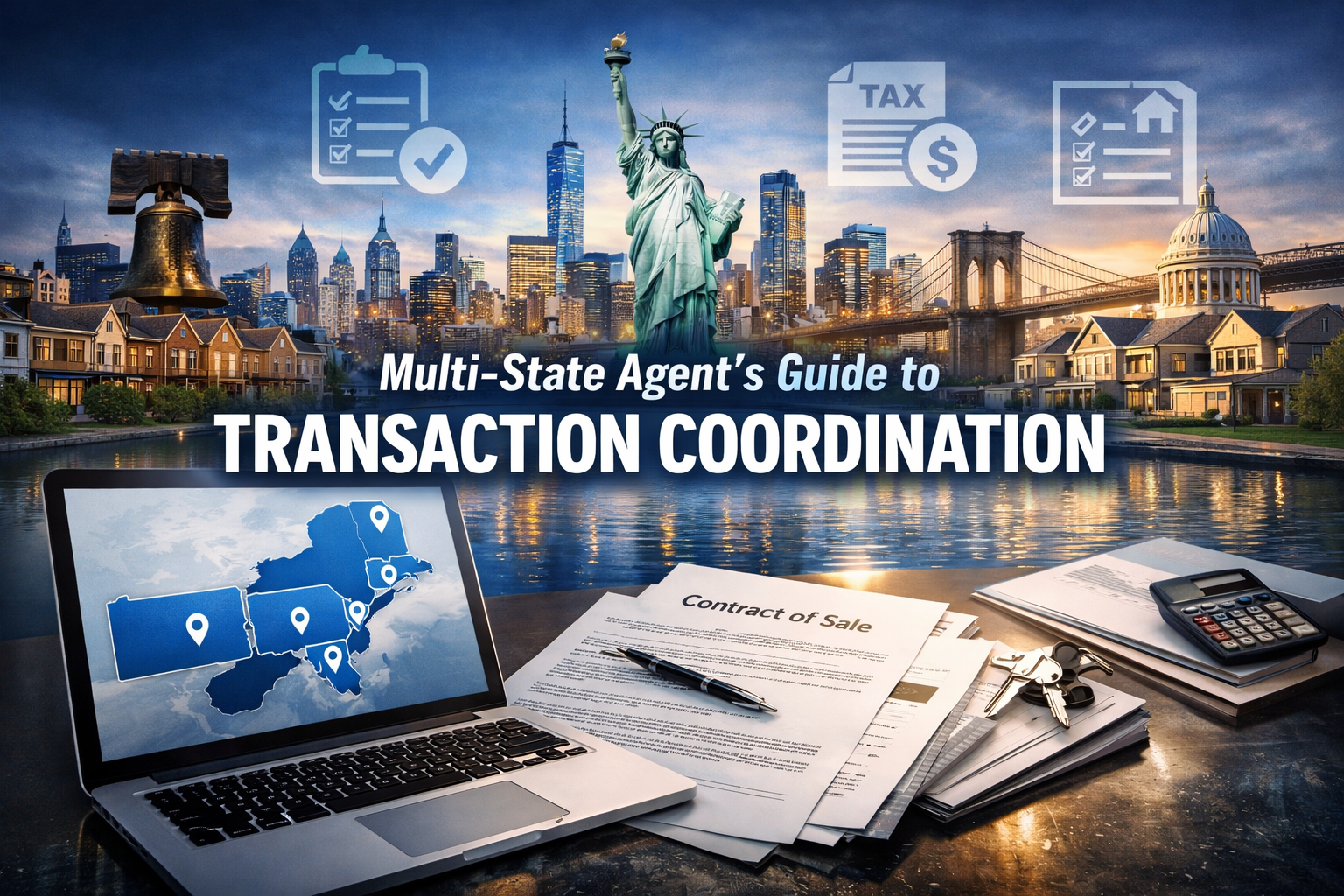
Multi-State Agent's Guide to Transaction Coordination
Single-state practice is hard. Multi-state practice is harder in specific, non-obvious ways — different contracts, disclosure requirements, tax structures, closing processes, and vendor ecosystems in every state. Here's what it takes to run a multi-state practice well across PA, NJ, NY, MD, CT, and DE, and what a multi-state TC actually provides.

Crossing State Lines: What Agents Working in PA + NJ Need to Know
Working both sides of the Delaware River isn't something you just do. Pennsylvania and New Jersey are both turf states with no reciprocity — practicing in both requires dual licensing. Here's the actual path from PA to NJ (or vice versa), how to run a cross-border practice, and the operational realities agents need to know.

Delaware Settlement Statements and Transfer Tax: Agent's Guide
Delaware is small but punches above its weight on one dimension: a 4% realty transfer tax, split 50/50 by custom, is among the highest in the US. Combined with the state's attorney-required closing model and three-county recording system, Delaware closings require specific operational discipline. Here's the agent's complete guide.

Connecticut Attorney Closings: A Transaction Coordinator's Walkthrough
Connecticut is the most structurally attorney-driven state in the Northeast — CT law requires a Connecticut-licensed attorney at every real estate closing, by statute. Here's how CT attorney closings actually work, the tiered state and municipal conveyance tax, the July fiscal property tax year, and exactly what a transaction coordinator handles.
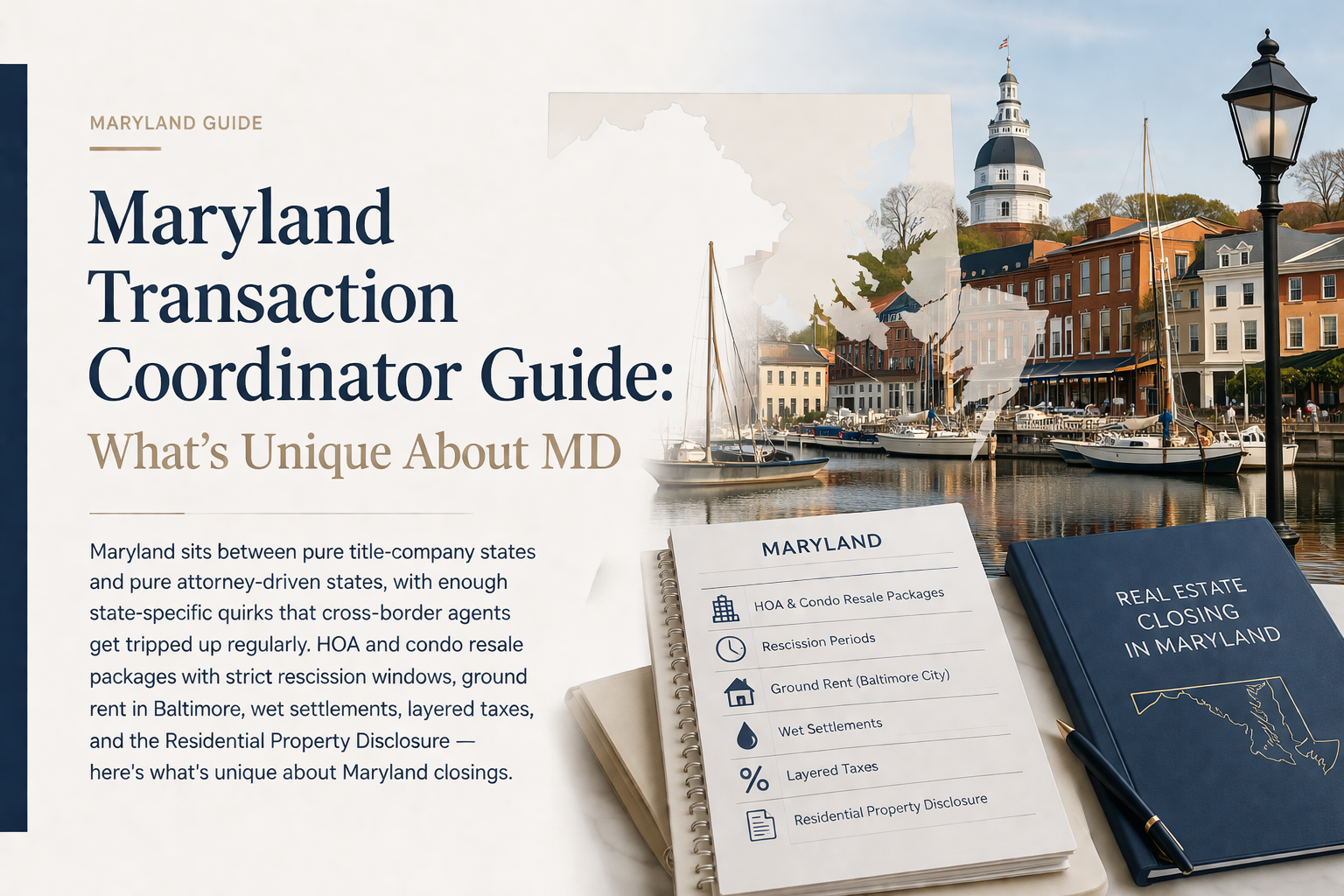
Maryland Transaction Coordinator Guide: What's Unique About MD Closings
Maryland sits between pure title-company states and pure attorney-driven states, with enough state-specific quirks that cross-border agents get tripped up regularly. HOA and condo resale packages with strict rescission windows, ground rent in Baltimore, wet settlements, layered taxes, and the Residential Property Disclosure — here's what's unique about Maryland closings.

Maryland Recordation Tax and Lead Paint Requirements Explained
Maryland stacks state recordation tax, state transfer tax, local transfer tax, and sometimes a Baltimore City yield tax on the same transaction — and applies one of the country's most aggressive lead paint laws to every pre-1978 rental. Here's the agent's guide to both, including county rates, exemptions, and MDE compliance.

NY Attorney-Driven Closings: What Your Transaction Coordinator Handles
In New York, attorney involvement on both sides of a residential transaction isn't optional — it's the system. Brokers can't even draft the contract. Here's how NY attorney-driven closings actually work, what the closing tax stack looks like in NYC, and exactly what a transaction coordinator handles inside the process.

New York Co-op Board Approval Process: Step-by-Step for Agents
NYC co-op board approval is unlike anything else in residential real estate — a private board holds broad authority to approve or reject buyers based on extensive documentation and a personal interview. Here's the full process, what goes in a board package, and what the new 2026 timeline law changes starting July 28.

Title-Company-Driven Closings: How Pennsylvania Transactions Actually Work
Most real estate advice is written from an attorney-state perspective. Pennsylvania doesn't work that way. PA residential closings run on a title-company-driven model where the title company is the operational spine of the deal, and agents carry more coordination responsibility than they do in attorney states. Here's how it actually works.

PA vs. NJ Real Estate Transactions: Key Differences Agents Miss
Pennsylvania and New Jersey look similar on the surface — same timelines, same contingencies, same Delaware River in between. The operational reality is that PA is title-company-driven while NJ is attorney-driven, and the differences in transfer taxes, attorney review, CO/UO, and mansion tax catch cross-border agents off guard constantly. Here's the field guide.

Pennsylvania Realty Transfer Tax: What Agents Need to Know
Pennsylvania realty transfer tax isn't one tax — it's a state 1% plus a local rate that varies by municipality, from 2% in most suburbs to 4.578% in Philadelphia and 5% in Pittsburgh. Here's the working agent's guide to rates, exemptions, who pays, and the mistakes that cause five-figure surprises at closing.
New Jersey Transaction Coordinator Checklist: Contract to Close
New Jersey transactions have more moving parts than most states. Attorney review, municipal certifications, utility certifications, and attorney-driven closings add layers that generic national TC checklists don't cover. Here's the complete, task-by-task checklist for coordinating an NJ transaction from signed contract to closing day.

What Is a CO and UO in New Jersey Real Estate Transactions?
Somewhere between contract and closing on a New Jersey transaction, someone says "we need to order the CO." In some towns it's a UO. In others it's a CCO. And in most towns, it's one of the most common sources of closing delays in the state. Here's the complete walkthrough of what these certifications actually are, how the process works, and how to keep your closing on track.