Maryland Transaction Coordinator Guide: What's Unique About MD Closings
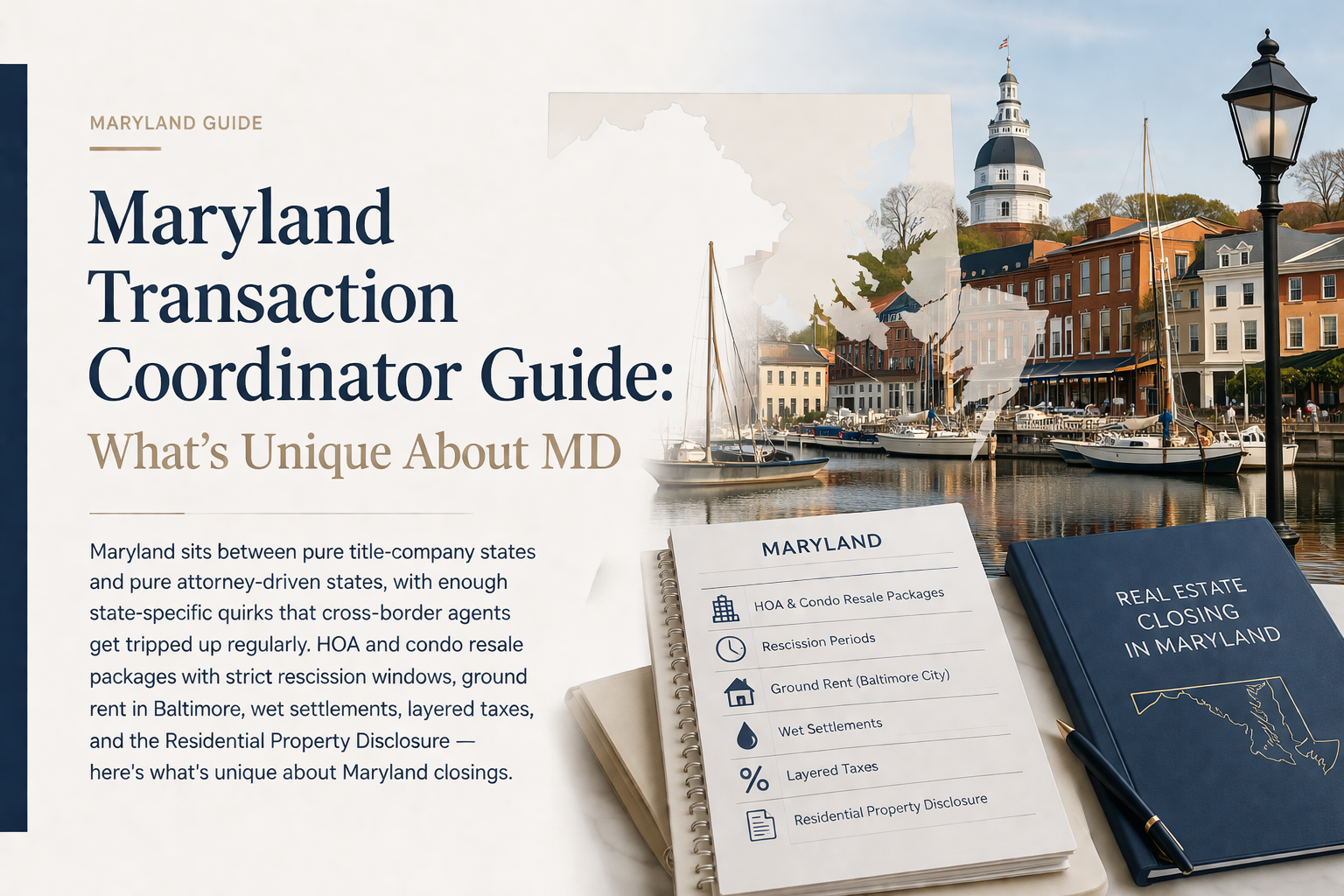
Maryland sits in the middle of the Northeast corridor — north of DC, south of Pennsylvania, east of nothing, and west of the Delaware and Chesapeake bays. Geographically, it's a state agents can get to easily from PA, NJ, DE, or DC. Operationally, it's a state that runs real estate closings in its own way, with enough state-specific quirks that agents crossing in from neighboring markets get tripped up regularly.
I wrote separately about Maryland's recordation tax and lead paint law — two of the biggest single topics. This post is the broader companion piece: everything else that makes Maryland closings distinctive. The hybrid attorney/title company model. Wet settlement requirements. The HOA and condo resale package process with its specific rescission windows. Ground rent — genuinely unique to Maryland among the states we cover. The Residential Property Disclosure and Disclaimer Statement. The first-time Maryland homebuyer provisions. The contract structure and timing.
Maryland isn't a hard state to close in. It's a state where the details are specific and getting them wrong causes real closing-day problems. For agents expanding into Maryland, or for teams running Maryland files alongside PA, NJ, NY, or DE files, building TC infrastructure that respects those specifics is the difference between clean closings and messy ones.
Written from the perspective of a transaction coordination firm that processes Maryland files every week, for agents who want the operational picture.
The Hybrid Structure: Title Company or Attorney (or Both)
Maryland sits between pure title-company states (like PA) and pure attorney-driven states (like NY) in a genuine operational sense. Maryland law doesn't require attorney involvement in residential real estate transactions, and most Maryland residential closings can be — and often are — handled by a title company without attorneys on either side. But attorney involvement is common, often encouraged, and sometimes operationally preferable, especially on complex files or investor deals.
The title company path. A title company handles the title search, title commitment, preparation of closing documents, settlement, funds disbursement, and recording. The buyer and seller don't need attorneys. This path works well for routine transactions and is common across most of Maryland.
The attorney path. One or both parties retain an attorney. The attorney handles contract review, may represent the client at settlement, reviews closing documents, and may handle some of the work a title company would otherwise do. In some Maryland counties, especially those closer to DC or Baltimore, attorney involvement is more common. FSBO transactions and investor-heavy transactions frequently involve attorneys on one or both sides.
The common combination. In many Maryland deals, the title company handles the bulk of the closing mechanics while one or both parties have an attorney review the contract and attend settlement. This hybrid is probably the most common pattern on moderately complex Maryland residential files.
What this means for agents: Maryland gives flexibility. Agents can refer to title companies for straightforward transactions and bring in attorneys when deals get complex. Understanding which path makes sense for a given transaction — and when to encourage attorney involvement — is part of operational Maryland competency.
The Maryland Contract: Standard Form, Serious Consequences
Residential Maryland contracts are typically based on forms maintained by the Maryland REALTORS® (the state REALTOR® association) and local REALTOR® associations. The MR Residential Contract of Sale and its addenda form the backbone of most MLS-listed residential transactions in the state. FSBO and investor transactions often use attorney-drafted contracts or other forms.
Key contract features:
Binding at signing. Unlike New Jersey (with automatic three-day attorney review) or New York (where an accepted offer isn't binding until attorneys finalize the contract), Maryland contracts are generally binding upon full execution. Any attorney review a party wants must happen before signing. This operational similarity to PA catches NJ-based agents off guard.
Maryland-specific addenda. The contract typically includes multiple state-specific addenda that vary by property type and transaction. Common required addenda:
Maryland Residential Property Disclosure and Disclaimer Statement (Real Property Article § 10-702).
Lead Paint Disclosure for pre-1978 properties (federal and Maryland).
HOA Disclosure for properties in homeowners associations.
Condominium Disclosure for condo units.
Ground Rent Disclosure for properties subject to ground rent.
Well and Septic Addendum for properties with private systems (common in rural Maryland).
Notice of Estimated Closing Costs provided by the listing broker (Maryland-specific).
Agents who assume Maryland contracts look like PA or NJ contracts, or who skip required Maryland-specific addenda, create both transactional friction and potential contract defects.
Financing contingency structure. Standard Maryland contracts include financing contingency provisions with specific timelines for loan application and commitment. Negotiating these timelines and tracking them precisely is a core post-contract task.
Home inspection contingency. Typically included, with a specified inspection period (often 7-15 days). The buyer can cancel or negotiate repairs based on inspection findings within the window.
The Residential Property Disclosure and Disclaimer Statement
Maryland is one of the states with a specific statutory disclosure obligation governed by Real Property Article § 10-702. Sellers of residential real property have two choices:
Option 1: Disclosure. The seller completes the Maryland Residential Property Disclosure Statement, affirmatively disclosing known material defects in specific categories (foundation, roof, plumbing, electrical, HVAC, water/sewer, appliances, environmental hazards, etc.).
Option 2: Disclaimer. The seller completes the Maryland Residential Property Disclaimer Statement, declining to make representations about the property's condition and selling "as-is." Even under the disclaimer option, however, the seller must disclose known latent defects that could pose a direct threat to the health or safety of the buyer.
The form is attached to the contract as an addendum and signed by both parties. Failing to provide a required disclosure or disclaimer can be grounds for the buyer to cancel the contract and recover the deposit — up until closing. This is a real enforcement mechanism and a real risk for sellers who don't complete the form properly.
Specific scenarios that matter for agents:
Disclaimer ≠ hidden defects. Sellers can't use the disclaimer option to hide known defects. Selling "as-is" doesn't mean hiding material latent defects that threaten health or safety.
Updates if knowledge changes. If a seller becomes aware of a defect after submitting the disclosure but before closing, they're generally expected to update it.
First-time and owner-occupied exemptions. Certain transactions (e.g., newly constructed and never-occupied property, transfers among family members, certain estate/trust transfers) may be exempt from the § 10-702 disclosure requirement but still subject to other disclosure obligations.
HOA and Condo Resale Packages: The Single Biggest Maryland Timing Trap
If there's one thing that causes more late-stage delays on Maryland deals than anything else, it's the HOA or condominium resale package. Maryland law imposes specific, statutory disclosure obligations on sellers of properties in HOAs and condominiums — and the timing of delivery and buyer rescission windows are the places deals most often get stuck.
What the Resale Package Contains
For HOA properties (under the Maryland Homeowners Association Act, § 11B-106 of the Real Property Article), the resale disclosure package typically includes:
Governing documents (Declaration, Bylaws, Rules and Regulations).
Current financial statements and operating budget.
Information about pending lawsuits against the association.
Statement of upcoming or approved special assessments.
Monthly/quarterly/annual dues and fees.
Statement of any outstanding violations or unpaid balances for the specific unit or lot.
Capital reserve information.
For condominiums (under the Maryland Condominium Act, § 11-135 of the Real Property Article), the resale certificate is similar, with specific condominium-related items added (insurance coverage, common elements, limited common elements, pending litigation, etc.).
The Timing and Rescission Windows
This is where agents have to pay close attention:
Request and delivery. The seller (or their agent) requests the package from the HOA/condo association or its management company. The association typically has 20 days to produce the package after receiving a written request and the required fee.
Delivery to buyer. The seller must provide the package to the buyer either before contract signing or within a specified window after execution (typically 20 calendar days).
Buyer's rescission window — HOA: If the buyer doesn't receive the complete resale disclosure package at least 5 calendar days before signing the contract, the buyer has the right to cancel the contract within 5 calendar days after receiving the package.
Buyer's rescission window — Condo: Similar structure but with a 7-day rescission window for condo purchases.
Additional 3-day rescission. If mandatory fees increase by more than 10% or other material amendments are made, buyers may have an additional 3-day rescission right.
The resale package process is where Maryland closings most often get delayed, for a few reasons:
Slow production. HOA/condo management companies can take the full 20 days (or longer if incomplete at first). Agents who order the package late compress the downstream timeline.
Incomplete packages. Packages missing required documents can extend the buyer's rescission window or create grounds for dispute.
Last-minute changes. A newly approved special assessment or material fee increase between contract and closing can trigger a buyer rescission right even after the original window has closed.
Buyer objections to contents. A buyer reviewing a resale package may discover something (pending litigation, large upcoming assessment, restrictive rules) that causes them to back out during the rescission window.
For TCs working Maryland files, HOA/condo resale package management is one of the most time-sensitive workstreams. Ordering the package the day after contract signing (not the day before closing) is essential.
Ground Rent: A Maryland Oddity
Ground rent is genuinely unique to Maryland among the states we cover. It's a legal arrangement dating back to 18th-century English common law, under which a property owner pays periodic "rent" to a separate "ground rent holder" who retains a technical property interest in the land under the home.
Most common in Baltimore City and surrounding older Maryland communities, ground rent is typically a small annual payment ($60, $90, $120) to the ground rent holder. The arrangement is distinctive because:
The homeowner owns the building but doesn't own the land beneath it in fee simple.
The ground rent holder has a property interest that must be dealt with at any transfer.
Ground rent can be redeemed (purchased outright) by the homeowner under specific statutory provisions.
Unpaid ground rent historically could lead to ejectment actions, though modern Maryland law has added significant protections for homeowners.
For agents selling ground rent properties, specific obligations apply:
Disclosure. The seller must disclose that the property is subject to ground rent, including the amount and identity of the ground rent holder.
Redemption option. Buyers may want to redeem the ground rent at closing, converting the property to fee simple. This requires locating the ground rent holder (sometimes difficult with old, passed-down interests) and paying the redemption amount.
Title search. The title company or attorney needs to confirm the ground rent title is clear of liens and judgments and that the party claiming to be the ground rent holder actually has that interest.
Unknown holders. If the ground rent holder can't be located, Maryland's Department of Assessments and Taxation has a process for redeeming ground rent even when the holder is unknown — but this adds time to the transaction.
For agents unfamiliar with ground rent — especially PA, DE, or NJ agents expanding into Baltimore City or Baltimore County — this is the kind of issue that can delay closings if not spotted early. Listing agents need to identify ground rent properties upfront and include the disclosure and handling approach in the contract.
Wet Settlements Only
Maryland is a "wet settlement" state. Unlike some states where "dry settlements" are permitted (funds disburse some days after signing), Maryland law requires that all funds be transferred at settlement. The buyer's funds, the lender's funds, and the seller's net proceeds all have to be at the closing table on closing day.
Practical implications:
Wire transfer timing. Wire transfers must arrive before settlement, not after. A delayed wire from the lender or buyer can delay the closing.
Certified funds. Buyers sometimes bring certified checks for any small differences between estimated and actual closing costs.
Seller proceeds available immediately. Sellers receive their net proceeds (by wire or certified check) at settlement, not days later.
This is a distinction from some other states where settlement and funding are separated by a day or two. In Maryland, it all happens in one motion.
First-Time Maryland Homebuyer Provisions
Maryland has specific statutory provisions for first-time homebuyers that reduce closing costs — and that agents need to know about and apply correctly:
State transfer tax reduction. As mentioned in the recordation tax post, first-time Maryland homebuyers purchasing a principal residence pay the state transfer tax at 0.25% instead of 0.5% — and under statute, the seller is required to pay the tax at the reduced rate.
County-specific first-time buyer exemptions. Many Maryland counties have additional first-time buyer exemptions that reduce or eliminate local transfer or recordation taxes. Examples: some counties exempt the first $50,000, $75,000, or $100,000 of purchase price for first-time buyers, and some apply county-specific reduced rates similar to the state's.
Principal residence qualification. To qualify, the buyer must generally affirm under oath that they'll occupy the property as a principal residence for a specified period (often 7 of the first 12 months after closing).
Co-borrower complications. If multiple borrowers are on the loan and one is a first-time Maryland buyer while the other isn't, the rules can be complicated. Specific statutory provisions cover co-makers and guarantors, but applying them requires attention to the exact language in the deed and financing documents.
Agents who identify first-time Maryland buyer status early, properly document it in the contract (including the specific transfer tax payment shift to the seller), and coordinate with the title company/attorney on applying all available exemptions can save buyers thousands of dollars at closing. Missing this is a tangible disservice to first-time homebuyer clients.
The Notice of Estimated Closing Costs
A Maryland-specific requirement: when listing a property for sale, the listing broker is generally required to provide the seller with a written Notice of Estimated Closing Costs. This document outlines the anticipated costs the seller will incur at closing — commissions, transfer taxes, recordation tax, title fees, other settlement costs, and mortgage payoffs.
The notice is intended to give sellers a clear early picture of their expected net proceeds. For buyers, a similar informal estimate is typically provided (often through the buyer's agent and/or lender) but isn't separately mandated in the same form.
For listing agents, preparing an accurate Notice of Estimated Closing Costs is a real operational task. Getting the recordation tax, transfer tax, and commission math right from the start builds seller trust; getting it wrong undermines the agent's credibility when the CD shows different numbers.
Post-Contract Operational Workflow
Once the Maryland contract is signed, the typical post-contract workflow runs in parallel:
Title work. The title company (or attorney coordinating with a title company) orders the title search, reviews for defects, and works on clearing any issues. Common Maryland title issues include old ground rent interests, unreleased mortgages, judgment liens, and prior deed errors.
Lender processing. The buyer's lender orders the appraisal, processes and underwrites the loan, and works toward clear-to-close. TRID rules apply — the Closing Disclosure must be provided to the buyer at least three business days before consummation.
Inspection and contingencies. The buyer's inspection is typically scheduled within the first week or two after contract. Any repair requests, credit negotiations, or contingency responses happen within the inspection period.
HOA/Condo resale package. Ordered by the seller immediately after contract execution. Delivered to the buyer within the statutory window. Buyer's rescission windows tracked carefully.
Lead paint compliance (for pre-1978 properties). Federal lead disclosure delivered before contract binding. Maryland-specific lead disclosure for pre-1978 properties. For pre-1978 rental properties being sold to investor buyers, MDE registration status confirmed and transition planning for the buyer's 30-day registration window.
Closing preparation. Title company/attorney prepares the deed, closing documents, and settlement statement. Coordinates with the lender on funding. Schedules settlement and confirms all parties' availability.
Settlement. Wet settlement at the title company or attorney's office. All parties present (buyer, seller, agents, settlement agent, possibly attorneys). Documents signed, funds disbursed, keys transferred.
Post-closing. Deed recorded. Title policies issued. Post-closing follow-up on any outstanding items.
Typical timeline: 30-45 days from contract to close for standard financed transactions, with some variation based on HOA/condo resale package timing, inspection-related negotiations, and lender pace.
What Makes a Good Maryland TC
For agents using a transaction coordinator on Maryland files, the TC's role centers on Maryland-specific operational details that don't line up with other states:
1. Addendum tracking
Maryland contracts involve more addenda than PA or NY contracts. The TC maintains a file-specific checklist of required addenda (property disclosure, lead paint, HOA or condo, ground rent where applicable, well/septic, financing, inspection) and tracks that each is properly executed.
2. HOA/Condo resale package management
This is the single highest-value TC task on Maryland HOA/condo deals. Order the package immediately after contract. Confirm delivery to the buyer within the statutory window. Track the buyer's rescission window. Flag any material amendments that could extend the window. Follow up with management companies that are slow producing packages.
3. Tax stack calculation
Verify the county-specific recordation tax rate. Confirm the state and local transfer tax rates. Apply principal-residence exemptions, first-time homebuyer exemptions, and any county-specific reductions. Verify the closing statement math against the expected numbers.
4. First-time Maryland homebuyer flagging
Identify first-time buyer status at contract. Ensure the contract reflects the seller-paid state transfer tax obligation at the reduced 0.25% rate. Confirm all available exemptions are applied.
5. Ground rent handling
For properties subject to ground rent, ensure the disclosure is properly completed. Track whether the buyer intends to redeem the ground rent at closing. Coordinate with the title company or attorney on ground rent clearance.
6. Property disclosure/disclaimer handling
Confirm the seller's Residential Property Disclosure or Disclaimer Statement is completed correctly and delivered to the buyer as required. Flag any known defects that need attention.
7. Lead paint compliance
On pre-1978 properties, ensure federal and Maryland lead disclosures are properly delivered. For rental-to-rental sales, manage the transition of MDE registration obligations.
8. Settlement coordination
Confirm the wet settlement logistics — title company or attorney location, date, time, wire transfer timing, certified funds requirements, and all parties' availability. Secure wire verification protocols prevent wire fraud.
9. Post-closing follow-up
Confirm the deed is recorded. Confirm title policies are issued. Close out any outstanding items (ground rent redemption documentation, lead paint certificate transfers, HOA/condo transition notifications).
10. Cross-border coordination
For agents with files in multiple states, the TC maintains state-specific workflows that respect Maryland's particular requirements rather than applying a generic cross-state checklist.
Common Mistakes Agents Make on Maryland Deals
In rough order of frequency:
1. Treating Maryland contracts like PA or NJ contracts
Missing required addenda, assuming a non-existent attorney review window, or under-appreciating the Maryland Residential Property Disclosure/Disclaimer Statement's legal weight. Maryland contracts look familiar but have specific requirements that need to be met.
2. Late HOA/Condo resale package orders
Waiting a week or two after contract to order the resale package is a near-certain way to compress the downstream timeline or push closing. Order immediately after contract.
3. Missing first-time Maryland homebuyer benefits
The reduced 0.25% state transfer tax rate AND the seller-paid provision are both material. Also flagging available county-specific first-time buyer exemptions. Missing any of these costs buyers real money.
4. Ignoring ground rent on Baltimore properties
Particularly in Baltimore City and parts of Baltimore County, ground rent properties are common. Missing the disclosure, or failing to plan for redemption or title clearance, causes late-stage complications.
5. Underestimating the closing tax stack
As covered in the recordation tax post — the combined state transfer, local transfer, and recordation tax, with recordation tax applying to both sale price and loan amount, produces higher closing costs than agents from most other states expect.
6. Forgetting the Notice of Estimated Closing Costs
This is a listing-broker obligation in Maryland. Listing agents who don't provide an accurate Notice at listing create problems with seller net proceed expectations later.
7. Mishandling lead paint on pre-1978 investor sales
Selling a pre-1978 rental property to an investor buyer requires careful handling — federal lead disclosure, Maryland lead disclosure, and transition of the MDE compliance obligations. Missing pieces here creates compliance exposure for the buyer.
8. Not coordinating wet settlement logistics
Maryland wet settlements require funds to be in place at closing. Wire transfer delays, late lender funding, or certified fund problems can force a closing delay. Coordination with all parties on funding timing is essential.
9. Assuming title company or attorney choice is arbitrary
Buyers have the right to choose under RESPA, but the choice matters. Title company/attorney competence, responsiveness, and Maryland experience all shape the closing. Agents with established relationships in Maryland produce smoother deals.
10. Missing well and septic issues on rural properties
In Maryland counties with significant rural areas (Carroll, Frederick, Cecil, parts of Anne Arundel, and others), properties with private well and septic systems are common. The well/septic addendum needs to be completed, inspections ordered, and any issues addressed before closing.
The Bottom Line
Maryland is operationally accessible to agents from neighboring states, but the state's specific requirements demand specific attention. The tax stack is more layered than most states'. The HOA/condo resale package process has concrete rescission windows that cause closings to collapse when mishandled. The Residential Property Disclosure and Disclaimer Statement is a real legal obligation with real consequences. Ground rent properties require handling that doesn't exist anywhere else we cover. First-time Maryland homebuyer benefits are real and worth capturing. Lead paint compliance on pre-1978 rentals is enforced by MDE.
None of this is insurmountable. All of it requires discipline. For agents expanding into Maryland or running Maryland alongside other states, the operational layer — the TC work, the checklists, the timing, the specific Maryland addenda — is what separates clean Maryland closings from messy ones.
A Maryland-experienced transaction coordinator who knows the state's tax stack, runs the HOA/condo resale package on a tight clock, flags first-time homebuyer status correctly, manages ground rent disclosures where relevant, and handles the wet settlement logistics is the difference between a file that closes on time and a file that doesn't. That's the value proposition for Maryland — not legal expertise (which belongs to attorneys where involved) or title expertise (which belongs to the title company) but the operational glue that keeps the specifically Maryland pieces coordinated.
Frequently Asked Questions
Does Maryland require an attorney at closing?
No. Maryland law does not require attorney involvement in residential real estate transactions. Most standard residential closings are handled by a title company. Attorney involvement is common — and often advisable — on complex files, investor transactions, FSBO deals, or transactions with title or legal complications, but it's not mandatory for routine residential sales.
What is the Maryland Residential Property Disclosure and Disclaimer Statement?
It's a required form under Real Property Article § 10-702. Sellers of residential property must either (a) complete a Disclosure Statement affirmatively disclosing known material defects, or (b) complete a Disclaimer Statement selling the property "as-is" (while still disclosing known latent defects that pose health or safety risks). The form is attached to the contract as an addendum. Failing to provide it can give the buyer grounds to cancel the contract and recover the deposit up until closing.
What is an HOA or condo resale package in Maryland?
The Maryland Condominium Act (§ 11-135) and Maryland Homeowners Association Act (§ 11B-106) require sellers of condo or HOA properties to provide buyers with a resale disclosure package. This includes governing documents, financial statements, budget, information about pending litigation, approved special assessments, dues and fees, and any outstanding unit-specific issues. The association typically has 20 days to produce the package after a written request. The buyer has a 7-day rescission window for condo purchases and 5-day rescission window for HOA purchases if the package isn't delivered at least 5 days before contract signing.
What is ground rent in Maryland?
Ground rent is a legal arrangement unique to Maryland (dating back to 18th-century English common law) where a homeowner pays periodic "rent" — typically a small annual amount — to a separate "ground rent holder" who owns a technical property interest in the land under the home. Ground rent is most common in Baltimore City and surrounding older communities. Ground rent can be redeemed (purchased outright) by the homeowner, converting the property to fee simple. Sales of ground rent properties require specific disclosures and title work to ensure the ground rent interest is properly handled.
What is a wet settlement state?
Maryland is a wet settlement state, meaning all funds must be transferred at settlement — the buyer's funds, the lender's funds, and the seller's net proceeds all have to be in place at the closing table on closing day. This differs from "dry settlement" states where funds can disburse a day or two after signing. Wet settlement rules mean wire transfers must arrive before settlement, not after, and lender funding delays can force closing delays.
How long does a typical Maryland closing take?
A typical Maryland residential transaction runs 30-45 days from contract execution to closing, with financed deals taking the upper end of that range. Cash deals can close faster (2-3 weeks). Complicated deals (title issues, appraisal problems, HOA/condo resale package delays, ground rent complications) can extend. The HOA/condo resale package process is often the pacing constraint on condo and HOA sales.
What are the state and local transfer taxes in Maryland?
Maryland's state transfer tax is 0.5% of consideration for most sales, or 0.25% for first-time Maryland homebuyers purchasing a principal residence (with the seller paying this reduced rate under statute). On top of this, each county and Baltimore City may impose its own local transfer tax, ranging from 0% (in counties like Frederick) up to 1.5% in Baltimore City, Baltimore County, and Montgomery County (on sales over $1M). Local exemptions for principal residence buyers and first-time buyers can reduce these amounts significantly.
What is the Notice of Estimated Closing Costs?
A Maryland-specific obligation: listing brokers are generally required to provide sellers with a written Notice of Estimated Closing Costs when listing a property. The notice outlines anticipated closing-day costs (commissions, transfer and recordation taxes, title fees, mortgage payoffs, etc.) so sellers have a realistic early view of their expected net proceeds.
Are Maryland real estate contracts binding at signing?
Yes. Unlike New Jersey (automatic three-day attorney review) or New York (accepted offer is not binding until attorneys finalize the contract), Maryland residential contracts are binding upon full execution. Any attorney review a party wants should happen before signing, not after. The contract can be canceled based on failure to provide required disclosures or based on contractual contingencies (financing, inspection, HOA/condo resale package review), but there's no automatic cooling-off period.
What are the key differences between a Maryland closing and a Pennsylvania closing?
Maryland closings tend to have more required addenda (property disclosure/disclaimer, HOA/condo resale package, lead paint, ground rent for applicable properties, well/septic for rural properties), a more layered closing tax stack (state + local transfer tax + recordation tax on both sale price and loan), more specific first-time homebuyer provisions, and the HOA/condo resale package timing is a major operational focus. Pennsylvania is simpler on most of these dimensions — flat 2% transfer tax in most counties, less extensive addendum requirements, and no ground rent concept. Both states are title-company-driven in most transactions, but Maryland's hybrid attorney/title company model is slightly more flexible.
How can a transaction coordinator help with Maryland files?
A Maryland-experienced TC handles the state-specific operational layer that doesn't line up with other states' practices. This includes managing the HOA/condo resale package timeline (often the biggest single delay risk), tracking all required Maryland addenda, verifying county-specific recordation and transfer tax calculations, applying first-time Maryland homebuyer exemptions correctly, handling ground rent disclosures on applicable properties, coordinating lead paint compliance on pre-1978 properties, and managing wet settlement logistics. A TC without specific Maryland knowledge can miss enough details to cause closing problems — a specialized Maryland TC prevents them.
Ready to See What a Transaction Coordinator Can Do For Your Maryland Files?
Signed to Keys provides full-service transaction coordination for real estate agents across Pennsylvania, New Jersey, New York, Maryland, Connecticut, and Delaware — with deep experience in Maryland's hybrid closing model, HOA/condo resale package timing discipline, county-by-county recordation and transfer tax verification, first-time Maryland homebuyer provisions, ground rent handling, lead paint compliance, and the wet settlement logistics that Maryland files require. One dedicated point of contact, 30+ tasks handled per file, a secure portal with wire fraud protection built in.
Free 30-minute consultation. No pressure, no obligation. We'll learn about your business, walk you through how we handle Maryland files specifically, and help you figure out whether we're the right fit.
Request Your Free Consultation →
Sources
Maryland Department of the Environment (MDE). Lead Poisoning Prevention Program. Retrieved from https://mde.maryland.gov
Maryland General Assembly. Md. Code, Real Property Article (Titles 10, 11, and 11B), Environment Article (Title 6), and Tax-Property Article (Titles 12 and 13).
The Maryland People's Law Library. Residential Real Estate Transactions and Disclosures. Retrieved from https://www.peoples-law.org
Maryland Courts. Recording Fees and Taxes. Retrieved from https://www.mdcourts.gov
Maryland REALTORS®. Residential Contract of Sale and Standard Forms. Retrieved from https://www.mdrealtor.org
National Association of REALTORS®. What the NAR Settlement Means for Home Buyers and Sellers. Retrieved from https://www.nar.realtor/the-facts/what-the-nar-settlement-means-for-home-buyers-and-sellers
Disclaimer: This post is general information about Maryland residential real estate closings based on public sources and common practice, not legal or tax advice. Maryland real estate law, tax rates, and disclosure requirements are subject to change, and interpretation can vary by fact pattern. Any agent or party with a specific question about a Maryland transaction should consult a licensed Maryland real estate attorney. Rates, thresholds, and statutory provisions cited are current as of April 2026 and subject to change.
About Signed to Keys
Signed to Keys is a real estate transaction coordination firm serving agents across six Northeast states — Pennsylvania, New Jersey, New York, Maryland, Connecticut, and Delaware. From contract to keys, we handle the 30+ administrative tasks per file that would otherwise eat your prospecting time, built on secure systems that protect your clients and your license.
signedtokeys.com | hello@signedtokeys.com | (703) 420-9757