New York Co-op Board Approval Process: Step-by-Step for Agents
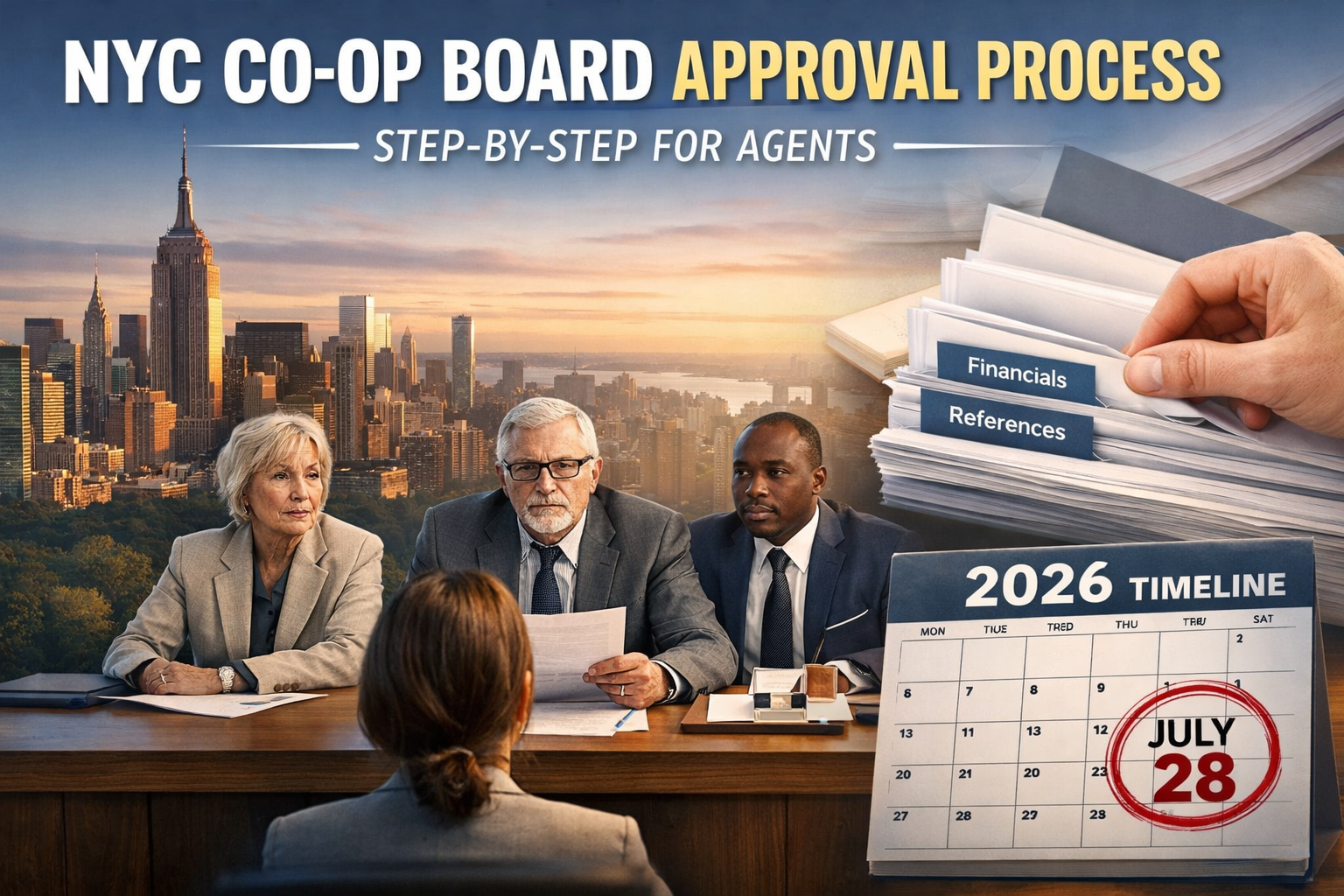
If you've done any residential work in New York City, you've encountered the co-op board approval process. For agents coming from Pennsylvania, New Jersey, or really anywhere outside the New York metro, the co-op approval process is one of the most alien features of the NYC real estate system. A buyer can be pre-approved for a mortgage, have cash reserves ten times what the purchase requires, have stellar references and a perfect credit score — and still be rejected by a co-op board for reasons the board doesn't have to disclose. And the rejection is final.
The process is also about to change meaningfully. In early 2026, the New York City Council enacted Local Law 58 of 2026 (Int. 1120-B), the Cooperative Application Timeline Law, which for the first time imposes enforceable deadlines on co-op boards and managing agents for acknowledging and ruling on applications. The law takes effect July 28, 2026. Agents who last worked a co-op deal under the old system — where a board could sit on an application for months with no recourse — need to understand what changes this summer and what doesn't.
This post is the working agent's walkthrough. How the co-op board approval process actually works, what goes into a board package, what happens at the interview, how the timeline runs, what the new 2026 law changes, and where agents most often fumble. Written from the perspective of a transaction coordination firm that runs NYC files every week.
What a Co-op Actually Is
Before getting into approval mechanics, a short reset on structure — because the approval process makes more sense once the underlying ownership model is clear.
When someone "buys a co-op," they're not buying real property. They're buying shares in a cooperative corporation that owns the building, plus a proprietary lease that gives them the right to occupy a specific apartment. The corporation owns the real estate. The shareholder owns stock. This is different from a condominium, where each unit owner owns their individual apartment as real property along with a percentage interest in the common areas.
The co-op corporation has a board of directors, elected by the shareholders. The board is responsible for managing the corporation's finances, maintaining the building, enforcing house rules, and — critically for agents — approving or rejecting new shareholders (buyers) and subtenants. The board's authority to approve or reject transfers is baked into the proprietary lease and the corporation's bylaws. In New York, that authority is broad. Co-op boards can reject a buyer for almost any reason except for reasons that violate federal, state, or city anti-discrimination law. And until July 2026, they can take as long as they want doing it.
Most Manhattan apartment buildings are co-ops — estimates put the number at roughly 70–75% of Manhattan residential buildings. Brooklyn and Queens have a mix, with more condos than Manhattan but substantial co-op inventory. The Bronx and Staten Island skew toward other ownership structures. For any agent doing meaningful Manhattan work, co-op fluency is not optional.
The Core Structure of the Approval Process
A typical NYC co-op approval runs through roughly seven steps:
Contract signed. The buyer and seller execute the contract of sale. Earnest money goes into the seller's attorney's escrow account (typically 10% of the purchase price, which is substantially larger than typical escrow elsewhere).
Board package assembled. The buyer, with help from their agent and attorney, assembles an extensive package of financial documents, reference letters, and the completed board application.
Package submitted to managing agent. The package goes to the building's managing agent, who reviews it for completeness before forwarding to the board.
Managing agent and board counsel review. The managing agent and sometimes the board's attorney review the completed package, conduct background checks, and prepare a summary for the board.
Board review and interview. The board of directors reviews the package and schedules an interview with the buyer.
Board vote. The board votes to approve, approve with conditions, or reject the application.
Closing. If approved, the transaction proceeds to closing — the buyer signs the proprietary lease and receives the stock certificate.
Each of these steps has its own timeline, complications, and places where deals can stall or die. Before July 28, 2026, there are no statutory deadlines. After that date, deadlines apply to co-ops with more than 10 units.
The Board Package: What Actually Goes In
The board package is the centerpiece of the whole process, and the amount of documentation required is genuinely startling if you haven't seen one before. A typical board package runs 100-300 pages and includes some combination of the following:
Financial documents:
Two to three years of signed federal tax returns (both personal and business, if self-employed)
Two to three years of W-2s or 1099s
Recent pay stubs (typically covering the past 2-3 months)
Employment verification letter from the employer
Two to three months of statements for every bank account, investment account, retirement account, and brokerage account
Verification of the source of down payment funds (including gift letters if applicable)
A personal financial statement or net worth statement, often using the building's specific form
Credit report authorization and release
Reference letters:
Personal references — typically 2-3 letters from individuals who can speak to the applicant's character
Professional references — often 1-2 letters from employers, colleagues, or business contacts
Landlord references (if applicable) or prior co-op board references if moving from another co-op
Banker or financial reference
Transaction documents:
Fully executed contract of sale
Mortgage commitment letter from the lender (if financing)
Proof of funds for the cash portion of the purchase
Recognition agreement (if financing — this is a three-way agreement between the buyer, lender, and co-op corporation)
Personal and background:
Completed board application (specific to the building)
Photo ID
Biography or personal statement introducing the applicant
Sometimes additional questionnaires specific to the building (pets, renovations, occupation, household composition)
Payment:
Application fees (usually $500-$1,500, varying by building)
Move-in deposit (often $500-$2,000, refundable if no damage during move-in)
Sometimes an interview fee or background check fee
Some buildings — especially older pre-war buildings on Park Avenue, Fifth Avenue, Central Park West, and other highly desirable addresses — have even more extensive requirements. Tax returns going back five years. Separate letters of reference from each member of the building's board. A detailed disclosure of the buyer's travel and residency patterns. A full financial statement showing not just current assets but projected expenses for the next several years. These "white glove" buildings have some of the most rigorous approval processes in the United States.
A well-prepared board package is meticulously organized. Tab dividers, a table of contents, consistent formatting, clear labeling of every document. Board members are reviewing dozens of packages and don't have patience for disorganized submissions. A sloppy package creates a bad first impression that can hurt the application regardless of the buyer's underlying qualifications.
Financial Expectations Boards Actually Apply
Different co-ops have different financial standards, but there's a loose set of benchmarks that run through most NYC co-op board decisions:
Down payment. Most co-ops require 20-25% down as a minimum, with more prestigious buildings requiring 25-50%. A handful of ultra-exclusive Manhattan co-ops require all-cash purchases and don't allow any financing at all. This is a hard floor set by the building's proprietary lease or bylaws, and it's not negotiable by the buyer.
Debt-to-income ratio. Co-op boards typically want total housing costs (mortgage + maintenance + any assessments) to be under 28-33% of gross income, and total debt-to-income (all obligations) to be under 36-45%. Buyers at the upper edges of these ratios get closer scrutiny.
Post-closing liquidity. Boards want to see that the buyer has substantial liquid reserves after closing — typically at least 12 months of combined mortgage and maintenance payments, and in stricter buildings 18-24 months or more. Some co-ops specifically require "X years post-closing liquidity" as a stated minimum. This is often the single biggest financial hurdle — a buyer with perfectly adequate income but tight post-closing reserves can fail the liquidity test even if every other ratio is fine.
Income stability. Salaried employees with long tenure are easier to underwrite than self-employed applicants. Bonuses, commission income, and equity compensation get scrutinized for stability. Recent job changes or short tenure at current employment create concerns.
Source of funds. Boards want clear documentation of where the down payment is coming from. Gift funds require gift letters. Funds recently transferred from overseas accounts require explanation. Money that "appeared" in an account within the past 60 days without documented source is a flag.
Buyers who don't meet these standards on paper aren't automatically rejected — boards have discretion and sometimes approve borderline candidates with strong references or other compensating factors. But understanding the financial framework upfront helps agents identify applications that are going to face real difficulty.
The Managing Agent's Role
Most NYC co-ops are professionally managed, meaning a managing agent (a property management company) handles day-to-day building operations and, importantly, the administrative side of the board approval process. For agents working co-op deals, the managing agent is often the most important point of contact during the approval process.
The managing agent's role in approvals typically includes:
Providing the board application form and requirements to buyers/their agents
Receiving the completed board package
Reviewing for completeness and requesting any missing items
Running background checks (credit, criminal, litigation, sometimes media searches)
Distributing the package to the board members
Coordinating the board's review and any follow-up questions
Scheduling the board interview
Communicating the board's decision
Processing closing logistics after approval
A competent, responsive managing agent makes the approval process dramatically smoother. A slow or disorganized one can drag an approval out for months.
Managing agents are also the target of the new 2026 timeline law. Before July 2026, a managing agent could sit on a package for weeks without responding. After July 2026, managing agents for co-ops with more than 10 units have hard deadlines to acknowledge receipt, flag deficiencies, and move the package forward.
The Board Interview
If the package clears review and the board decides to proceed, the next step is the interview. The interview is a core part of the approval process and one buyers frequently underestimate.
Interview mechanics vary by building. Some typical formats:
Short in-person interview. 15-30 minutes in the building, usually in a common area or the managing agent's office. A few board members and the managing agent attend.
Full board interview. The entire board attends. Can run longer and feel more formal, especially in larger or more exclusive buildings.
Video interview. Increasingly common post-2020, especially for buyers who live out of town.
Committee interview. Some buildings have an admissions committee that does the initial interview and makes a recommendation to the full board.
What boards actually ask varies widely. Common categories of questions:
Background and work — tell us about yourself, your career, why you're moving.
Why this building — what attracts you to this specific co-op?
Financial questions — these are heavily constrained by anti-discrimination law and boards are generally advised to avoid questions that could be seen as targeting protected characteristics.
House rules and lifestyle — pets, renovations, sublet plans, noise, occupancy (who will be living there).
Plans for the apartment — are you planning to renovate? Move in immediately? Rent it out eventually?
What boards are explicitly not allowed to ask about:
Race, ethnicity, national origin, religion
Familial status (whether you have or plan to have children)
Disability
Sexual orientation or gender identity
Marital status (though questions about who will occupy the apartment are permissible)
Age (except confirming you're above 18)
Source of income in a discriminatory sense (NYC human rights law has specific protections)
A skilled attorney representing the buyer briefs the buyer on interview prep before the interview: likely questions, what to wear, what to bring, what to volunteer, what not to volunteer. The interview prep is one of the most valuable services an experienced NYC buyer's attorney provides.
Interview etiquette matters more than buyers expect. Arrive early. Dress professionally. Bring a copy of the board package. Be polite to the doorman, the managing agent's assistant, and anyone else you encounter. Answer directly. Don't volunteer extraneous information. Don't bring up sensitive topics. Don't treat it like a casual conversation — it's an interview with significant stakes.
The Decision
After the interview, the board deliberates. Outcomes fall into four buckets:
Approved. The board votes to approve the transfer. The managing agent notifies the buyer and their attorney. The transaction proceeds to closing, which can often be scheduled within days of approval.
Approved with conditions. The board approves subject to specific conditions — most commonly, the buyer agrees to post additional escrow (often 6-24 months of maintenance held in reserve), agrees to a guarantor, or commits to certain behavioral terms (no subletting for X years, no renovations in the first year). The buyer and their attorney decide whether to accept the conditions.
Rejected. The board votes to reject. Historically, NYC co-op rejection rates have run 3-5% of applications, though recent market conditions have pushed rejection rates higher in some buildings. A rejection is typically final — the deposit is returned to the buyer, the deal terminates, and the buyer generally has no effective recourse. Boards are not required to provide reasons for rejection (though under certain NYC human rights law protections, a rejection that appears to be discriminatory can trigger an investigation).
Pending / Held. Sometimes boards don't vote at the scheduled meeting and want more information or time. Under the new 2026 law, this kind of indefinite holding becomes harder to do.
The New 2026 Timeline Law: What Changes July 28, 2026
This is the biggest structural change to NYC co-op approvals in decades. Local Law 58 of 2026 (originally Int. 1120-B) imposes enforceable timelines on co-op approval processes. Key provisions that take effect on applications submitted on or after July 28, 2026:
Who's covered. Co-ops with more than 10 residential units. Smaller buildings, HDFC cooperatives, and cooperatives subject to government agency approval (like Mitchell-Lama developments) are exempt.
15-day acknowledgment. The co-op (through the managing agent) must acknowledge receipt of a completed application within 15 days. If the application is incomplete, the managing agent must notify the applicant of exactly what's missing within the same 15-day window. If no acknowledgment is sent within 15 days, the application is deemed complete as of submission.
45-day decision deadline. Once an application is complete, the board has 45 days to approve or deny the application. Boards are allowed one 14-day extension as of right, and additional extensions only with the written consent of the prospective buyer.
Summer recess allowed. Boards can adopt a written policy tolling the 45-day clock during July and August if the board doesn't meet during those months. The policy must be documented and maintained in building records.
Mandatory written transfer requirements. Co-ops must create and maintain a complete list of all requirements, documents, information, forms, fees, disclosures, and procedural steps, and provide this list promptly upon request to sellers, buyers, or their agents.
Enforcement. Complaints about non-compliance go to the NYC Department of Housing Preservation and Development (HPD). Civil penalties can be imposed. Notably, the law does not grant automatic approval if deadlines are missed — so a missed deadline doesn't mean the buyer is automatically approved; it means the board faces administrative consequences.
What the law doesn't do. It doesn't require boards to give reasons for rejection. It doesn't change the board's substantive approval authority. It doesn't change financial standards or eliminate the interview. It's fundamentally a procedural reform focused on timing and transparency, not a substantive reform of what boards can consider.
For agents, the practical impact is significant. Before July 2026, "the board hasn't gotten to it yet" could drag for months. After July 2026, that excuse has a 45-day statutory cap (plus extensions). The predictability of the timeline is about to improve meaningfully, though the substantive uncertainty of the outcome remains.
Typical Timeline
A normal NYC co-op approval process, contract to approval:
Contract signing to package submission: 1-3 weeks. Depends on how organized the buyer is and how quickly reference letters and financial documents come together.
Package review by managing agent: 1-2 weeks. Longer if the package is incomplete and back-and-forth is required.
Board review: 1-3 weeks. Boards typically meet monthly, so the timing depends on when the next board meeting falls after the package is deemed complete.
Interview scheduling to decision: 1-2 weeks. The interview is often scheduled within a week or two of board review; the decision usually comes within a few days after the interview.
Total: typically 4-8 weeks from contract to decision, with some buildings faster and some slower. Summer months (July and August) traditionally run slower because many boards reduce or pause activity. The new law explicitly allows this recess if properly documented.
After approval, closing typically happens within 2-4 weeks, depending on the lender's readiness if financing is involved.
For agents accustomed to PA's 30-45 day contract-to-close timelines, NYC co-op closings feel slow. For agents accustomed to NJ's 45-60 day timelines, NYC co-ops feel moderate but structurally different. The time is spent in the approval process, not in attorney review or title work.
Common Reasons Buyers Get Rejected (or Applications Stall)
Co-ops don't have to give reasons for rejection, but industry practitioners have a good sense of the common patterns:
Thin liquidity. The single most common financial reason. Buyer has enough for the down payment but not enough post-closing reserves.
High debt-to-income. Total monthly obligations (including mortgage + maintenance) eating too much of gross income.
Unclear source of funds. Large recent deposits without documented origin. Overseas transfers without explanation.
Self-employment without stable income documentation. Self-employed buyers need to make a stronger case with multiple years of tax returns and demonstrated income consistency.
Credit issues. Even a fundamentally strong buyer with a single credit blemish may struggle.
Incomplete or sloppy package. Missing documents, inconsistent numbers across forms, disorganized presentation.
Weak or absent references. References that are vague, unenthusiastic, or from people who don't really know the applicant.
Interview performance. Coming across as evasive, unprepared, arrogant, or disrespectful to board members or building staff.
Specific building concerns. Plans to sublet in a building that restricts subletting. Plans to renovate in a building with renovation concerns. Occupation that the board views as unfit.
Something in background check. Undisclosed litigation, an old criminal matter, a public controversy that shows up in a media search.
Agents who work co-ops seriously develop pattern recognition for these issues and can guide clients through remediation before the package goes in, not after a rejection.
Cross-Border Agents: The Common Mistakes
For PA, NJ, or other out-of-state agents who find themselves representing a buyer in an NYC co-op (common for cross-border moves), the mistakes tend to cluster:
1. Not understanding the timeline
A buyer moving from PA, where a 30-day close is normal, often can't believe an NYC co-op could take 2-3 months to approve. Setting expectations correctly at the start of the search prevents frustration.
2. Underestimating the financial requirements
NYC co-ops want substantially more documented financial strength than most other markets. A buyer who comfortably cleared a PA mortgage approval can fail a co-op board application on liquidity alone. Agents need to pre-screen.
3. Treating the board package as administrative paperwork
It's not administrative — it's the central document of the approval process, and quality matters enormously. A professionally assembled package with good references gets treated better than a rushed one with weak references.
4. Not engaging a qualified NYC buyer's attorney early
This is the single biggest mistake. NYC co-op transactions absolutely require an experienced NYC buyer's attorney — someone who works co-op deals regularly, knows the managing agents, knows the building-specific quirks, and knows how to prepare the package and brief the buyer on the interview. An out-of-state attorney, or a NYC attorney without specific co-op experience, is not adequate.
5. Missing the contract differences
NYC co-op contracts are different from PA or NJ real estate contracts. They use specific legal forms (typically a Blumberg or similar proprietary contract), have different deposit structures (10% is standard), and integrate with the board approval process in ways that require specialized legal understanding.
6. Not preparing the buyer for the interview
Interview prep is a real discipline. Buyers who walk in cold often don't perform well. The attorney should brief the buyer, and the agent should reinforce the preparation.
7. Assuming rejection is recoverable
Rejection is generally final. There is no meaningful appeal process. If a buyer is rejected, the deposit is returned and the deal is dead. Agents who treat rejection as a recoverable event are setting false expectations.
8. Missing building-specific quirks
Every co-op has its own personality. Some buildings are tough on pets, some are restrictive on renovations, some are skeptical of pied-à-terre buyers who won't live there full-time, some are focused on long-term residents vs. short-term flips. Understanding the building before submitting the package saves time and improves outcomes.
What Good TC Support Looks Like on NYC Co-op Files
For agents using a transaction coordinator on NYC co-op deals, the TC's role centers on the document-intensive and deadline-heavy parts of the approval process:
Board package assembly and tracking. The TC maintains a specific checklist for the building, tracks which documents have been received from the buyer, flags missing items, and ensures the package is complete and well-organized before submission.
Managing agent coordination. The TC is in regular contact with the managing agent, confirming receipt of the package, monitoring the 15-day acknowledgment window (under the new law), and tracking progress through the board review.
Timeline tracking. The TC tracks the deadlines that matter — contract dates, package submission targets, board meeting dates, the 45-day decision window, interview scheduling, approval-to-closing timing.
Reference letter management. The TC helps coordinate the collection of reference letters from the buyer's network, following up with reference providers and ensuring letters arrive in time.
Document verification. The TC spot-checks financial documents for consistency — tax returns match pay stubs match bank statements match the financial statement. Inconsistencies that would trigger board questions get resolved before submission.
Interview preparation logistics. The TC confirms the interview date, time, location, attendees, and works with the attorney to ensure the buyer is prepped.
Closing coordination. Once approved, the TC coordinates the transition to closing, tracking the lender's clear-to-close, the recognition agreement (for financed deals), and the logistics of the stock transfer and proprietary lease signing.
NYC co-op deals have more moving documentary pieces than almost any other residential transaction in the country. A good TC turns a process that would otherwise consume enormous agent time into a tracked, systematic workflow.
The Bottom Line
The NYC co-op board approval process is unlike anything else in residential real estate. A private board of building shareholders holds broad authority to approve or reject buyers based on extensive financial documentation and a personal interview, with limited accountability for timing (until July 2026) and no requirement to explain rejection decisions.
For agents, the process demands a different operational mindset than PA title-company closings or NJ attorney-driven transactions. Documentation is extensive. Relationships with managing agents matter. The interview is a real event, not a formality. Timing runs slower than other markets, with real variance by building. And the new 2026 timeline law is about to reshape the procedural layer of the process in ways that will affect every active NYC co-op transaction.
Agents who work NYC co-ops well — especially cross-border agents representing clients relocating from PA, NJ, or elsewhere — build the operational discipline the process requires: strong buyer's attorney relationships, careful package preparation, pattern recognition for financial red flags, honest expectation-setting with clients, and tight coordination through the document-heavy approval window.
Agents who treat NYC co-ops as ordinary residential transactions get humbled. It's its own world, and the agents who do well in it are the ones who respect the complexity and build their practice to match it.
Frequently Asked Questions
What is a co-op board package?
A co-op board package is the comprehensive application a prospective buyer submits to a New York City co-op's managing agent and board of directors as part of the approval process. It typically includes personal financial documents (tax returns, pay stubs, bank statements, investment accounts), reference letters (personal, professional, landlord), the executed contract of sale, mortgage documents if financing, a completed board application form, identification, and application fees. Packages typically run 100-300 pages and are reviewed in depth by the managing agent, board counsel, and board of directors before a decision is made.
How long does NYC co-op board approval take?
Under the current pre-July 2026 system, typical contract-to-approval timelines run 4-8 weeks, with significant variation by building. The managing agent's review takes 1-2 weeks, the board's review and interview scheduling adds another 2-4 weeks, and the decision usually comes within a few days after the interview. Summer months traditionally run slower because many boards reduce activity. Effective July 28, 2026, Local Law 58 of 2026 imposes new deadlines — 15 days for acknowledgment of receipt and 45 days from a complete application to decision — which will formalize timelines for co-ops with more than 10 units.
Can a co-op board reject a buyer without giving a reason?
Yes. New York co-op boards have historically had broad discretion to reject applicants without providing reasons, as long as the rejection doesn't violate federal, state, or city anti-discrimination law. The 2026 Cooperative Application Timeline Law requires boards to decide within 45 days but does not require them to explain a rejection. Rejection is generally final — there is no meaningful appeal process, and the buyer's deposit is returned when the deal terminates.
What financial requirements do NYC co-ops typically have?
Most NYC co-ops require a minimum of 20-25% down payment, with more prestigious buildings requiring 25-50% down or even all-cash purchases. Boards typically want total housing costs (mortgage + maintenance) to be under 28-33% of gross income, total debt-to-income under 36-45%, and post-closing liquidity of at least 12 months of mortgage + maintenance payments (often 18-24 months or more in stricter buildings). Requirements vary significantly by building, and these are baseline expectations rather than universal standards.
What is the NYC Cooperative Application Timeline Law?
Local Law 58 of 2026 (originally introduced as Int. 1120-B) is a New York City law that, effective July 28, 2026, imposes enforceable timelines on co-op board approval processes. It applies to co-ops with more than 10 residential units. Key requirements include: a 15-day window for the managing agent to acknowledge receipt or flag incomplete applications, a 45-day window from complete application to board decision, and mandatory written transfer requirements that must be provided to buyers and sellers upon request. The law is enforced by the NYC Department of Housing Preservation and Development (HPD) and includes civil penalties for non-compliance.
What happens at the co-op board interview?
The board interview is a 15-60 minute meeting between the buyer and some or all of the board members (and usually the managing agent) to evaluate the applicant personally. Typical topics include the buyer's background, reasons for purchasing in this specific building, lifestyle (pets, renovations, plans for the apartment), and general fit with the building. Federal, state, and NYC anti-discrimination laws prohibit boards from asking about race, religion, national origin, familial status, disability, sexual orientation, gender identity, or marital status. A buyer's attorney typically provides interview prep, and performance at the interview can meaningfully influence the board's decision.
What's the difference between buying a co-op and buying a condo in NYC?
Condos are real property — buyers own their apartment as real estate along with a percentage interest in common areas. Co-ops are corporations — buyers own shares in the corporation that owns the building, plus a proprietary lease giving them the right to occupy a specific apartment. Condos generally have fewer approval hurdles (usually just a right of first refusal by the condo board, which is rarely exercised), lower down payment requirements, and more flexibility around subletting and ownership structures. Co-ops tend to be less expensive than comparable condos but require board approval, typically have higher down payment requirements, and are more restrictive. Most Manhattan apartment buildings are co-ops; Brooklyn and Queens have more condo inventory.
What is a "recognition agreement" in a co-op transaction?
When a co-op buyer finances their purchase, the lender requires a recognition agreement — a three-way agreement between the buyer, the lender, and the co-op corporation. The recognition agreement acknowledges the lender's security interest in the buyer's shares and proprietary lease, and establishes what happens if the buyer defaults on the loan. Not all co-ops allow financing (some are all-cash buildings), and those that do typically have specific recognition agreement forms they require lenders to use. For agents working co-op deals with financed buyers, confirming that the building accepts financing and the buyer's lender uses acceptable forms is a critical early step.
Can out-of-state buyers be approved for NYC co-ops?
Yes, out-of-state buyers are regularly approved for NYC co-ops, but they face additional scrutiny. Boards often want to understand whether the apartment will be the buyer's primary residence, a pied-à-terre, or an investment — and some buildings restrict non-primary-residence use. Out-of-state buyers should expect questions about their connection to NYC, frequency of intended use, and occupancy plans. International buyers face even more scrutiny and often need to provide additional documentation around source of funds, tax status, and U.S. residency.
How is a co-op closing different from a regular real estate closing?
At a co-op closing, the buyer doesn't receive a deed — because co-ops aren't real property. Instead, the buyer receives a stock certificate (representing the shares they just purchased) and signs the proprietary lease (granting them the right to occupy the apartment). The transaction is technically a transfer of personal property (shares), not a conveyance of real estate. There's no deed recording with the county — the stock transfer is noted in the co-op corporation's records. New York City transfer taxes still apply, including the NYC Real Property Transfer Tax and the NY State Transfer Tax. Closings typically happen at the co-op's attorney's office or the managing agent's office, with the buyer, seller, their attorneys, the managing agent, and lender representatives present.
How can a transaction coordinator help with NYC co-op deals?
A transaction coordinator provides the document-intensive, deadline-heavy operational layer that NYC co-op approvals demand. The TC maintains the building-specific checklist, tracks document collection from the buyer, confirms package completeness before submission, coordinates with the managing agent, monitors the 15-day and 45-day deadlines under the new law, tracks reference letter collection, verifies document consistency before submission, coordinates interview logistics, and manages the transition from approval to closing. Given the volume of paperwork and coordination in a typical co-op deal, a specialized TC with NYC experience meaningfully reduces the risk of the process stalling due to operational gaps.
Ready to See What a Transaction Coordinator Can Do For Your New York Files?
Signed to Keys provides full-service transaction coordination for real estate agents across Pennsylvania, New Jersey, New York, Maryland, Connecticut, and Delaware — with experience handling NYC co-op board packages, managing agent coordination, timeline tracking under the new 2026 Cooperative Application Timeline Law, and the document-intensive operational work that NYC co-op deals demand. One dedicated point of contact, 30+ tasks handled per file, a secure portal with wire fraud protection built in.
Free 30-minute consultation. No pressure, no obligation. We'll learn about your business, walk you through how we handle NYC files specifically, and help you figure out whether we're the right fit.
Request Your Free Consultation →
Sources
New York City Council. Int. 1120-2024 B / Local Law 58 of 2026 — Cooperative Application Timeline Law.Retrieved from https://legistar.council.nyc.gov
NYC Department of Housing Preservation and Development (HPD). Cooperative Housing Regulations. Retrieved from https://www.nyc.gov/site/hpd
New York State Division of Human Rights. Fair Housing Regulations. Retrieved from https://dhr.ny.gov
NYC Commission on Human Rights. Source of Income Discrimination and Fair Housing Protections. Retrieved from https://www.nyc.gov/site/cchr
Brick Underground. Submitting a co-op board package? Starting this summer, you'll be approved (or rejected) much faster. Retrieved from https://www.brickunderground.com
National Association of REALTORS®. What the NAR Settlement Means for Home Buyers and Sellers. Retrieved from https://www.nar.realtor/the-facts/what-the-nar-settlement-means-for-home-buyers-and-sellers
Disclaimer: This post is general information about the NYC co-op board approval process based on public sources and common practice, not legal advice. New York real estate law and municipal regulations change, and interpretations can vary. The Cooperative Application Timeline Law (Local Law 58 of 2026) takes effect July 28, 2026, and rules and procedures from the NYC Department of Housing Preservation and Development (HPD) may further define its implementation. Any agent or party with a specific question about a co-op transaction should consult a licensed New York real estate attorney with co-op-specific experience. Rates, thresholds, and timelines cited are current as of April 2026 and subject to change.
About Signed to Keys
Signed to Keys is a real estate transaction coordination firm serving agents across six Northeast states — Pennsylvania, New Jersey, New York, Maryland, Connecticut, and Delaware. From contract to keys, we handle the 30+ administrative tasks per file that would otherwise eat your prospecting time, built on secure systems that protect your clients and your license.
signedtokeys.com | hello@signedtokeys.com | (703) 420-9757