Delaware Settlement Statements and Transfer Tax: Agent's Guide
I have everything I need. Key Delaware facts: attorney required (2000 DE Supreme Court — In re Mid-Atlantic Settlement Servs.), 4% total transfer tax (state 2.5% + local 1.5%), state 1% added Aug 2017, split 50/50 by custom but negotiable, first-time homebuyer exemption capped at $2,000 on first $400K state portion plus county exemption, three counties with own rules, buyer chooses attorney.
Let me write the post.
Delaware Settlement Statements and Transfer Tax: Agent's Guide
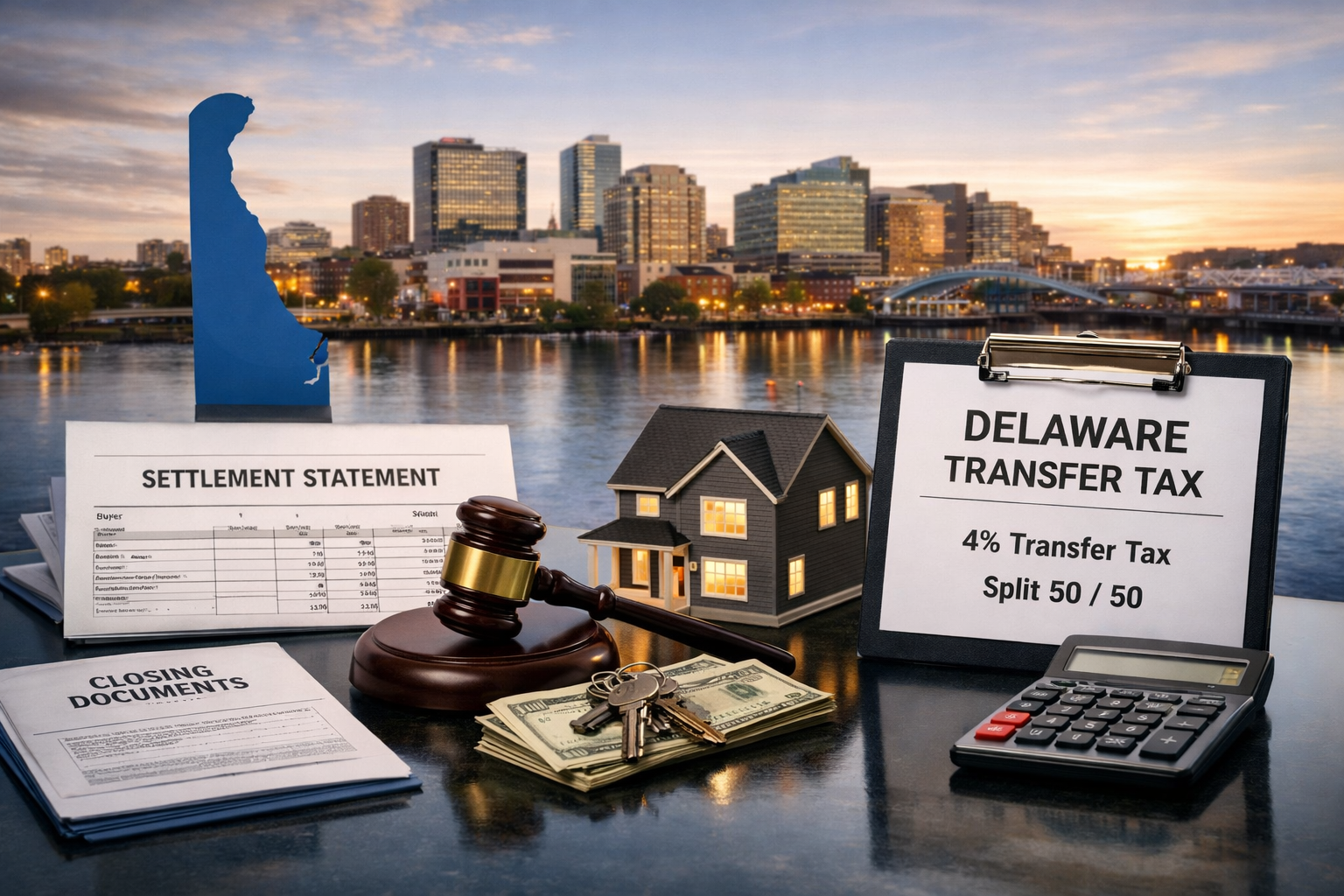
Delaware is the smallest state we cover at Signed to Keys, but punches well above its weight on one specific dimension: the transfer tax. At 4% of the sale price — split 50/50 between buyer and seller by custom — Delaware has one of the highest realty transfer tax rates in the United States. A $400,000 Delaware home triggers $16,000 in transfer tax at closing, split roughly $8,000 to each side. For context, that same $400,000 sale in Pennsylvania would trigger about $8,000 total (split 50/50 = $4,000 each). In New Jersey, the seller would pay about $1,800 in RTF. In Maryland, combined taxes would be maybe $6,000-$8,000 depending on county and exemptions. Delaware's transfer tax is in a league of its own.
That high tax is the single most important operational fact about Delaware closings. Everything else — the attorney-required structure, the three-county system, the specific first-time homebuyer exemptions, the settlement statement (Closing Disclosure) review discipline — exists in a market where a 4% transfer tax materially shapes how agents negotiate, how buyers budget, and where TC attention focuses.
This post is the working agent's walkthrough of Delaware settlement statements and transfer tax. How the 4% tax is structured between state and local portions, who pays what by custom and by contract, what the first-time homebuyer exemption actually does, how Delaware's attorney-required settlement process operates, what a settlement statement in a Delaware deal includes, and where agents most often fumble. Written from the perspective of a transaction coordination firm that processes Delaware files every week.
The Core Structure: Attorney-Required, Like Connecticut
Before the tax math, the structural piece. Delaware is an attorney-required state for real estate settlements — similar to Connecticut in that a Delaware-licensed attorney must conduct the closing. The requirement isn't codified in a standalone statute like CT's, but it comes from a 2000 Delaware Supreme Court decision (In re Mid-Atlantic Settlement Services) finding that conducting real estate settlements in Delaware without attorney involvement constitutes the unauthorized practice of law.
The practical effect is the same as Connecticut:
A Delaware-licensed attorney must preside over the settlement.
Title companies participate but cannot conduct the closing alone.
Out-of-state attorneys cannot conduct Delaware closings.
The buyer has the right to choose their attorney — the Delaware Supreme Court has been explicit that purchasers must know who is representing them and must freely choose that representation.
One specific Delaware procedural detail: because the Supreme Court has emphasized the buyer's right to choose counsel, attorneys handling Delaware closings typically send the buyer an explicit representation letter at the outset, explaining the attorney-client relationship and asking the buyer to affirm their choice of counsel in writing. This is a Delaware-specific protocol that doesn't have a direct parallel in other states.
Who typically has attorneys. The buyer's attorney conducts the closing and represents the buyer's interests throughout. Sellers may or may not have their own attorney — on many Delaware residential deals, the seller relies on the buyer's attorney to prepare closing documents and process the settlement without engaging separate seller counsel. On more complex transactions (investor deals, FSBO sales, high-value properties), both sides often have attorneys.
What the attorney does. The Delaware closing attorney typically handles: ordering and reviewing the title, coordinating with the title company on title insurance issuance, preparing the deed, acting as escrow agent for closing funds (the attorney's trust account), preparing the settlement statement (Closing Disclosure), conducting the settlement meeting, collecting and disbursing funds, recording the deed with the county Recorder of Deeds, paying transfer taxes, and post-closing follow-up.
The 4% Transfer Tax
Delaware's realty transfer tax is the defining closing cost feature of the state. Breaking it down:
State Realty Transfer Tax. The state portion is 2.5% of the sale price in most scenarios. Historically, the state imposed a 2% tax, but the rate was increased to 3% effective August 1, 2017. Counties and municipalities are authorized to impose a local tax of up to 1.5%. When the local tax is 1.5%, the state portion is reduced to 2.5%, keeping the combined total at 4%. In practice, all three Delaware counties impose the full 1.5% local tax, so the effective combined rate is 4% (state 2.5% + local 1.5%).
County/Municipal Realty Transfer Tax. Each of Delaware's three counties — New Castle, Kent, and Sussex — imposes the 1.5% local transfer tax. Some municipalities within counties may have additional rules, but the standard residential combined rate is 4% across the state.
Who pays. By Delaware custom, the 4% transfer tax is split 50/50 between buyer and seller — each party pays 2% of the sale price. This is convention, not law. The split is negotiable and can be shifted by contract. In buyer's markets or as seller inducements, sellers occasionally agree to cover a larger share; in competitive bidding situations, buyers sometimes offer to take on more.
When it's paid. At closing, collected by the buyer's attorney, paid to the County Recorder of Deeds at recording, which then distributes the state portion to the Delaware Division of Revenue and retains the county portion.
Example calculations on a 50/50 split:
$300,000 sale: Total tax $12,000. Buyer pays $6,000. Seller pays $6,000.
$500,000 sale: Total tax $20,000. Buyer pays $10,000. Seller pays $10,000.
$700,000 Rehoboth Beach sale: Total tax $28,000. Buyer pays $14,000. Seller pays $14,000.
$1,000,000 sale: Total tax $40,000. Each side pays $20,000.
These numbers surprise buyers and sellers moving into Delaware from elsewhere. An agent who doesn't communicate the tax burden early in the process creates closing-day friction that could have been prevented.
First-Time Homebuyer Exemption
Delaware provides a partial transfer tax exemption for first-time homebuyers, which is materially valuable on qualifying transactions. The specifics:
What's exempt. The exemption applies only to the buyer's share of the transfer tax, and only to the state portion (not the county/municipal portion). The buyer's 2% state transfer tax obligation is reduced on the first $400,000 of the purchase price.
Specifically:
State portion exemption: Buyer is exempt from the state's 1.25% rate (which is the buyer's 50% share of the 2.5% state tax) on the first $400,000 of the purchase price. This caps the savings at $5,000 on the state side.
County portion exemption: All three Delaware counties provide an additional county-side first-time buyer exemption, varying by county. This typically caps savings at an additional $2,000-$3,000 on the county side.
Eligibility. A "first-time homebuyer" in Delaware is defined as someone who has never owned a primary residence anywhere — in Delaware or any other state. The buyer must be purchasing the property as a primary residence.
The seller keeps paying. Importantly, the exemption applies only to the buyer's share. The seller still pays the full 2% (1.25% state + 0.75% county) on their side regardless of whether the buyer qualifies. This differs from some other states' first-time buyer provisions that shift or reduce the seller's obligation.
Example on $350,000 sale in New Castle County to first-time buyer:
Without exemption: Buyer owes $7,000 (2% of $350,000). Seller owes $7,000.
With exemption: Buyer's state portion reduced by up to $4,375 (1.25% of $350,000), and county portion further reduced. Buyer's effective payment drops to roughly $4,000-$5,000 depending on the exact county exemption applied.
The buyer must claim it. The exemption is not automatically applied — the buyer's attorney has to complete the appropriate paperwork (specific forms filed with the deed) asserting first-time buyer status. Agents and TCs who don't flag first-time buyer status at the start, and ensure the attorney applies the exemption, leave real money on the table.
Form 5402. Every Delaware transfer tax filing uses the State of Delaware Realty Transfer Tax Return Form 5402. First-time homebuyer claims are made on this form, along with supporting affidavits.
The "Improvements" Tax Wrinkle
One Delaware-specific complication worth knowing: the state imposes a separate tax on new improvements exceeding $10,000 when the underlying property has been held by the same owner for less than a specified period. This is sometimes called the "improvements tax" and is designed to capture transfer tax value on newly constructed or substantially improved properties that wouldn't otherwise be subject to transfer tax.
This comes up most often in:
New construction where a builder or developer sells a completed home.
Substantial renovations where a property's value has increased significantly due to recent improvements.
Short-term holds where an investor or flipper sells quickly after making improvements.
Delaware closing attorneys handle this calculation at settlement. Agents working new construction or flip properties need to be aware that transfer tax on these transactions may include an improvements tax component in addition to the standard 4% on the sale price.
The Three Delaware Counties
Delaware's three counties each have their own Recorder of Deeds office and their own county transfer tax affidavits:
New Castle County. Includes Wilmington, Newark, and the bulk of Delaware's northern population. New Castle County Realty Transfer Tax Affidavit must be completed for every property transfer, including parcels starting with parcel IDs 06 through 15 (which cover specific municipalities and geographic zones). The county office processes all recordings for New Castle properties.
Kent County. Includes Dover, the state capital, and central Delaware. Kent County has its own recording office and its own transfer tax filing procedures. Kent County's transfer tax rules are generally consistent with the state framework but use county-specific forms.
Sussex County. Includes Rehoboth Beach, Lewes, Bethany Beach, Millsboro, Georgetown, and all of southern Delaware — the state's beach market. Sussex has its own Recorder of Deeds office and unique considerations around coastal properties, second-home purchases, and investor-heavy transactions. Sussex County's active beach market means a lot of transfer tax revenue flows through its office.
Form considerations. Each county uses slightly different affidavits and supporting documents. The closing attorney needs to use the correct forms for the specific county. An out-of-state agent working with a new attorney relationship should confirm the attorney has county-specific experience — particularly important in Sussex County, which sees significant non-resident buyer volume.
The Settlement Statement (Closing Disclosure)
In Delaware as in other states, financed transactions use the Closing Disclosure (CD) as the primary settlement accounting document, required under the TRID (TILA-RESPA Integrated Disclosure) rule. Cash transactions use the ALTA Settlement Statement or a similar attorney-prepared settlement accounting.
What's on a Delaware settlement statement:
Purchase price and financing details.
Transfer tax line items — separately broken out between state and county portions, and between buyer's and seller's shares.
First-time buyer exemption when applicable — showing the reduction against the buyer's transfer tax line.
Attorney fees for the buyer's attorney (and seller's attorney, if represented separately).
Title insurance premiums — owner's policy and lender's policy, regulated at state rates.
Title company/settlement company fees.
Recording fees paid to the county Recorder of Deeds.
Real estate commissions.
Mortgage-related costs — origination fees, loan processing, credit report, appraisal, etc.
Prepaid items — homeowner's insurance, property tax escrows, prepaid interest.
Property tax prorations.
HOA/condo dues prorations if applicable.
Credits and adjustments (seller concessions, repair credits, etc.).
Delaware property tax proration. Delaware counties have their own property tax calendars. New Castle County, Kent County, and Sussex County each have their own fiscal year structure and billing cycles. Proration at closing depends on the specific county's tax year — something closing attorneys handle but that TCs and agents should verify on the settlement statement.
TRID three-day rule applies. The CD must be provided to the buyer at least three business days before consummation of a federally related mortgage loan. Late CD issuance causes closing delays in Delaware, same as other states.
The Closing Meeting
Delaware closings typically happen at the buyer's attorney's office, with participants including:
The buyer and seller (may be represented by power of attorney or via mail-away closing).
The buyer's attorney (conducts the closing).
The seller's attorney if one is involved.
Real estate agents (attendance varies).
Representatives of the lender or title company (sometimes).
At settlement:
The attorney walks through the settlement statement line by line.
All parties sign required documents — deed (seller), mortgage and note (buyer, if financing), affidavits, transfer tax forms, lender disclosures.
The buyer's funds (down payment, closing costs) are confirmed in the attorney's trust account.
The seller's existing mortgage payoff is wired.
Transfer taxes are prepared for payment at recording.
Real estate commissions are disbursed.
Seller's net proceeds are disbursed.
Keys are transferred.
Recording follow-up. After closing, the attorney submits the deed, Form 5402, county-specific affidavits, and payment of transfer taxes to the appropriate county Recorder of Deeds. Recording typically happens same-day or next-business-day, depending on the county's volume and submission timing.
TC role at closing. Coordinate wire transfer timing (secure verification), confirm all parties' attendance, verify the settlement statement before signing, track any last-minute issues that arise, and confirm recording follows closing cleanly.
What a Good Delaware TC Handles
For agents using a transaction coordinator on Delaware files, TC responsibilities center on Delaware's specific structural elements:
1. Attorney coordination and buyer's right to choose
The TC confirms the buyer has freely chosen their Delaware attorney, the attorney's representation letter has been received and acknowledged, and the attorney is properly engaged from contract forward. Works through the buyer's attorney on all substantive issues.
2. Transfer tax calculation verification
Because the 4% tax is such a large line item, getting the math right matters. The TC verifies the state (2.5%) + county (1.5%) split, confirms the buyer/seller allocation matches the contract, and flags any errors on the settlement statement before closing.
3. First-time homebuyer exemption application
When the buyer qualifies, the TC ensures the attorney applies both the state and county first-time buyer exemptions correctly. Verifies the reduction appears on the settlement statement. Confirms the savings matches expectations. Missing this is a direct, dollar-quantifiable disservice to first-time buyer clients.
4. County-specific recording coordination
Because Delaware's three counties have separate Recorder of Deeds offices with county-specific forms, the TC confirms the attorney is using the correct county affidavits and tracks recording timing for the specific county.
5. Improvements tax awareness
On new construction or recently renovated properties, the TC flags potential improvements tax exposure and confirms the attorney's calculation. For flipped properties in particular, this is a real consideration.
6. Property tax proration verification
Each Delaware county has its own tax calendar. The TC verifies proration calculations use the correct fiscal year and reflect accurate tax bills.
7. Settlement statement review
Given the attorney prepares the CD, the TC independently reviews it for obvious issues before closing. Transfer tax math, attorney fees, title insurance premiums, commissions, and prorations are the most common error zones.
8. Secure wire transfer protocols
Delaware high-value closings — especially Rehoboth Beach and Lewes vacation home purchases — are wire fraud targets. TC enforces verified wire instructions via phone (not email), educates buyers on wire fraud risks, confirms wire receipt before closing.
9. Cross-border coordination
Delaware sits adjacent to PA (New Castle County borders PA), MD (Sussex and Kent County border MD), and NJ (across the Delaware Bay). Cross-border buyers and sellers are common. A TC coordinates between states when parties are dealing with both sides of a border — Delaware settlement proceeding while Pennsylvania or Maryland property is also being bought or sold.
10. Closing-to-recording follow-up
Delaware's attorney-led closings don't fully conclude until recording. The TC tracks post-closing recording with the county, confirms title insurance policies are issued, and closes out the file cleanly.
Common Mistakes Agents Make on Delaware Deals
In order of frequency, mistakes we see on Delaware files:
1. Not flagging the 4% transfer tax early in the process
The single biggest Delaware-specific mistake. Buyers moving from PA, NJ, NY, or elsewhere commonly don't expect a 2% buyer-side transfer tax — it dwarfs what they'd pay in neighboring states. Not building this into early net-cost or closing-cost conversations creates significant client friction.
2. Missing first-time homebuyer exemption
Either by not identifying first-time buyer status at contract, or by not ensuring the attorney applies both state and county exemptions, agents leave thousands of dollars on the table. This is a direct, quantifiable disservice to qualifying clients.
3. Using an out-of-state attorney
Delaware requires a Delaware-licensed attorney. Buyers coming from Maryland or New Jersey sometimes want to use an attorney they already know from across the state line. That doesn't work for a Delaware closing — Delaware counsel is required.
4. Assuming the 50/50 split is mandatory
The contract controls the split, and it's negotiable. In slower markets or as an inducement, shifting the transfer tax allocation can be a meaningful negotiating tool. Agents who treat 50/50 as a fixed rule miss negotiation opportunities.
5. Improvements tax surprises on new construction
When selling a new construction home, or an investor-flip, agents sometimes don't realize the improvements tax could apply. Buyers and sellers can get surprised at closing.
6. Not communicating buyer's right to choose attorney
Delaware's Supreme Court protocol requires the buyer to actively choose their attorney, typically documented by a letter from the attorney. Agents who recommend attorneys without giving buyers a clear choice process create compliance and trust issues.
7. Missing county-specific filing requirements
Each Delaware county has its own affidavits and forms. Attorneys with limited Delaware experience, or title companies without county familiarity, sometimes mishandle the paperwork, causing delays at recording.
8. Underestimating the Sussex County beach market dynamics
Sussex County sees significant non-resident buyer activity — New Yorkers, Pennsylvanians, Marylanders buying vacation or investment properties. These transactions have specific complexities (second-home financing, short-term rental considerations, coastal flood zone issues) that need Delaware-specific handling.
9. Confusing Delaware with its neighbors on transfer tax
Agents working PA and Delaware alongside each other sometimes import PA's much lower transfer tax expectations into Delaware client conversations. PA's 2% vs. Delaware's 4% is a huge difference on a $500,000 sale.
10. Treating settlement statement review as administrative
The CD or settlement statement in a Delaware deal contains substantial transfer tax line items, attorney fees, and various other charges. Careful review — ideally by a TC in the days before closing — catches errors that would otherwise show up at the table.
The Bottom Line
Delaware closings are fundamentally shaped by the 4% transfer tax and the attorney-required settlement structure. The tax is high, the attorney is mandatory, and the first-time homebuyer exemption is the most meaningful way to reduce costs for qualifying buyers. Three counties each have their own recording offices and affidavits. Settlement statements (primarily the Closing Disclosure) require careful review because the transfer tax alone can represent $10,000-$40,000 or more on typical Delaware residential transactions.
For agents expanding into Delaware from PA, MD, NJ, or NY, the tax burden is the first thing to internalize and communicate to clients. The attorney-required structure is the second. The first-time homebuyer exemption is the third. Beyond those core facts, Delaware operates similarly to other attorney-assisted states — title companies participate, the closing happens at the attorney's office, and the settlement statement is the final accounting of an often-complicated set of numbers.
A Delaware-experienced transaction coordinator handles what agents can't carry alone: verifying the transfer tax math, ensuring the first-time buyer exemption is applied, tracking county-specific recording requirements, coordinating with the attorney throughout, and reviewing the settlement statement carefully before closing. That operational discipline is what separates smooth Delaware closings from ones where the tax surprise or the exemption miss becomes a real problem for the client.
Frequently Asked Questions
What is the transfer tax rate in Delaware?
Delaware's combined realty transfer tax is 4% of the sale price — 2.5% state plus 1.5% county/municipal. By custom, the tax is split 50/50 between buyer and seller, with each paying 2% of the sale price. This makes Delaware's transfer tax one of the highest in the United States. The split is negotiable by contract, though the 50/50 convention is dominant in most transactions.
Who pays the Delaware transfer tax?
By Delaware custom, buyer and seller each pay 2% of the sale price — half of the combined 4% total. This is convention, not statute, and can be negotiated differently in the contract of sale. In buyer's markets or as seller concessions, sellers sometimes agree to cover a larger share; in competitive situations, buyers may offer to take more. The specific allocation should be clearly stated in the purchase contract.
Is an attorney required to close a real estate transaction in Delaware?
Yes. Under a 2000 Delaware Supreme Court decision (In re Mid-Atlantic Settlement Services), real estate settlements in Delaware must be conducted by a Delaware-licensed attorney. Title companies cannot conduct closings without attorney involvement. The buyer has the right to choose their attorney, and Delaware has specific protocols requiring attorneys to send representation letters asking the buyer to affirm their choice of counsel.
What is Delaware's first-time homebuyer exemption?
Delaware provides a partial transfer tax exemption for first-time homebuyers, applying only to the buyer's share of the transfer tax. The state portion exemption reduces the buyer's 1.25% state share on the first $400,000 of purchase price (capping savings at $5,000). All three Delaware counties (New Castle, Kent, and Sussex) provide additional county-side first-time buyer exemptions. Eligibility requires the buyer has never owned a primary residence in any state and is purchasing the property as a primary residence. The exemption must be claimed on Form 5402 and is not automatically applied — attorneys and TCs need to ensure it's properly filed.
Can a buyer choose their own attorney in Delaware?
Yes. The Delaware Supreme Court has been explicit that buyers have the right to choose their attorney in a real estate transaction. Attorneys handling Delaware closings typically send the buyer a representation letter at the outset, explaining the attorney-client relationship and asking the buyer to affirm their choice of counsel. Real estate agents can recommend attorneys, but the buyer ultimately chooses — and must do so freely, not under pressure.
What counties have their own Recorder of Deeds in Delaware?
Delaware has three counties — New Castle, Kent, and Sussex — each with its own Recorder of Deeds office. Each county uses slightly different transfer tax affidavits and forms. New Castle County covers the Wilmington-Newark area. Kent County covers central Delaware including Dover. Sussex County covers southern Delaware including Rehoboth Beach, Lewes, Bethany Beach, and Georgetown. Closings are recorded with the county where the property is located.
What is Delaware's improvements tax?
When a property's value has increased substantially due to new improvements exceeding $10,000 — and the property has been held by the same owner for less than a specified period — Delaware may impose a separate "improvements tax" on the increased value. This applies most often to new construction, substantial renovations, and investor flip properties. It's in addition to the standard 4% transfer tax on the sale price. Closing attorneys handle the calculation at settlement.
How long does a Delaware closing take from contract to close?
A typical Delaware residential transaction runs 30-45 days from contract execution to closing, with financed deals taking the upper end of that range. Cash deals can close faster (15-25 days). Complications around title, appraisal, inspection, or attorney coordination can extend the timeline. The three-business-day Closing Disclosure rule under TRID applies to financed purchases, meaning late CD issuance can push closing.
What is Form 5402?
The State of Delaware Realty Transfer Tax Return Form 5402 must be filed for every real estate transfer in Delaware. The form documents the sale price, calculates the state and county transfer tax, and supports any exemption claims (including the first-time homebuyer exemption). The closing attorney typically prepares and files this form along with the deed at recording. Line 7 of the form addresses the 2017 state rate increase, with specific rules for contracts executed before August 1, 2017.
How does Delaware's transfer tax compare to neighboring states?
Delaware's 4% combined transfer tax is significantly higher than neighboring states. Pennsylvania's standard rate is 2% (higher in Philadelphia, Pittsburgh, Reading). New Jersey's Realty Transfer Fee is graduated but typically under 1% unless mansion tax applies. Maryland's stack can reach 2-3% depending on county. On a $400,000 home, the transfer tax would be roughly $16,000 in Delaware, $8,000 in PA, $2,000-$3,000 in NJ, and $4,000-$8,000 in Maryland depending on county.
How can a transaction coordinator help with Delaware files?
A Delaware-experienced TC handles the operational details that shape closing outcomes: verifying the 4% transfer tax math (state 2.5% + county 1.5%, split correctly between buyer and seller), ensuring first-time homebuyer exemptions are applied, managing county-specific recording requirements across New Castle, Kent, and Sussex, coordinating with the buyer's attorney throughout the transaction, flagging improvements tax exposure on applicable properties, verifying property tax prorations using county-specific tax calendars, reviewing the settlement statement before closing, managing wire transfer security protocols, and coordinating cross-border transactions with PA, MD, or NJ. Given the size of Delaware's transfer tax line items, careful verification saves clients thousands and prevents closing-day surprises.
Ready to See What a Transaction Coordinator Can Do For Your Delaware Files?
Signed to Keys provides full-service transaction coordination for real estate agents across Pennsylvania, New Jersey, New York, Maryland, Connecticut, and Delaware — with deep experience in Delaware's attorney-required settlement model, 4% transfer tax calculation and verification, first-time homebuyer exemption application, three-county recording coordination, and cross-border coordination with surrounding states. One dedicated point of contact, 30+ tasks handled per file, a secure portal with wire fraud protection built in.
Free 30-minute consultation. No pressure, no obligation. We'll learn about your business, walk you through how we handle Delaware files specifically, and help you figure out whether we're the right fit.
Request Your Free Consultation →
Sources
Delaware Code, Title 30, Chapter 54 (Realty Transfer Tax). Retrieved from https://delcode.delaware.gov
Delaware Division of Revenue. Realty Transfer Tax and Form 5402. Retrieved from https://revenue.delaware.gov
Delaware Division of Revenue. First-Time Home Buyer Credit. Retrieved from https://revenue.delaware.gov/RTT/FHB_credit.shtml
New Castle County, DE. Transfer Tax. Retrieved from https://www.newcastlede.gov/138/Transfer-Tax
Kent County, DE. Realty Transfer Tax Rates. Retrieved from https://www.kentcountyde.gov
Delaware Supreme Court. In re Mid-Atlantic Settlement Services (2000 Del. LEXIS 243).
Delaware Association of REALTORS®. State Transfer Tax. Retrieved from https://delawarerealtor.com/statetransfertax/
National Association of REALTORS®. What the NAR Settlement Means for Home Buyers and Sellers. Retrieved from https://www.nar.realtor/the-facts/what-the-nar-settlement-means-for-home-buyers-and-sellers
Disclaimer: This post is general information about Delaware real estate transfer tax and settlement procedures based on public sources and common practice, not legal or tax advice. Delaware tax rates, exemptions, and closing procedures are subject to change, and interpretation can vary by fact pattern. Any agent or party with a specific question about a Delaware transaction should consult a licensed Delaware real estate attorney. Rates, thresholds, and statutory provisions cited are current as of April 2026 and subject to change.
About Signed to Keys
Signed to Keys is a real estate transaction coordination firm serving agents across six Northeast states — Pennsylvania, New Jersey, New York, Maryland, Connecticut, and Delaware. From contract to keys, we handle the 30+ administrative tasks per file that would otherwise eat your prospecting time, built on secure systems that protect your clients and your license.
signedtokeys.com | hello@signedtokeys.com | (703) 420-9757