How Wire Fraud Became the #1 Risk in Real Estate (and What To Do About It)
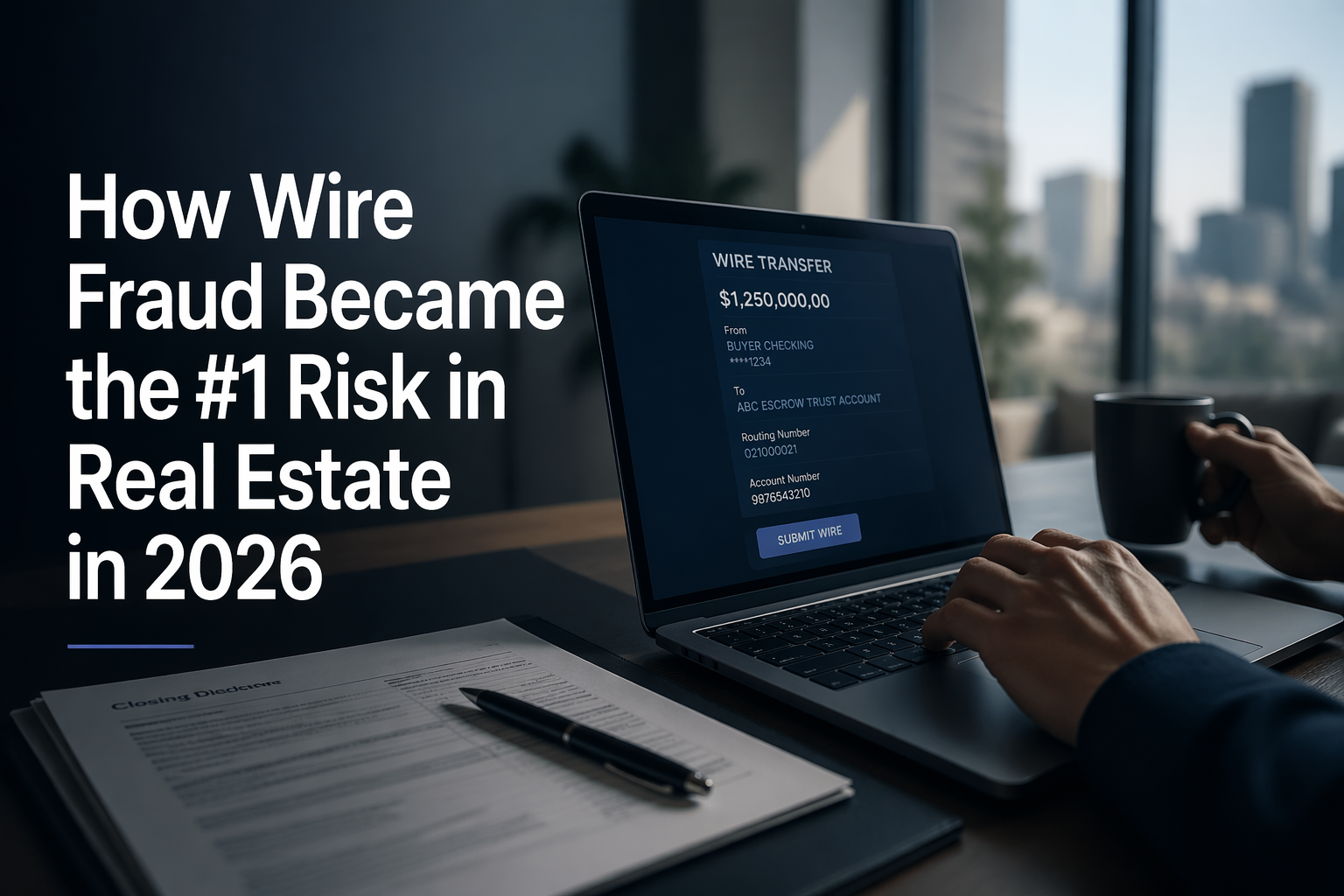
There's a specific moment that exposes every real estate transaction to catastrophic risk. It lasts maybe 30 seconds. It happens on a laptop or a phone, usually with a cup of coffee nearby, usually on the morning of closing or the day before.
A buyer pulls up their online banking, enters the routing and account numbers they received by email, types in the wire amount — often their entire life savings plus a loan — clicks submit, and in that instant, if the wiring instructions were fake, the money is gone. Usually forever. No bank will reverse it. No title insurance covers it. No one is coming to make them whole.
This is wire fraud. And in the span of about eight years, it has become the single largest financial risk in residential real estate. Not the biggest deal risk — inspections and financing still kill more deals. But the biggest dollar risk by orders of magnitude. A failed inspection costs a commission. A wire fraud event costs a family their down payment and a title company its reputation, and the industry has spent the better part of a decade trying to catch up.
This is how it happened, where the industry stands in 2026, and — more importantly — what actually works to stop it.
The numbers: just how bad is this
The FBI's Internet Crime Complaint Center (IC3) has been tracking real estate wire fraud for years, and the trend line is sobering. The most recent data:
2025: $275+ million in losses across 12,368 real estate-related fraud complaints (NAR, 2026 citing FBI IC3; RISMedia, April 2026).
2024: $173.6 million across 9,359 complaints.
2023: $145 million across 9,521 complaints.
2022 (peak year): $397 million across 11,727 complaints.
Zoom out to the broader cybercrime picture and the scale becomes clearer. The FBI reported $16.6 billion in total cybercrime losses in 2024, a 24% to 33% year-over-year increase depending on the calculation (Plymouth Title; CertifID 2026 Report). Business Email Compromise (BEC) — the mechanism behind almost every real estate wire fraud incident — accounted for over $2.77 billion in reported losses in 2024 and over $3 billion by 2025 (National Mortgage News, 2026).
And those are just the reported losses. Many victims never file. Many incidents get classified under different categories. The real number is higher.
Two statistics that reframe the risk:
60% of title professionals surveyed in 2026 reported that fraud attempts are increasing (CertifID, 2026). This is no longer a story about rising sophistication happening to a few victims. It's a widespread, active, daily attack surface across the industry.
56% of consumers say they would not work with a title company or real estate firm again after a wire fraud incident — even if all of their funds were fully recovered. Trust doesn't automatically follow a recovery (CertifID, 2026). The reputational cost for firms that get breached outlasts the financial cost by years.
Why real estate specifically
Wire fraud targets industries with a specific profile: large dollar amounts, complex multi-party transactions, time pressure, and email-driven coordination between people who've often never met in person. Real estate checks every box.
A typical residential purchase involves a buyer, seller, buyer's agent, listing agent, lender, loan officer, loan processor, underwriter, title officer, escrow agent, and (in attorney states) multiple attorneys — all coordinating primarily through email across 30 to 90 days with tight, shifting deadlines. Real estate transactions create a unique environment for fraud risk — the conditions make it easy for fraudsters to insert themselves at exactly the right moment (CertifID).
A fraudster doesn't have to break into anything sophisticated. They just need to compromise one email account in the chain — a busy loan officer, an overworked paralegal, an agent who uses the same password across multiple tools — and from there, they can read weeks of email correspondence, learn the specific cadence and language of that transaction, wait until closing is imminent, and send a perfectly-timed email impersonating the title company with updated wiring instructions.
By the time anyone realizes, the money is gone.
How the attack actually works
The mechanics are worth understanding in detail, because the defenses all flow from understanding exactly what the attackers do.
Step 1: Initial compromise. The fraudster gains access to an email account somewhere in the transaction chain. Usually through a phishing email that tricks someone into entering their credentials on a fake login page. Sometimes through credential theft (passwords leaked in a prior breach). Increasingly through AI-generated voice calls impersonating IT staff.
Step 2: Reconnaissance. Once inside the email account, the fraudster doesn't act immediately. They read. They watch. They learn who the parties are, what the closing date is, what the loan amount is, how the real title company writes emails, and who reports to whom. This is often called the "dwell period," and it can last weeks.
Step 3: Impersonation. The fraudster creates a lookalike email domain (say, @firstamerican-title.com instead of @firstamericantitle.com) or compromises the actual email account of a party in the chain.
Step 4: The strike. Timed precisely. Usually 1 to 3 days before closing, when urgency is high and scrutiny is low. The fraudster sends an email to the buyer — usually impersonating the title company or closing attorney — with "updated wiring instructions" and a note about the old instructions being outdated or containing errors. The email looks identical to the real thing because they've been watching real emails for weeks.
Step 5: The wire. The buyer, trusting the email, wires the funds to the fraudster's bank account. By the time the real title company calls to ask where the money is, it's often already been moved to a second account, then a third, then converted to cryptocurrency — a chain designed to make recovery nearly impossible.
This is textbook Business Email Compromise (BEC), which the FBI identifies as the primary real estate wire fraud mechanism (CertifID).
The three most common real estate fraud scenarios
According to CertifID's 2026 Fraud Recovery Services data, three categories account for the majority of cases:
Buyer cash-to-close fraud — 30% of cases. Criminals impersonate the title company and send fraudulent wire instructions to the buyer, usually targeting first-time buyers who are unfamiliar with the process and less likely to question instructions that appear to come from a trusted source. This is the classic scenario, and it's still the most common.
Seller proceeds fraud. Criminals impersonate the seller (often after compromising the seller's email) and send updated disbursement instructions to the title company, redirecting the sale proceeds to the fraudster's account. The seller finds out when their money never arrives.
Down payment / earnest money fraud. Similar to cash-to-close fraud but targeting earlier in the transaction — the initial earnest money deposit, typically 1 to 3% of the purchase price.
Newer attack patterns are also emerging:
AI-driven impersonation. Fraudsters are using AI-generated voices to mimic real title officers or attorneys during phone "verification" calls. A buyer who calls to verify wiring instructions can now reach a convincing AI voice that confirms the fraudulent instructions. The 2026 CertifID report calls out that "the acceleration tied to AI is unlike anything we've seen before" (CertifID, 2026).
Deepfake video calls. Still rare but actively emerging. Fraudsters use AI-generated video to impersonate known parties on Zoom or Teams calls.
Who's liable when it happens
One of the reasons wire fraud is so devastating: liability is almost always on the victim.
Banks generally aren't liable. Once a wire is sent with instructions the customer provided, the bank considers their obligation complete.
Title companies are rarely liable unless they were the source of the breach (e.g., the fraudster compromised their email).
Real estate agents are usually not legally liable, but they frequently get named in lawsuits under theories of negligent supervision or failure to warn.
Buyers and sellers bear the financial loss in the vast majority of cases.
Title insurance does not cover wire fraud losses. This is the single most important thing buyers and agents need to understand. Title insurance covers title defects — liens, ownership disputes, errors in public records. It does not cover a buyer who wired their down payment to a scammer.
The FBI's Recovery Asset Team (RAT) recovers or freezes about 66% of attempted stolen funds when notified quickly through its Financial Fraud Kill Chain (Plymouth Title, 2026; FBI IC3 2024 Report). But the key word is quickly — victims who report within hours have the best chance. Victims who report days later usually have no chance.
What actually works: the prevention playbook
The good news: wire fraud is preventable. The core techniques aren't complicated, but they require discipline across every party in the transaction. These are the defenses the industry has settled on as standard-of-care in 2026.
1. Never trust wire instructions received by email
This is the single most important rule. Every wire instruction — whether it's the first one sent or a supposed "update" — must be verified by phone using a number the recipient already had, not a number included in the email. Email accounts get compromised. Phone numbers in the email body can be fraudulent. The number you verify against must come from a previous source: a business card, the title company's website (typed in directly, not clicked from the email), or a phone number the agent has used before.
Every email with wire instructions should include language like: "Never trust wire instructions received by email. Always verify by phone using a number you already have." And that warning should be followed.
2. Use secure, encrypted portals instead of email for sensitive documents
The broader shift the industry is making. Secure portals — from title companies, TCs, and transaction management platforms — encrypt documents, verify identities, and provide an audit trail. Sensitive documents like wiring instructions, payoff statements, and closing disclosures should never be transmitted as email attachments or in email bodies. Prevention has to be built in — not added on (CertifID, 2026).
3. Verify identities before sharing or acting on instructions
Multi-factor authentication on every email account involved in the transaction. Verified contacts at every party. No acting on instructions that come from an email address you haven't previously confirmed. This sounds obvious but is routinely skipped under deadline pressure.
4. Buyer education — early and repeatedly
Most buyer wire fraud victims are first-time buyers who didn't know to be suspicious. The industry has learned that warnings at the closing table are too late. The warning has to come at contract execution, at the start of the mortgage phase, and at the moment wire instructions are issued — three separate touches, all explicit.
The message that works: "You will receive exactly ONE set of wire instructions from [title company name] on [day]. If you receive any other wire instructions — including updates, corrections, or last-minute changes — do not act on them until you have called me personally at [number] to confirm. Not the number in the email. The number I just gave you."
5. Small test wires
Some banks and title companies now recommend sending a small test wire ($1 to $100) before the main wire, then calling the title company to confirm receipt before sending the full amount. Adds a day to the process but eliminates almost all fraud exposure.
6. Use dedicated wire-protection services
Tools like CertifID, ClosingLock, and others now provide wire-verification services specifically for real estate transactions. The buyer enters wiring instructions through the service, which verifies them against the title company's actual account before the wire goes out. Still relatively new, but becoming standard practice at better-run title companies and TCs.
7. One vetted point of contact
The model modern TCs and title companies are moving toward: one vetted contact per file, one secure portal, one verified channel for sensitive information. The more "last-minute changes from different email addresses" a transaction allows, the more attack surface it creates. The fewer channels, the less exposure.
What to do if it happens
Time is everything. If wire fraud is suspected or confirmed:
Within the first hour:
Call the sending bank immediately and request a wire recall.
File a complaint with the FBI IC3 at www.ic3.gov — this triggers the Financial Fraud Kill Chain, which has the best chance of freezing funds at the receiving bank.
Notify local law enforcement.
Notify the title company, lender, and all other parties in the transaction.
Within the first day:
Have the compromised email account audited by IT.
Change passwords on every account that could have been exposed.
Notify the buyer's bank's fraud department in writing.
Preserve all evidence — don't delete emails, don't delete logs.
Longer term:
Consult a real estate attorney about potential liability exposure.
Contact insurance carriers — some cyber insurance policies cover wire fraud.
Document the entire incident for potential litigation or recovery proceedings.
The 66% FBI recovery rate depends entirely on speed (FBI IC3 2024; Plymouth Title). Every hour that passes drops the recovery likelihood substantially.
Where the industry is going
A few forward-looking trends:
Fraud protection as a competitive differentiator. The 2026 CertifID report notes that consumers are increasingly choosing closing teams based on protection — verified wire protection has gone from premium feature to baseline expectation, and firms that communicate it confidently are winning business on it (CertifID, 2026).
AI vs. AI defense. Just as attackers are using AI, defenders are deploying AI-based anomaly detection that flags unusual email patterns, inconsistent sender behavior, and suspicious timing of communications. This arms race is escalating quickly.
Regulatory pressure. State and federal regulators are increasingly pushing for mandatory wire verification standards in real estate transactions. Expect more jurisdictions to require secure portals, verification protocols, and disclosure of fraud risks as part of standard real estate practice.
Liability reallocation. Courts are starting to apportion more liability to parties that failed to implement reasonable protections. The "we emailed a warning" defense is weakening. Firms that don't implement modern fraud prevention are increasingly at risk of being held partially liable when their client gets scammed.
The Northeast specifically
A few regional considerations for the states Signed to Keys serves — PA, NJ, NY, MD, CT, and DE:
High-value transactions. The Northeast has some of the highest average home prices in the country, which means larger wire amounts, which means bigger targets. A buyer wiring $400,000 is a far more attractive target than one wiring $150,000.
Attorney state complexity. More parties in every transaction (both attorneys plus agents, lenders, title) means more attack surface. Each additional party is another email account that could be compromised.
Multi-state deals. Cross-state closings — common for NYC-area buyers purchasing in NJ, CT, or PA — involve more out-of-state parties, more unfamiliar email addresses, and more opportunities for fraudulent impersonation.
Co-op complexity. NYC co-ops have unique funding flows through management companies and managing agents, creating additional channels that need to be secured.
A TC trained specifically on wire fraud prevention across these markets is no longer optional — it's a core line of defense.
The one-line summary
Wire fraud has become the #1 dollar risk in real estate because the transaction environment — high stakes, multiple parties, email-driven coordination, time pressure — is perfectly designed for attackers to exploit. The defenses that work aren't complicated: verified phone calls on every wire instruction, secure portals instead of email, one vetted contact per file, and relentless buyer education at multiple touchpoints. What's changed in 2026 is that doing nothing is no longer defensible. Prevention has moved from best practice to standard of care, and the firms that treat it as infrastructure are the ones winning business.
Frequently Asked Questions
How common is wire fraud in real estate transactions?
Far more common than most people realize. The FBI IC3 recorded 12,368 real estate-related fraud complaints totaling $275+ million in losses in 2025 (NAR, 2026). 60% of title professionals surveyed in 2026 reported fraud attempts are increasing (CertifID, 2026). Those are just the reported cases — actual numbers are meaningfully higher.
Does title insurance cover wire fraud losses?
No. Title insurance covers title defects — liens, ownership disputes, errors in public records. It does not cover a buyer who wires their down payment to a scammer. This is the single most dangerous misconception in real estate. Buyers should be told this directly and early.
Can stolen funds be recovered?
Sometimes, if reported quickly. The FBI's Recovery Asset Team recovers or freezes about 66% of attempted stolen funds when notified in time through its Financial Fraud Kill Chain (FBI IC3 2024 Report). Speed is everything — victims who report within hours have a real chance; victims who report days later usually don't.
What's Business Email Compromise (BEC)?
BEC is the primary mechanism behind real estate wire fraud. A fraudster gains access to an email account involved in the transaction (title company, agent, attorney, lender), reads correspondence for weeks to learn the cadence and details, then impersonates a trusted party to send fraudulent wire instructions at a critical moment. BEC scams accounted for over $3 billion in reported losses in 2025 (National Mortgage News, 2026).
What's the single most effective way to prevent wire fraud?
Verify every wire instruction by phone using a number you already have — not a number from the email. Every wire, every time, no exceptions. This one practice prevents the overwhelming majority of wire fraud incidents. Everything else — secure portals, identity verification, multi-factor authentication — is supporting infrastructure.
Why is wire fraud getting worse with AI?
AI makes impersonation dramatically easier. Fraudsters can now generate convincing voices, deepfake video, and perfectly-worded emails that match the style of any party in the transaction. The CertifID 2026 report notes the acceleration tied to AI is unlike anything the industry has seen before (CertifID, 2026). The defense has to evolve: verification calls alone are no longer enough — they need to be calls to previously-known numbers, not numbers provided in the suspicious email.
Are agents and TCs legally liable when their client gets scammed?
Agents are usually not legally liable, but are frequently named in lawsuits under theories of negligent supervision or failure to warn. Courts are increasingly apportioning liability to parties that failed to implement reasonable protections. The "we sent an email warning" defense is weakening. Modern standard of care includes secure portals, documented buyer education, and verification protocols.
What's a secure portal and why does it matter?
A secure portal is an encrypted document-sharing platform with verified identity, audit trails, and no reliance on email for sensitive information. Tools like transaction management platforms and services like CertifID and ClosingLock provide these channels specifically for real estate. Sensitive documents — wiring instructions, payoff statements, closing disclosures — should never travel through unencrypted email.
How much does real estate wire fraud protection cost?
Surprisingly little, relative to the risk. Services like CertifID and ClosingLock charge per-transaction fees typically in the $30 to $100 range. Secure portals are often bundled into transaction management platforms agents and TCs already use. Multi-factor authentication is free. The cost of not implementing these protections is measured in entire down payments — the math is overwhelming.
What should buyers know about wire fraud before closing?
Three things, said explicitly and repeatedly: (1) title insurance doesn't cover wire fraud, (2) never act on wire instructions received by email without verifying by phone first, and (3) you will receive exactly one set of wire instructions from the title company — any "updates" or "corrections" are red flags until verified. Say this at contract execution, at the start of mortgage phase, and when wire instructions are issued. Three touches, every time.
Should real estate firms carry cyber insurance?
Yes. Cyber insurance policies are increasingly covering wire fraud, E&O exposure related to fraud incidents, and data breach response costs. Premium costs have risen, but so has the risk. Firms operating in 2026 without cyber insurance are carrying liability exposure that would be considered negligent in most other high-stakes industries.
What's the first thing to do if wire fraud is suspected?
Call the sending bank immediately and request a wire recall. Then file a complaint with the FBI IC3 at www.ic3.gov — this triggers the Financial Fraud Kill Chain, which has the best chance of freezing funds at the receiving bank. Then notify the title company, lender, and all parties. Every hour matters. Recovery rates drop dramatically with time.
Want a TC whose wire fraud prevention is built into the workflow — not bolted on as an afterthought? Signed to Keys runs every transaction across PA, NJ, NY, MD, CT, and DE through a secure portal with one vetted point of contact, verified channels for sensitive information, and documented buyer education at multiple touchpoints. Request a free 30-minute consultation and we'll walk you through how modern fraud prevention should look on your next file.