Why Your Email Is the Weakest Link in Your Closing
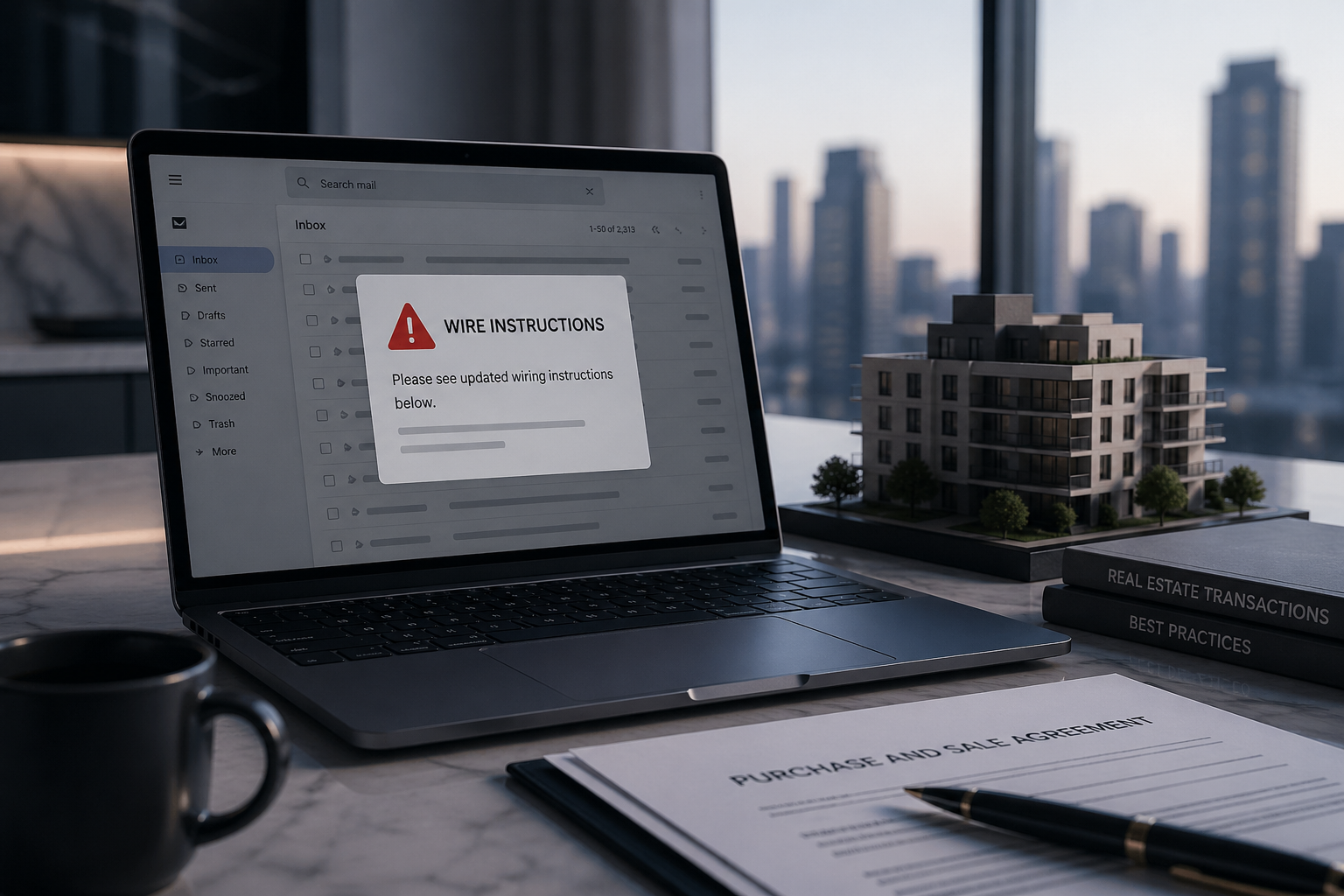
The Tool You Trust Most Is the One Fraudsters Exploit Best
Every real estate transaction runs through email. Contracts get forwarded, timelines get communicated, wire instructions get sent. Agents, title companies, lenders, attorneys, and buyers exchange dozens of messages across 30, 45, sometimes 90 days of a single deal. Email is the invisible infrastructure of the entire process — fast, familiar, and accessible to everyone involved.
It is also, by design, one of the least secure ways to conduct a high-stakes financial transaction.
Email continues to be the single largest conduit for cybercrime, both in terms of frequency and financial impact. A significant portion of the FBI's record-breaking $16.6 billion in 2024 cybercrime losses came from real estate and payroll fraud, where bad actors impersonated people to change wire transfer details or banking account information. Proofpoint
Business Email Compromise, the primary vehicle for real estate wire fraud, accounted for $2.77 billion in losses in 2024 — making it one of the top three most financially damaging forms of cybercrime in the country. Plymouthtitleinsurance
The reason email is this effective as an attack surface is not because agents and buyers are careless. It is because standard email was never built for what real estate professionals use it for. Its architecture, its default behaviors, and the way most people interact with it create a set of vulnerabilities that fraudsters have spent years learning to exploit precisely.
This post explains those vulnerabilities — what they are, how they are used against you, and what a transaction environment that doesn't rely on open email as its primary channel actually looks like.
Vulnerability #1: Email Addresses Are Trivially Easy to Fake
The most fundamental flaw in email as a secure communication channel is that the name a recipient sees in the "From" field bears almost no relationship to who actually sent the message.
Email display names are entirely free-form. Anyone can configure their email client to show any name they choose — your title company, your lender, your agent, even themselves. The actual sending address lives behind that display name, and in the default view of most email clients — Gmail, Outlook, Apple Mail — it is hidden unless the recipient deliberately clicks to expand it.
Spoofing involves creating email addresses that closely resemble legitimate ones — for example, replacing an "m" with an "rn" or using a different domain such as .biz or .net instead of .com. Impersonation may also include hijacking legitimate accounts, which makes it difficult for even vigilant users to detect fraud. Stewart
In many successful BEC cases, the emails were well written, cleanly formatted, and devoid of technical red flags — no links, no attachments, no misspellings. There is nothing to flag as suspicious. The email simply arrives, appears to come from a trusted party, and contains a plausible request. A buyer who has been receiving legitimate emails from their title company for six weeks does not think to scrutinize the sending address when the seventh email arrives. Palo Alto Networks
This is not a failure of technology — it is a design limitation that fraudsters exploit as a matter of course. Standard email authentication protocols exist but are inconsistently implemented, and even when they are in place, spoofed domains that closely resemble legitimate ones can still evade basic detection. The first line of defense — reading the actual sending address — is one that most recipients have never been taught to perform.
Vulnerability #2: A Compromised Inbox Gives Fraudsters Everything
Spoofing a sending address is one attack vector. The other, more dangerous one, involves compromising a real inbox and using it directly.
Attackers craft convincing phishing emails to trick victims into divulging login credentials. Once access is obtained, attackers either use the real account if it is not protected by MFA or create lookalike email addresses. They then use insider language and timing to manipulate recipients into taking urgent actions. Stewart
When a fraudster gains access to a real estate agent's email account — or a title company employee's, or a closing attorney's — they do not immediately strike. They wait.
The median dwell time before an attacker initiates a fraudulent action after inbox compromise is five days. Less than 8% of incidents are discovered through technical controls — most are uncovered through reconciliation or third-party notification. Palo Alto Networks
During those days, the fraudster reads every email in the inbox. They learn the names of the agent's buyers and sellers. They discover the property address, the purchase price, the closing date, the approximate wire amount, and the name of the title company. They understand the agent's writing style, the language they use, the way they sign their emails. They see which parties are in the transaction and what each person's role is.
It is not uncommon for attackers to create mail rules upon entry to provide filtering or backdoor capabilities. Specifically, they often create inbox rules that automatically delete or redirect any replies that mention fraud, wire recalls, or security concerns — so the legitimate account holder never sees a response that might alert them to the compromise. The fraudster can be operating inside the inbox invisibly, for days, while the real agent goes about their business believing everything is normal. Stewart
This is what makes a compromised inbox so much more dangerous than a spoofed address. The fraudulent email does not just look like it came from the agent — it actually did come from the agent's real account, with the agent's real signature, the agent's real email history. A buyer receiving that message has no reasonable way to detect the fraud without independently calling the agent to verify.
Vulnerability #3: Every Party in a Transaction Chain Is a Potential Entry Point
A real estate closing involves more email participants than most people realize: the buyer's agent, the seller's agent, the title company, the closing attorney, the lender, the transaction coordinator, and often inspectors, appraisers, HOA managers, and more. Each of these parties communicates by email. Each of their inboxes represents a potential entry point.
Commercial real estate transactions are particularly vulnerable to wire fraud because they happen on a regular, recurring basis and typically use established, straightforward processes. Fraudsters have learned the who, what, and when of purchase transactions, including when investors and banks finalize loan documents and send deposits. J.P. Morgan
The weakest security link in a transaction is not necessarily the agent or the title company — it could be a vendor, a co-op agent, or any other party whose inbox is accessible and less protected. Once any inbox in the chain is compromised, the fraudster has a window into the entire transaction. They do not need to compromise the most secure party. They need to compromise the least secure one.
Attackers often monitor communications to insert themselves at crucial moments, such as just before a wire transfer. They are not fumbling around trying to catch any opening — they are reading every email and waiting for the specific moment when money is about to move. That moment is the closing wire. The earnest money deposit. The down payment transfer. And when that moment arrives, they are ready with a message that looks indistinguishable from legitimate communication. Stewart
Vulnerability #4: Email Delivers Documents That Contain the Intelligence Fraudsters Need
Even when a fraudster cannot gain direct access to an inbox, the emails passing through an unsecured transaction chain give them valuable raw material. Contracts forwarded as attachments. Closing disclosures emailed between parties. HOA documents, inspection reports, title commitments — all carrying the property address, the parties' names, the purchase price, and the closing timeline.
Once the criminal gains access to an email account, they gain full details about the real estate deal — the property address, the closing date, the full amount, the down payment, the name of the bank. The criminal then sends a spoof wire transfer email to the homebuyer, with enough key details to be convincing, that informs them that there has been a last-minute change to the wiring instructions. Fortra
The specificity of these details is what makes the fraudulent email convincing. A generic scam email that says "please wire your closing funds" would be immediately suspicious. An email that references 47 Oak Street, mentions a closing date of May 12th, names the correct buyer and title company, and refers to a purchase price of $387,500 — that email passes every intuitive credibility check a buyer might apply.
Every sensitive document that travels through standard email is a potential intelligence source for a fraudster who intercepts any part of the chain. And standard email provides no way for the legitimate sender to know whether their message was intercepted, forwarded, or read by someone they never intended to reach.
Vulnerability #5: Email Creates a False Sense of Verification
Perhaps the most insidious aspect of email as a fraud vector is that it mimics the verification experience without providing it.
When a buyer receives what appears to be a follow-up message from their title company — referencing their specific transaction, using the company's logo, arriving from an address that looks correct — they feel as though they have identified the source. The email looks like confirmation that this is legitimate. In reality, they have verified nothing.
The only way to identify someone from their email address is to hover over their email address and read what it says. If you are suspicious about an individual's email, use the phone number that you got from your first physical contact with them — not what is written in the email. If the hacker has compromised that email address, they will alter everything within that email message to point to their fake websites and fake representatives. Viva Escrow
This matters because buyers and agents often perform what feels like verification — they look at the sender's name, they check that the email includes recognizable details, they may even reply to confirm receipt. But if the account is compromised or the address is spoofed, that reply goes back to the fraudster. The verification loop is closed inside the fraudulent channel, and the victim walks away believing they have confirmed what they never actually confirmed.
Vulnerability #6: The Volume and Pace of Email Makes Scrutiny Difficult
A real estate transaction generates dozens — sometimes hundreds — of email exchanges over its lifetime. Agents managing multiple active files receive this volume multiplied many times over. The sheer pace of email communication in a busy transaction environment creates conditions that make careful scrutiny of individual messages genuinely difficult.
Attackers impersonate partners, clients, or opposing counsel to request wire instructions or confidential documents. Because real estate communications often require quick action, the "urgency" angle in BEC lures victims into skipping verification steps. Strongestlayer
Fraudsters deliberately design their communications to fit naturally into the rhythm of an active transaction. A message about updated wire instructions arriving two days before closing is not an interruption of the workflow — it feels like part of it. The agent or buyer who is already managing a dozen moving pieces does not stop and interrogate this email the way they might if it arrived in a quieter moment. They process it as one more item in a busy queue.
BEC attacks do not rely on payloads or malware, which enables them to bypass technical detection by mimicking normal business operations. Attackers now leverage generative AI to write in brand and voice, insert rules into inboxes to redirect or delete replies, and target shared mailboxes where financial action is common. Palo Alto Networks
The professional-looking formatting, the familiar branding, the transaction-specific details, and the time-pressured context all work together to suppress the scrutiny that would catch the fraud. This is not a failure of individual judgment — it is a deliberate exploitation of the conditions that real estate email communication creates.
What the Alternative Looks Like
The solution to email's vulnerabilities is not to stop using email entirely. It is to stop routing sensitive, financial, and wire-related transaction communications through standard open email as if it were a secure channel.
A secure client portal changes the architecture of transaction communication in ways that directly address each of the vulnerabilities described above. Every user accessing the portal must authenticate with verified credentials — often with multi-factor authentication — meaning a display name cannot be faked and an unauthorized person cannot send messages that appear to come from a legitimate party. Sensitive documents live in a controlled environment rather than in email attachments. Communications exist in a single, audited thread rather than scattered across multiple inboxes that each represent a potential entry point.
Here are email security best practices for real estate agents: use multi-factor authentication for all email accounts, and implement employee training to identify phishing emails and suspicious behavior. These steps reduce the vulnerability of the email accounts that still exist, but they do not eliminate the structural problem — which is that email, even when protected, is still an open, spoofable, monitorable channel that fraudsters know how to exploit. Stewart
What truly changes the risk profile is combining secured email practices with a professional transaction coordination process that routes sensitive communications through a verified, encrypted environment from the start of the file — and that maintains one vetted point of contact for every party, so that any message arriving outside that environment can be immediately recognized as suspicious.
All parties involved should always verify wire instructions verbally, using known contact numbers established before any suspicious email arrived. This is the foundational verification step that email cannot provide — but a phone call to a number saved at the beginning of the transaction, through a coordinator who has already introduced every party and established every contact, can. Stewart
The Honest Assessment
Email's role in real estate transactions has never been reconsidered at the industry level because it works for almost everything except the one thing that matters most: the safe transfer of money. For scheduling, document routing, deadline reminders, and general coordination, email is fast and effective. For communicating wire instructions, transmitting sensitive financial documents, and establishing the identities of parties who will authorize large transfers — it is the wrong tool, used by an industry that has never been given a strong enough reason to change until now.
Email continues to be the most exploited attack vector, with cybercriminals using it for phishing scams, business email compromise attacks, and data exfiltration at scale. The growing need for organizations to adopt layered, human-centric defenses that mitigate human-activated threats across email, cloud, and collaboration platforms has never been clearer. Proofpoint
The agents, coordinators, and title professionals who understand this — and who have built their transaction processes around something more secure than open email for sensitive communications — are not just protecting their clients. They are running a fundamentally different kind of business. One where the weakest link in the closing has been identified and strengthened, rather than left open and hoped against.
Work With a Transaction Coordinator Who Doesn't Leave the Door Open
At Signed to Keys, every transaction runs through a secure client portal. Sensitive communications, documents, and wire-related updates route through a verified environment — not an open email chain. One dedicated coordinator. One vetted point of contact for every party. Established from day one of every file.
We serve real estate agents across Pennsylvania, New Jersey, New York, Maryland, Connecticut, and Delaware.
If you are ready to run transactions that treat email as what it is — a general communication tool, not a secure financial channel — let's talk.
Request Your Free Consultation → signedtokeys.com
No long-term commitment. No obligation. Just 30 minutes to find out whether we're the right fit for your business.
Frequently Asked Questions
Why is email so dangerous in real estate transactions specifically?
Because real estate combines the three conditions that make email exploitation maximally damaging: large sums of money moving in a defined, predictable window; multiple parties communicating primarily through email; and buyers who are unfamiliar with what legitimate transaction communications should look like. Fraudsters target this combination deliberately. Email is the shared infrastructure of every party in a closing, which means compromising any single inbox gives access to intelligence about the entire transaction.
What does "email compromise" actually mean and how does it happen?
Email account compromise means a fraudster has gained login access to a legitimate email account — typically through a phishing email that tricks the account holder into entering their credentials on a fake login page, or through credential stuffing using passwords leaked in prior data breaches. Once inside, the fraudster reads the account's emails, learns transaction details, sets up rules to hide their activity, and waits for the right moment to send fraudulent instructions — appearing to come from the real account holder.
If an email comes from a real email address, does that mean it's safe?
No — and this is one of the most dangerous misconceptions in real estate transaction security. When an inbox is compromised, messages sent from that inbox come from the genuine email address. They are signed with the real account holder's signature. They arrive in the recipient's inbox without any spoofing indicators. The only way to verify legitimacy is to call the supposed sender at a phone number that was saved before any suspicious communication arrived — not a number provided in the message itself.
How do fraudsters know the details of my specific transaction?
Either through a compromised inbox — where they read every email — or through publicly available data. MLS listings reveal property addresses, list prices, and listing dates. County records reveal ownership and mortgage status. Social media posts from agents sometimes reveal closing timelines. From this public information alone, a fraudster can identify which transactions are active and approximately when money will move. With inbox access, they know everything.
What is a forwarding rule and why is it dangerous?
When a fraudster gains inbox access, one of their first moves is often to create an email forwarding rule — a setting that automatically copies or redirects incoming messages to an address they control. This allows them to receive every email the account holder receives, in real time, without the account holder being aware. They can monitor the transaction from their own inbox while the agent or title company employee believes their account is secure. Checking for unexpected forwarding rules is one of the first steps in detecting a compromised inbox.
Does using a strong password protect against email compromise?
It significantly reduces the risk, but it is not sufficient on its own. Multi-factor authentication — requiring a second verification step beyond the password — is the most effective individual protection against unauthorized inbox access, because even a stolen password cannot unlock the account without the second factor. Using unique passwords for every account and enabling MFA on all email accounts used for transaction communications are the two most important steps any agent or coordinator can take.
What is the difference between a spoofed email address and a compromised one?
A spoofed address is a fabricated sending address that looks similar to a real one — like using "title-company.net" when the real domain is "titlecompany.com." The fraudster does not have access to the real account. A compromised account is the real account, accessed with stolen credentials. Compromised accounts are harder to detect because the sending address is genuinely correct. Both types are used in real estate fraud, often in combination — a fraudster may compromise one account and use it to send messages that appear to come from a different spoofed address.
Is there anything I can check in an email to determine if it's fraudulent?
Several things. First, reveal the actual sending address by clicking on the display name — compare it character by character to a previously confirmed address. Second, look at the email headers, which contain routing information about where the message actually came from. Third, examine whether the message asks for action through email alone, without a phone verification step — legitimate wire-related communications should always be confirmed by phone. Fourth, consider whether the request fits the expected transaction timeline and workflow. Fifth, when in doubt, call the supposed sender at a number you saved at the beginning of the transaction — not a number in the email.
How does a secure client portal reduce these email vulnerabilities?
A secure portal replaces open email as the channel for sensitive transaction communications. Every user must authenticate with verified credentials to access the portal, so display names cannot be faked and unauthorized parties cannot send messages that appear to come from legitimate contacts. Sensitive documents live in a controlled environment rather than email attachments. The communication history exists in a single audited thread rather than scattered across multiple inboxes. And because all parties are established in the portal at the start of the transaction, any message arriving outside it can immediately be treated as suspicious.
Can I just be more careful with email instead of changing my process?
Individual vigilance — checking sender addresses, using strong passwords, enabling MFA — reduces risk but does not eliminate it. The structural vulnerabilities of email exist regardless of individual care: an inbox can be compromised without the account holder doing anything wrong. A co-op agent or vendor in the transaction chain with weaker security can be the entry point for fraud that reaches your client. The only way to address these structural vulnerabilities is to route sensitive communications through a channel that is architecturally more secure than standard email — which is what a professional transaction coordination process built around a secure portal provides.