What Does a Transaction Coordinator Actually Do? A Day-by-Day Breakdown
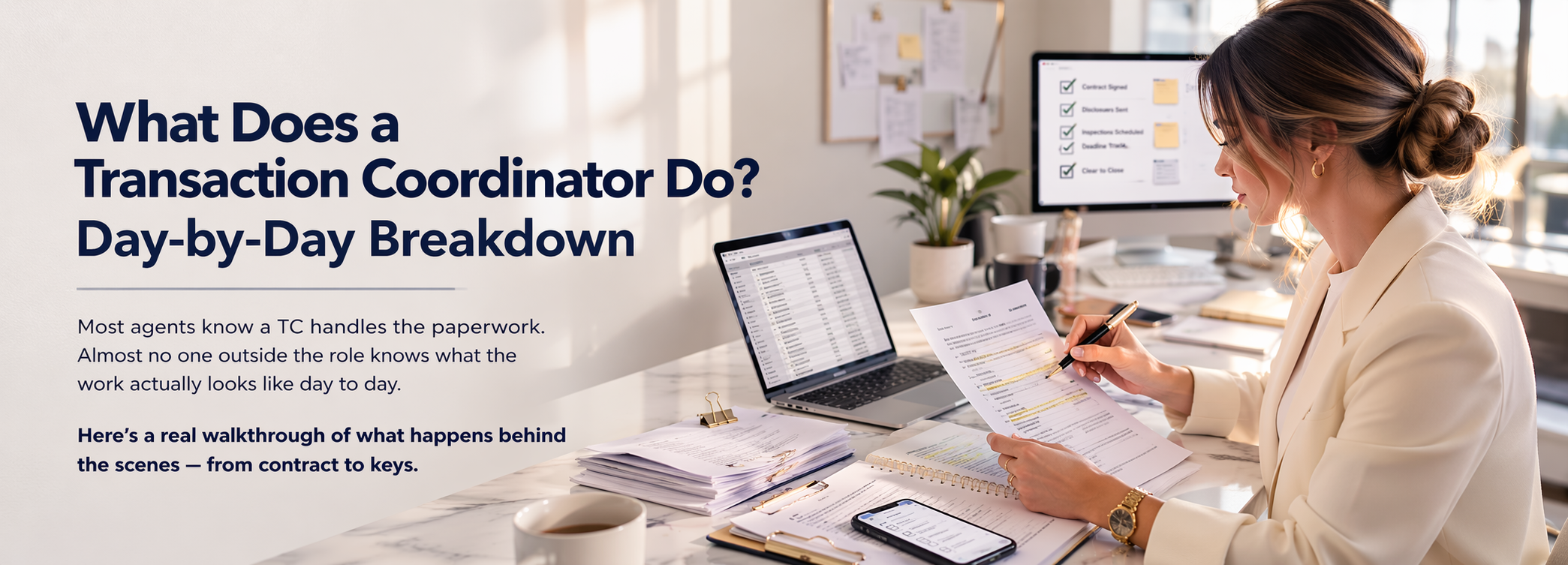
Most agents know, in general terms, what a transaction coordinator does. They handle the paperwork. They track deadlines. They talk to title companies and lenders. They make sure the deal closes.
But almost no one outside the role actually knows what the work looks like day to day. What happens on day one of a new file? What's actually getting done between contract and closing? Where do the hours actually go? What are the specific risks a TC is watching for that would otherwise kill your deal?
This post walks through a full transaction, day by day, from the perspective of the transaction coordinator handling it. The specifics vary by state, price point, and deal complexity, but the structure below is representative of a typical 30-day buyer-side closing across the Northeast markets we serve.
By the end of this post, you'll have a genuine understanding of what a TC does with your file — and why the role exists as a specialty rather than as general admin.
Day 1: The Handoff
Everything starts when the agent forwards the executed agreement of sale. On a well-run file, this happens within a few hours of the contract going fully executed.
The TC's first task is a detailed contract review. Not a glance — a line-by-line verification that every page is initialed where required, every signature block is complete, every addendum referenced in the contract is actually attached, and every blank has been filled in correctly. A surprisingly high number of contracts arrive with missing initials, unsigned addenda, or fields that were left blank during the back-and-forth of negotiation. Catching these on day one prevents the panic phone call on day 28 when the title company refuses to close because a required initial is missing from page 7.
Once the contract is verified, the TC logs every deadline into the transaction management system the agent uses — Dotloop, SkySlope, zipForm, Brokermint, or whatever platform is in play. This typically includes:
Mortgage application deadline
Inspection contingency period and response deadline
Attorney review period (in New Jersey, New York, and Connecticut)
HOA and condo document delivery deadlines
Mortgage commitment deadline
Appraisal contingency deadline
Title clearance and title objection deadline
Final walkthrough
Settlement/closing date
Each deadline gets a reminder set 3–5 business days in advance, so nothing is ever flagged on the day it's due.
Next, the introduction emails go out. On a typical buyer-side file, that means separate intros to:
The cooperating (listing) agent
The buyer's lender
The title company or settlement attorney
Any relevant attorneys (seller's attorney, buyer's attorney in NY/NJ/CT)
The buyers themselves, explaining the TC's role and what to expect
Each of these emails follows a template but includes deal-specific details — property address, contract date, relevant deadlines, the TC's direct contact information. The goal is to establish one clear point of coordination so every party knows where to send information and who's tracking what.
By the end of day 1, the file is set up, the calendar is loaded, every party has been notified, and the TC has a complete picture of what's ahead.
Days 2–3: Early Coordination
In the first 48 hours after intro emails go out, the TC starts pushing for the early items that need to happen before the inspection and mortgage work begins.
Inspection scheduling. The TC coordinates with the buyer and the inspection company to get the home inspection scheduled within the contingency period. If the contract allows for specialized inspections — radon, pest, pool, septic — those get scheduled at the same time. In states where time is tight (a 7- or 10-day inspection period is common), this happens fast.
Mortgage application verification. The TC confirms the buyer has officially submitted their mortgage application and that the lender has everything they need to start processing. If the buyer hasn't submitted yet, the TC follows up until they have.
HOA and condo document orders. If the property has an HOA or is a condo, the TC orders the resale certificate, covenants, financials, and any other required documents. These often take 7–14 days to receive and can hold up closings if ordered late, so they go out early.
Utility certifications. In states like New Jersey that require water, sewer, trash, and sometimes electric certifications, the TC identifies the relevant municipalities and submits the requests. These also have lead times — sometimes weeks — so they get triggered early.
Attorney review coordination. In New Jersey, the three-day attorney review period is the single most volatile window of the transaction. The TC tracks the start and end of attorney review, watches for any proposed amendments from either attorney, and ensures the agent is looped in immediately on anything substantive.
By the end of day 3, the early logistics are in motion on all fronts. If anything's going to cause a problem in the first two weeks, it's usually already visible by this point.
Days 4–10: The Inspection Window
This stretch is typically when the first serious pressure point of the transaction hits — the inspection and its aftermath.
The TC coordinates the actual inspection, confirms it happened on time, and then waits for the inspection report. Once the report comes back, the TC forwards it to the agent and the buyer, and if there's an inspection response period (typically 5 days after inspection), the clock starts.
If the buyer wants to request repairs or a credit, the agent drafts the request. The TC tracks the request through the seller's response and any negotiation back-and-forth, making sure the amendment gets signed, dated, and properly filed within the response window.
This is where a lot of deals quietly go sideways. An inspection response that misses its deadline can forfeit the buyer's right to renegotiate. A repair addendum that doesn't get signed correctly can create ambiguity at closing. A seller's response that doesn't get acknowledged in writing can leave the buyer without a clear agreement on what got fixed.
A good TC watches all of this in real time, flags anything that's at risk of sliding past a deadline, and escalates to the agent the moment anything feels off.
Meanwhile, in parallel:
The TC is following up with the lender to confirm the mortgage application is progressing
HOA documents are being received and reviewed
Utility certification requests are being submitted to the relevant municipalities
The appraisal is being scheduled
Every 2–3 days during this window, the TC is either sending a status update to the agent or flagging something that needs attention.
Days 11–21: The Middle Stretch
This is the deceptively quiet phase. On the outside, it looks like the transaction is on autopilot. In reality, the TC is doing the most important work of the file: actively managing the lender, appraisal, and title processes so that everything lands on time.
Mortgage commitment tracking. The mortgage commitment deadline is typically 21–30 days after contract, and it's the single most common deadline missed by overwhelmed agents. The TC is checking in with the lender every 3–5 days, confirming underwriting is progressing, flagging any document requests the buyer has received but hasn't returned, and pushing toward commitment by the contractual deadline.
Appraisal follow-up. The TC confirms the appraisal was ordered, scheduled, and completed. If the appraisal comes back low, the TC flags it immediately to the agent so the price negotiation or supplemental funding conversation can begin without wasting a day.
Title work. Title searches, municipal lien searches, and title commitments are being produced. The TC reviews the title commitment when it arrives and flags any exceptions, liens, or issues that need to be cleared before closing.
HOA document review. If HOA documents have arrived, the TC confirms the buyer has received and reviewed them within the contractual review period.
Certification tracking. Utility certifications are starting to come back from municipalities. The TC chases any that are missing or delayed and gets them cleared before settlement.
Throughout this window, the TC is also maintaining communication with the buyers — sending weekly or bi-weekly status updates so the clients feel informed and the agent doesn't get overwhelmed with "what's happening with our deal?" calls.
Days 22–28: Pre-Closing Prep
By the time day 22 rolls around, the focus shifts from coordination to confirmation. Every major contingency should be clearing, every major deadline should have been met, and the TC is now preparing every party for the actual closing.
Settlement scheduling. The TC coordinates with the title company or settlement attorney to get a firm settlement date, time, and location locked in, and communicates it to all parties.
Title charge sheet review. As the settlement company prepares the preliminary closing figures, the TC reviews the title charge sheet for accuracy — confirming the purchase price, credits, prorations, and fees match what was agreed to in the contract and any subsequent addenda. If anything looks wrong, it gets flagged immediately.
Preliminary ALTA or closing disclosure review. A day or two before closing, the preliminary ALTA statement (or Closing Disclosure in many markets) comes out. The TC reviews it carefully against the contract, addenda, and expected fees. Errors on the preliminary ALTA are common and need to be caught before the client sits down at the closing table.
Final walkthrough coordination. The TC coordinates the final walkthrough — typically scheduled within 24 hours of closing — to confirm the property is in the agreed-upon condition and any repairs have been completed.
Buyer closing prep. The TC sends the buyer a pre-closing communication: what to bring, where to go, what to expect, how to wire their funds (using the secure wire protocol, which is verified by phone to a known number at the settlement company to prevent fraud).
Agent briefing. The TC briefs the agent on anything unusual about the closing — flagged title items, last-minute addenda, unusual funding situations, or any party that's been difficult during the transaction.
Closing Day
Closing day is, from the TC's perspective, the quietest day of the file — because everything that could have gone wrong has already been handled. But the TC is still active:
Monitoring for any last-minute issues from the settlement company
Confirming the wire was received correctly
Tracking that the closing actually occurred and documents were signed
Receiving the final closing documents and ensuring they're complete
Sending confirmation to the agent, clients, and other parties that the file closed successfully
The keys transfer. The client moves in. The agent moves on to the next deal.
After Closing
The file doesn't quite end at the closing table. In the days after closing, the TC:
Downloads and archives the complete final closing package
Ensures all compliance documentation is in the transaction management system
Forwards the executed closing disclosure and settlement statement to the agent and clients
Handles any post-closing follow-up items — commission disbursement questions, tax prorations, repair escrow releases, etc.
Closes out the file in the transaction management system
For compliance and brokerage review purposes, a complete and organized post-closing file is as important as any other part of the transaction. This is where a lot of agents lose compliance points during broker audits — and where a TC prevents those problems entirely.
What the TC Is Also Doing in the Background
The day-by-day structure above is the work on one file. A working TC is typically managing 20–40 active files simultaneously. That means the real job isn't any single task — it's running all of them in parallel without dropping anything.
In practice, the TC's day looks like this:
Morning: reviewing every active file for anything that has a deadline approaching in the next 3–5 business days
Mid-morning: sending follow-ups on any outstanding items (unsigned addenda, missing documents, unreturned calls)
Late morning: reviewing incoming documents (HOA packages, title commitments, appraisals, certifications)
Afternoon: coordinating new contracts just signed, handling escalations on active files, reviewing closing disclosures
Late afternoon: sending status updates to agents and clients, wrapping up pending items
The skill isn't handling one file perfectly. It's handling 30 files simultaneously without any single one falling through. That's why the role is a specialty.
The Risks Being Managed Behind the Scenes
Most agents don't see half of what a TC actually prevents. A competent TC is continuously watching for:
Wire fraud attempts. Spoofed emails from "the title company" with updated wiring instructions. AI-generated phishing that looks legitimate. The TC verifies every wire instruction change by phone to a known number.
Deadline drift. A lender quietly missing a commitment date. An inspector not delivering a report on time. An HOA taking longer than promised. The TC sees the drift before it becomes a missed deadline.
Document errors. Typos in an addendum, missing initials, unsigned exhibits, incorrect legal descriptions, name misspellings that will create title issues.
Communication breakdowns. A lender not talking to the title company. An attorney not receiving a required document. A client not responding to a request. The TC keeps everyone moving.
Compliance exposure. Missing required disclosures, inadequately documented buyer agency agreements, incomplete post-settlement files that create broker audit problems.
None of this is exotic. All of it is the daily reality of modern real estate transactions. And all of it is what agents absorb when they handle transactions themselves without a dedicated coordinator.
Why This Workload Is Increasing
The day-by-day breakdown above represents what a typical transaction looks like in 2026. A few years ago, the list would have been shorter.
Following the 2024 NAR settlement, written buyer agreements are now required before showing any property, with specific compensation disclosure requirements embedded throughout the transaction.¹ Wire fraud has become a top-three business risk for every brokerage, requiring secure protocols on every file.² The tools agents are expected to manage — CRMs, transaction management software, compliance platforms, e-signature systems — have multiplied to the point where most agents struggle to keep up.³
Every one of those pressures makes the day-by-day TC workload heavier and higher-stakes. It's not that transactions used to be simple. It's that they've gotten meaningfully more complex, and the TC role has gotten more valuable in proportion.
The Bottom Line
A transaction coordinator's job isn't paperwork. It's coordination, risk management, vendor relationship management, deadline tracking, compliance enforcement, client communication, and operational specialization — all happening in parallel across dozens of active files.
The reason top-producing agents rely on TCs isn't because they're lazy. It's because managing 20+ active transactions at once, without errors, while also prospecting, showing, and closing new business, is genuinely not possible for a single person. Something gives. The question is just what.
Agents who try to handle it themselves usually give up quality of service, quality of life, or new business — sometimes all three. Agents who delegate it to a qualified TC get their evenings back, their weekends back, their capacity back — and their deals still close on time.
If you've been doing it all yourself and wondering whether there's a better way, the day-by-day walkthrough above is what the better way looks like.
Frequently Asked Questions
How long does a typical real estate transaction take from contract to close?
Most residential real estate transactions close in 30–45 days from executed contract. Cash deals can close in as little as 10–14 days. Financed deals typically run 30–45 days to allow for mortgage underwriting, appraisal, and title work. Transactions involving HOAs, co-ops, attorney review periods, or complex financing can take 60+ days. The TC's job throughout is to keep every party moving so the closing actually happens on the agreed-upon date rather than slipping.
What happens if a deadline is missed during the transaction?
It depends on which deadline. Some missed deadlines are recoverable with a signed extension. Others — like the inspection response period or mortgage commitment deadline — can cost the buyer their contingency rights if not handled immediately. A missed attorney review window in New Jersey can lock in a contract the parties were still negotiating. Deadline management is one of the core reasons the TC role exists, because the stakes of missing the wrong deadline can include losing the deal entirely or exposing a party to legal liability.
Does the transaction coordinator communicate with my clients directly?
Yes, typically — but in a clearly defined, limited way. The TC introduces themselves to the clients at the start of the transaction, sends status updates throughout the file, and handles logistical communication like inspection scheduling and closing prep. The TC does not negotiate on the client's behalf, advise on contract terms, or take over the agent-client relationship. That remains with the agent. Done well, TC client communication actually increases client satisfaction because buyers and sellers feel more attended to and informed, not less.
What's the hardest part of a transaction coordinator's job?
Running many files in parallel without dropping any single one. A single file is manageable. Twenty files, each at a different stage with different deadlines, different vendors, different clients, and different risks, is a significant operational challenge. The skill isn't in any one task — it's in the systems, discipline, and attention required to manage all of them simultaneously without anything slipping.
How does a transaction coordinator handle multi-state transactions?
Carefully, and with state-specific playbooks. Each state has its own processes, forms, timelines, and quirks. New Jersey has attorney review and CO/UO requirements. Pennsylvania has Realty Transfer Tax and is title-company driven. New York has attorney-driven closings and co-op board approvals. Maryland has recordation tax and lead paint requirements. A TC handling multi-state work needs genuine fluency in each state's process — not a generic national approach applied to different jurisdictions. For agents who cross state lines regularly, a multi-state TC is substantially more valuable than a single-state specialist.
What happens if something goes wrong on a file?
The TC's job is to see problems early and flag them to the agent while there's still time to fix them. When something does go wrong — a low appraisal, a title issue, a buyer losing financing, a seller refusing to make agreed-upon repairs — the TC coordinates the response, documents every communication, and works with the agent and attorneys (where applicable) to resolve it. Most problems on a file are solvable if caught early. The ones that sink deals are usually the ones that weren't seen until it was too late to fix.
Can a transaction coordinator prevent wire fraud?
Substantially reduce the risk, yes. Prevent every possible attack, no single person can. A good TC operates as a single vetted point of contact for the transaction, uses a secure portal for document and information sharing, and follows a strict protocol for verifying any wire instruction changes by phone to a known number. This dramatically reduces the attack surface compared to open email communication between multiple parties on a transaction. In 2026, with AI-generated phishing getting more convincing, the human-verified human in the middle of a transaction is more valuable than ever.
How do I know if my transaction coordinator is doing a good job?
The clearest signal is how things feel week to week. A good TC delivers proactive status updates without you having to ask. Deadlines don't surprise you — you hear about them well in advance. Problems get flagged early, with options attached. Your clients feel informed and well cared for. Your files close on time, with complete compliance documentation. If all of those are true, your TC is doing a good job. If you're chasing information, reacting to problems after the fact, or hearing about issues the week of closing, something's broken — either the TC or the process.
Ready to See What a Transaction Coordinator Can Do For You?
Signed to Keys provides full-service transaction coordination for real estate agents across Pennsylvania, New Jersey, New York, Maryland, Connecticut, and Delaware. One dedicated point of contact, 30+ tasks handled per file, a secure portal with wire fraud protection built in, and the multi-state expertise that's genuinely hard to find in a single firm.
Free 30-minute consultation. No pressure, no obligation. We'll learn about your business, walk you through how we work, and help you figure out whether it's a fit — regardless of whether you hire us.
Request Your Free Consultation →
Sources
National Association of REALTORS®. What the NAR Settlement Means for Home Buyers and Sellers. Retrieved from https://www.nar.realtor/the-facts/what-the-nar-settlement-means-for-home-buyers-and-sellers
AgentUp. Overwhelmed by New Real Estate Tech? A Transaction Coordinator Has Your Back. Retrieved from https://www.agentup.com/blog/a-transaction-coordinator-has-your-back
AgentUp. The Future of Real Estate Transaction Coordination: Trends to Watch. Retrieved from https://www.agentup.com/blog/the-future-of-real-estate-transaction-coordination
About Signed to Keys
Signed to Keys is a real estate transaction coordination firm serving agents across six Northeast states — Pennsylvania, New Jersey, New York, Maryland, Connecticut, and Delaware. From contract to keys, we handle the 30+ administrative tasks per file that would otherwise eat your prospecting time, built on secure systems that protect your clients and your license.
signedtokeys.com | hello@signedtokeys.com | (703) 420-9757